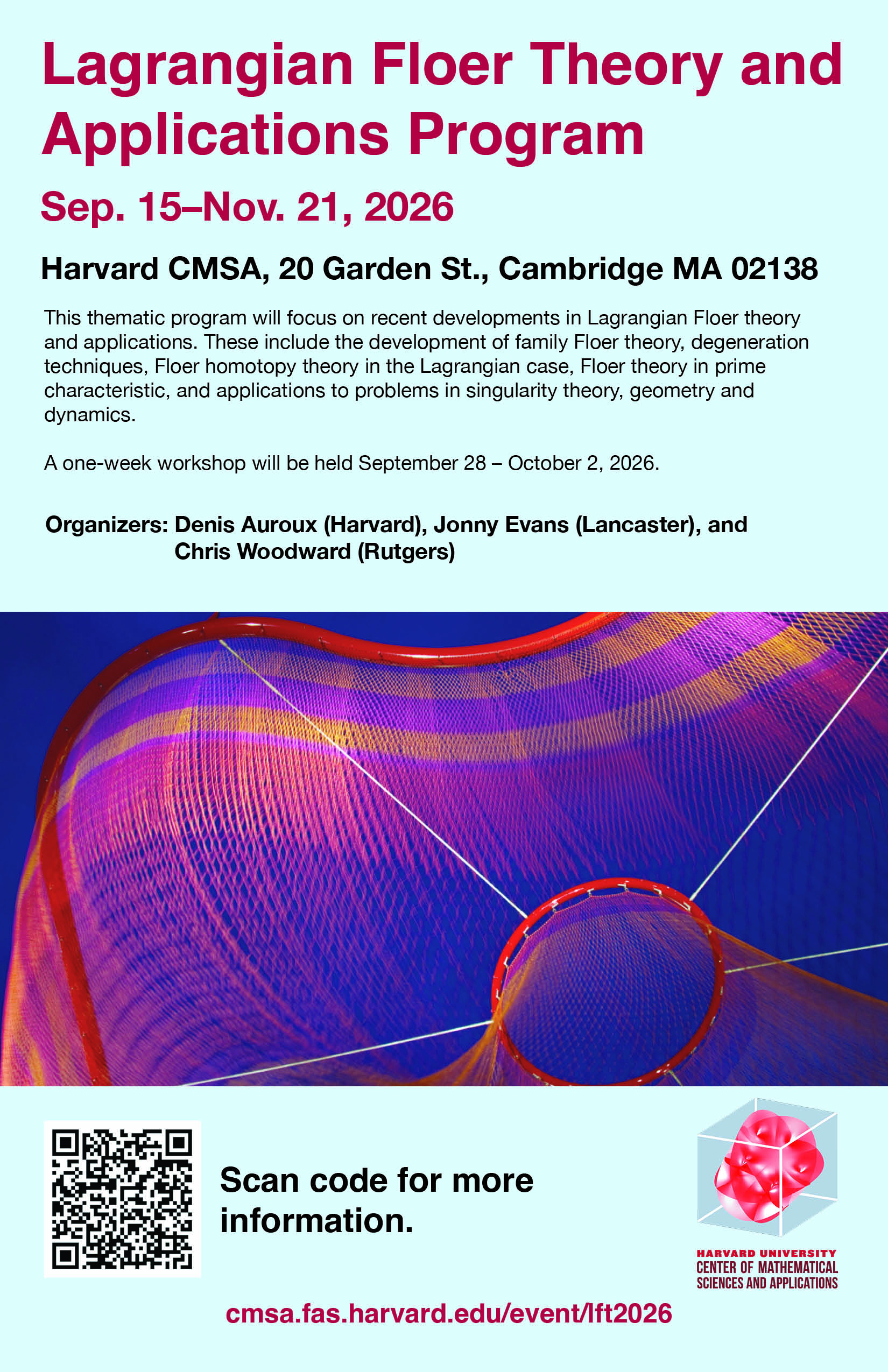
Lagrangian Floer theory and Applications Program Dates: September 15–November 21, 2026 Location: CMSA G10, 20 Garden St., Cambridge MA 02138 This thematic program will focus on recent developments in Lagrangian Floer theory and applications. These include the development of family Floer theory, degeneration techniques, Floer homotopy theory in the Lagrangian case, Floer theory in prime […]
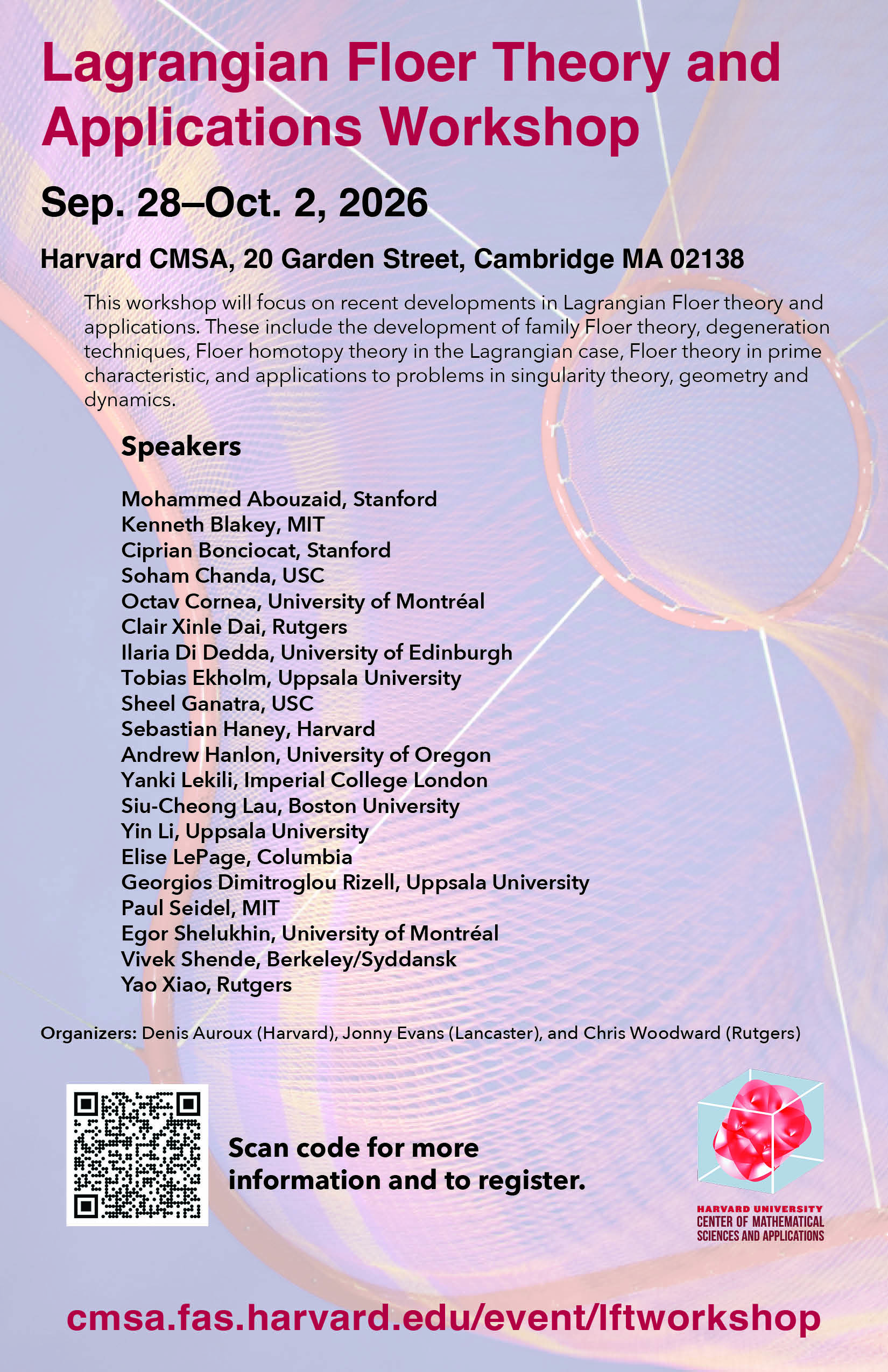
Workshop on Lagrangian Floer Theory and Applications Dates: September 28 – October 2, 2026 Location: CMSA G10, 20 Garden St., Cambridge MA 02138 This workshop is part of the Lagrangian Floer Theory and Applications Program In Person Registration Zoom Webinar Registration Speakers will include: Mohammed Abouzaid, Stanford University Kenneth Blakey, MIT Ciprian Bonciocat, Stanford Soham […]
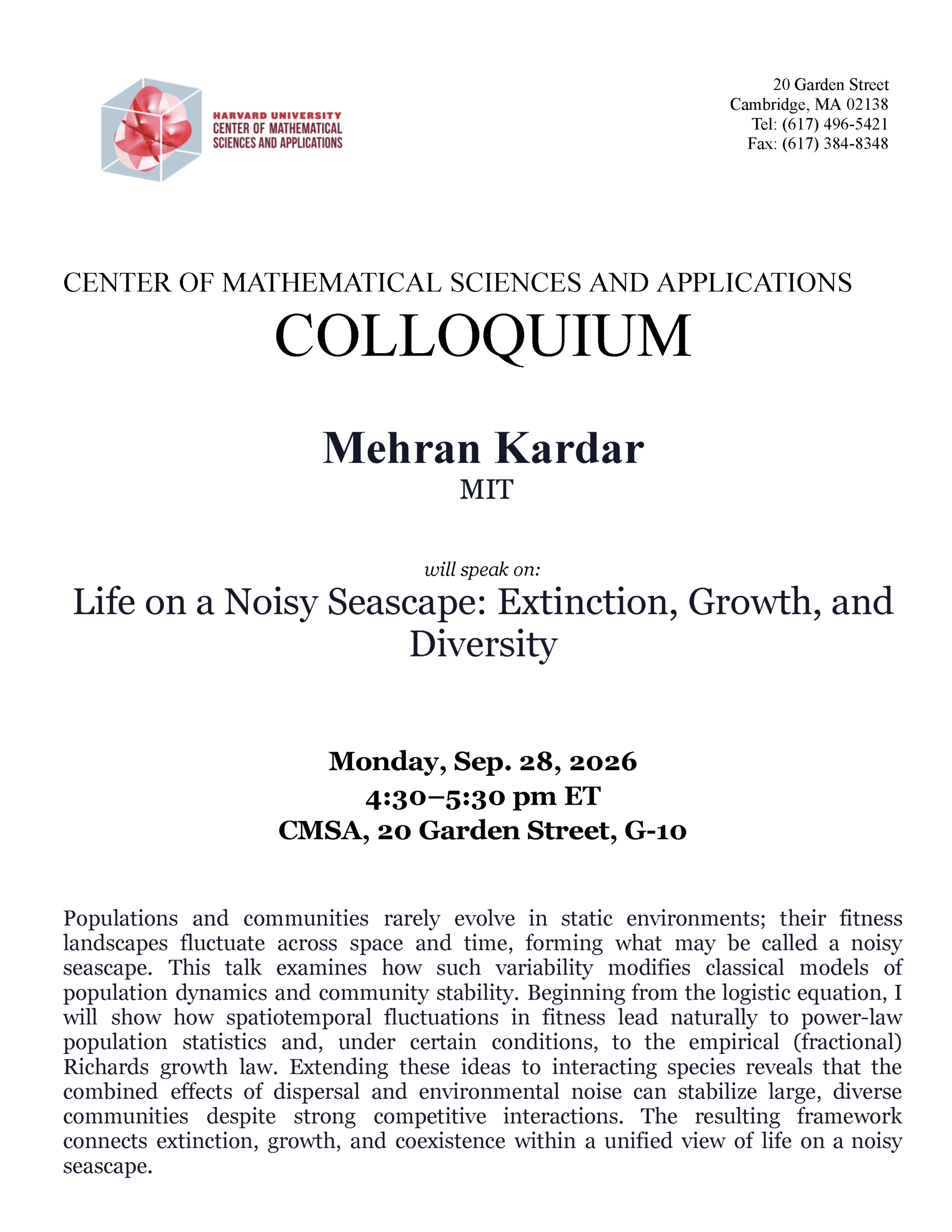
Colloquium Speaker: Mehran Kardar, MIT Title: Life on a Noisy Seascape: Extinction, Growth, and Diversity Abstract: Populations and communities rarely evolve in static environments; their fitness landscapes fluctuate across space and time, forming what may be called a noisy seascape. This talk examines how such variability modifies classical models of population dynamics and community stability. Beginning from the […]
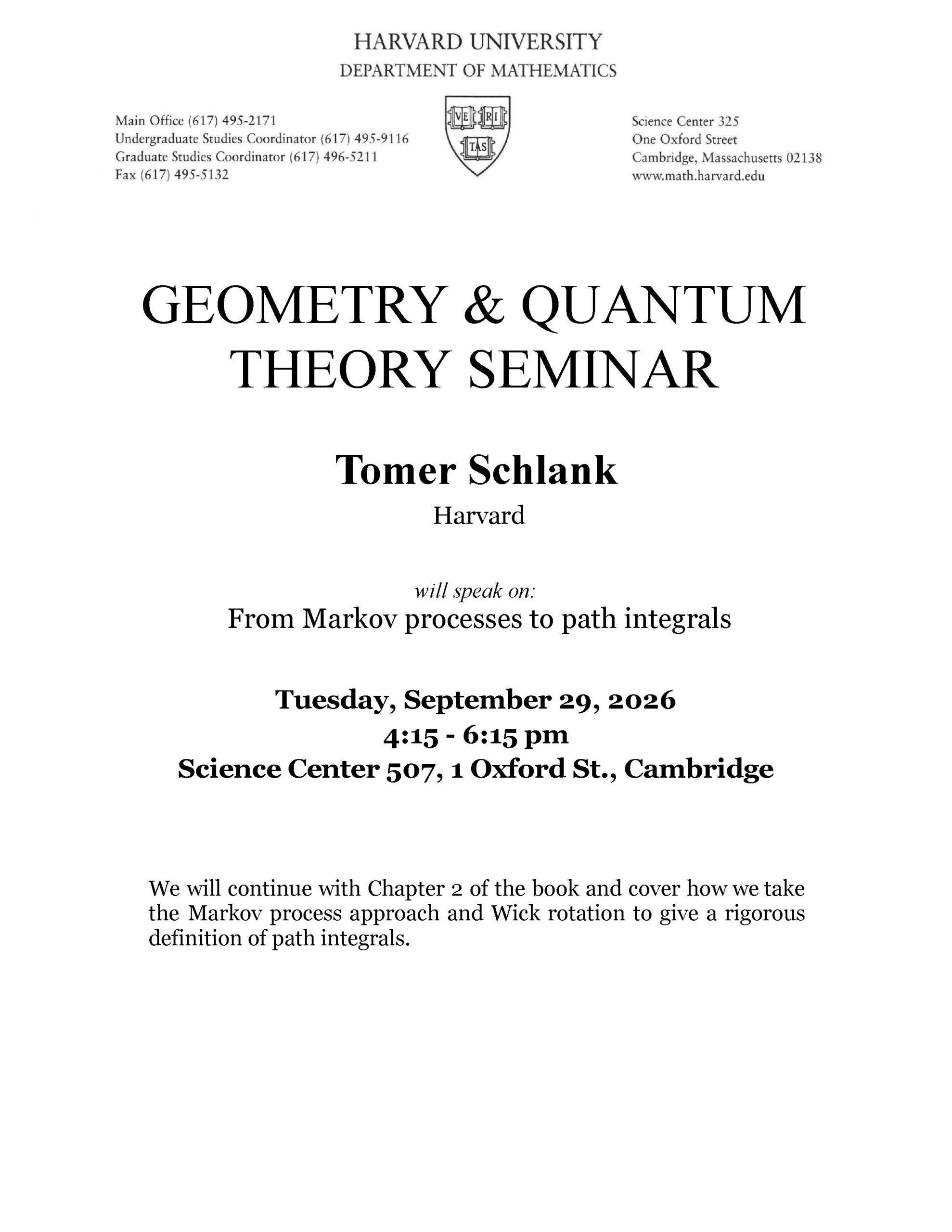
Joint Math/CMSA Geometry and Quantum Theory Seminar Speaker: Tomer Schlank Title: From Markov processes to path integrals Abstract: We will continue with Chapter 2 of the book and cover how we take the Markov process approach and Wick rotation to give a rigorous definition of path integrals.
AI for the Working Mathematician Speaker: Harold Williams, USC Title: An Informal Introduction to Formal Proofs Abstract: In this talk we will give an introduction to Lean, a programming language adapted to expressing and verifying proofs. Lean and its flagship library, mathlib, have been the focus of a dedicated user community for about a decade, […]
Geometry and Mathematical Physics Seminar Speaker: Tobias Ekholm, Uppsala Title: Skein valued curve counts and associatives Abstract: We consider Lagrangians in the cotangent bundle of a 3-manifold that give branch covers the 0-section. A circle bundle over the cotangent bundle that degenerates over the Lagrangian gives an A_n-fibration over the base 3-manifold. We equip this A_n […]
Member Seminar Speaker: Aaron Landesman Title: Painlevé VI: the search for canonical representations Abstract: In 1902, Painlevé classified second order differential equations whose only movable singularities are poles, thereby obtaining the six Painlevé equations. Algebraic solutions to Painlevé's sixth equation correspond to canonical triples of 2 by 2 complex matrices. One can alternatively view these […]
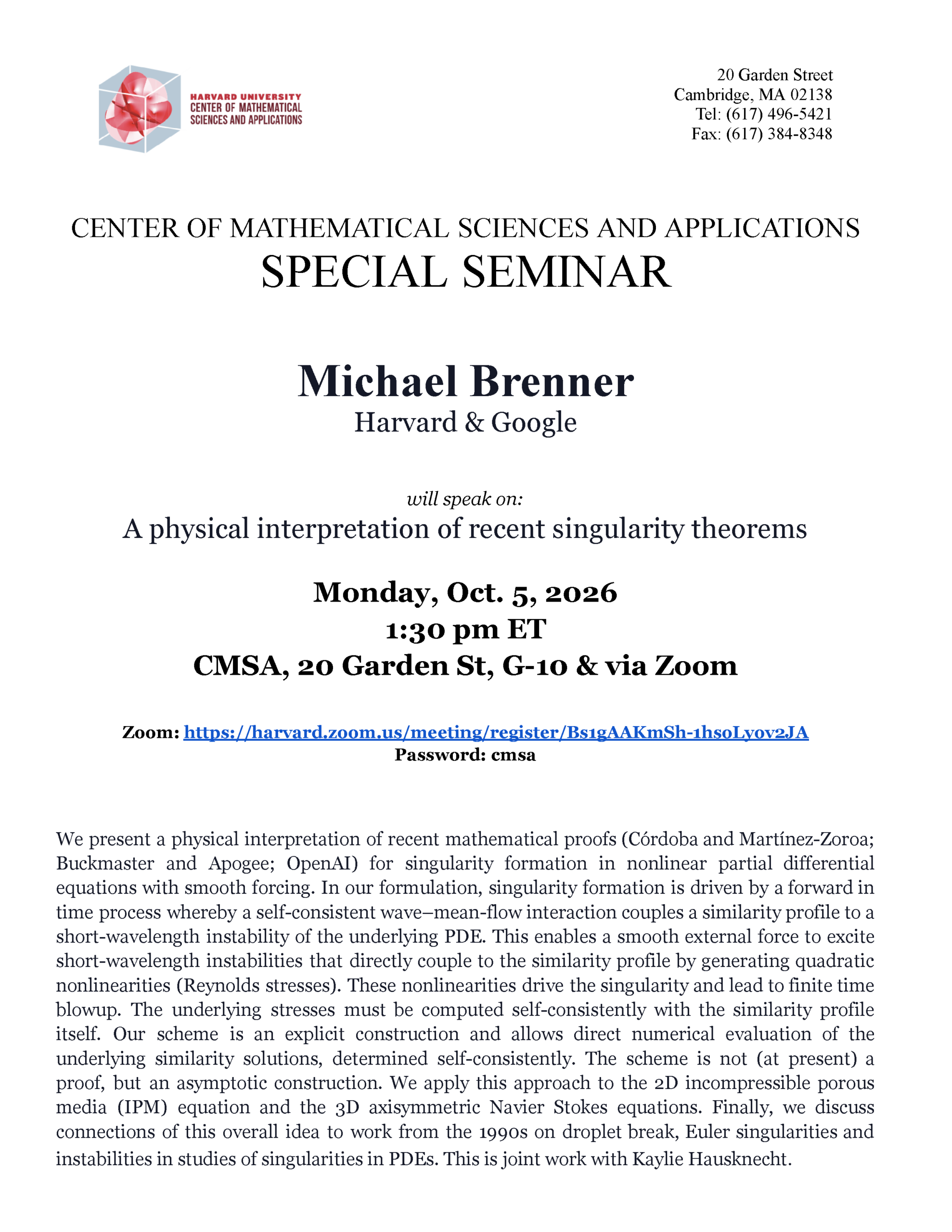
CMSA Special Seminar Speaker: Michael Brenner Title: A physical interpretation of recent singularity theorems Abstract: We present a physical interpretation of recent mathematical proofs (Córdoba and Martínez-Zoroa; Buckmaster and Apogee; OpenAI) for singularity formation in nonlinear partial differential equations with smooth forcing. In our formulation, singularity formation is driven by a forward in time process whereby […]
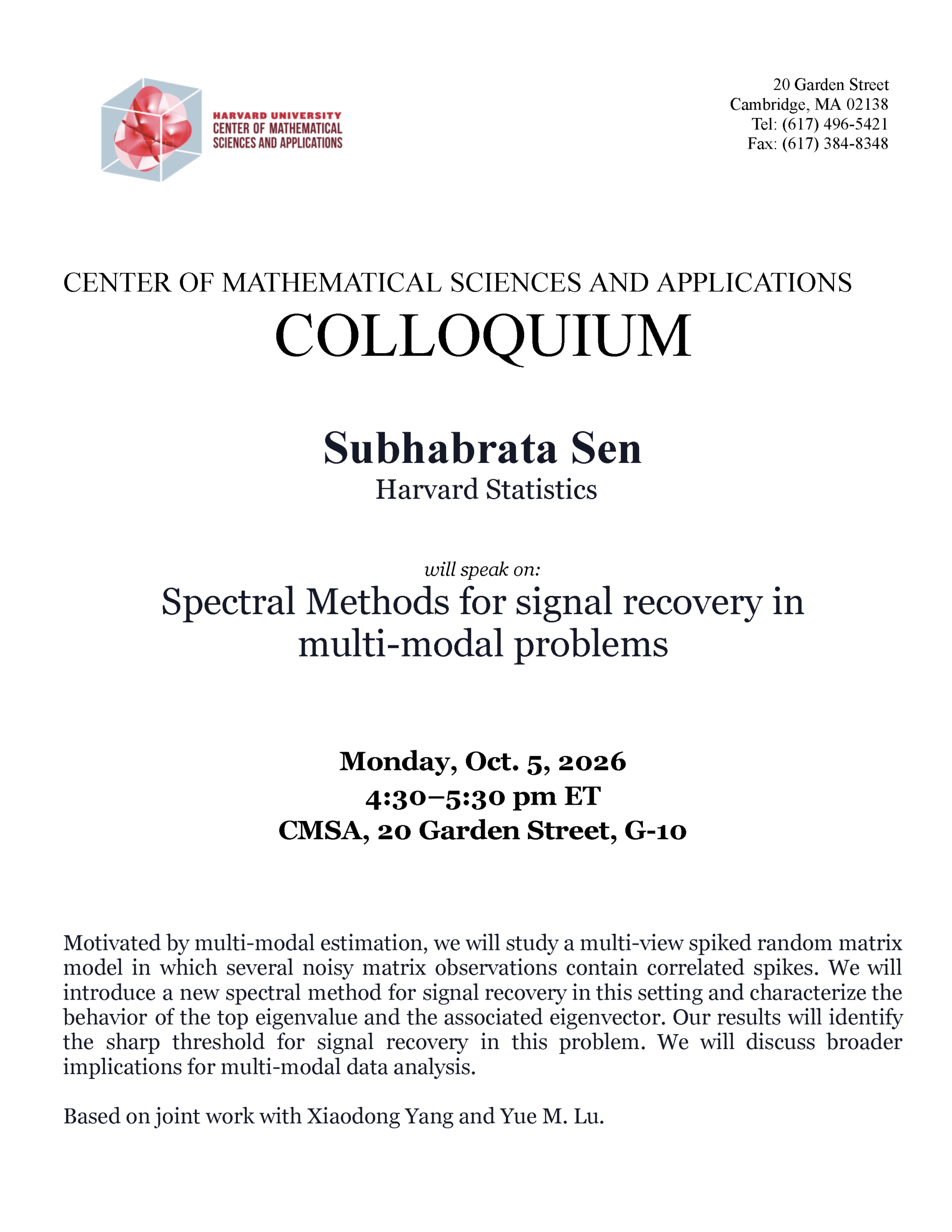
Colloquium Speaker: Subhabrata Sen, Harvard Statistics Title: Spectral Methods for signal recovery in multi-modal problems Abstract: Motivated by multi-modal estimation, we will study a multi-view spiked random matrix model in which several noisy matrix observations contain correlated spikes. We will introduce a new spectral method for signal recovery in this setting and characterize the behavior […]
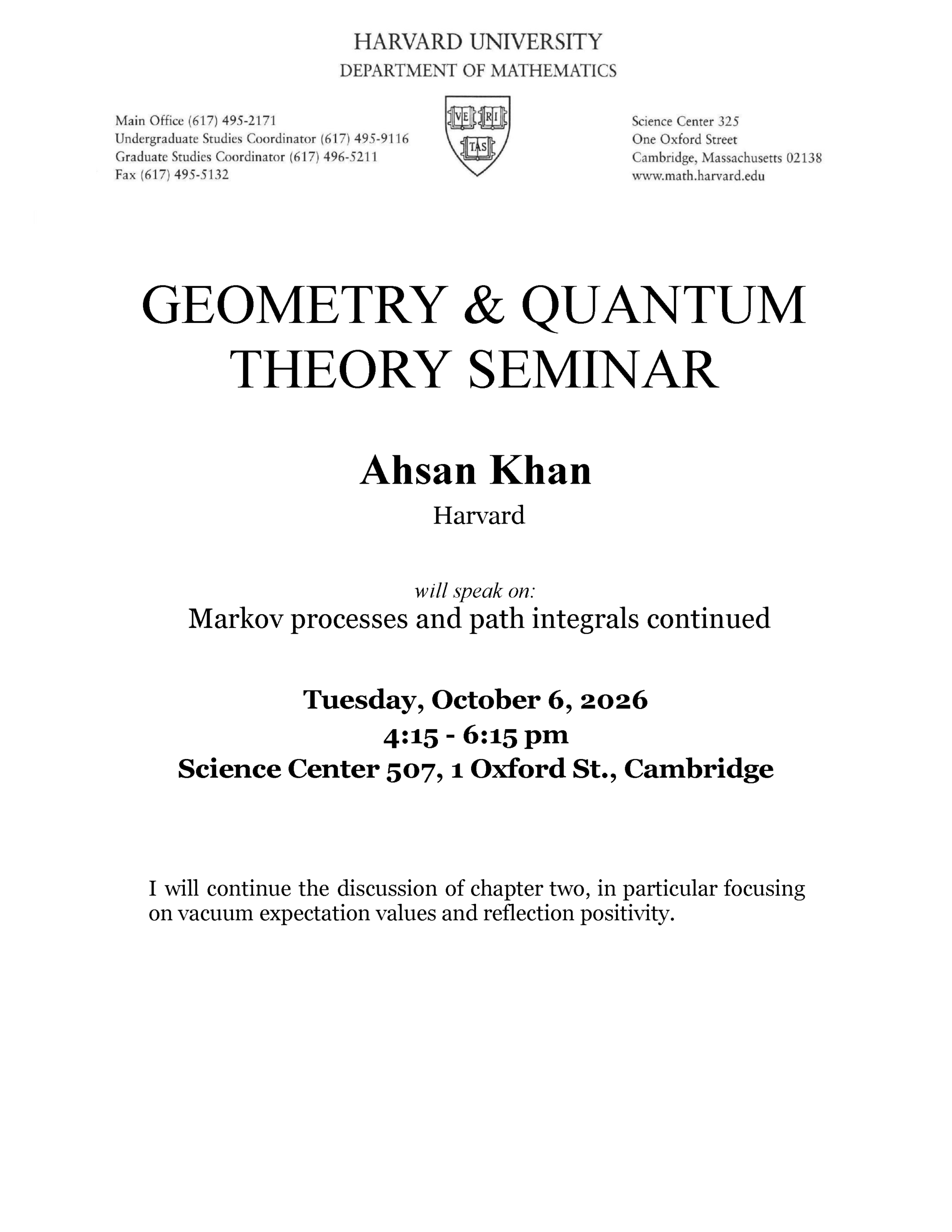
Joint Math/CMSA Geometry and Quantum Theory Seminar Speaker: Ahsan Khan, HarvardCMSA Title: Markov processes and path integrals continued Abstract: I will continue the discussion of chapter two, in particular focusing on vacuum expectation values and reflection positivity.
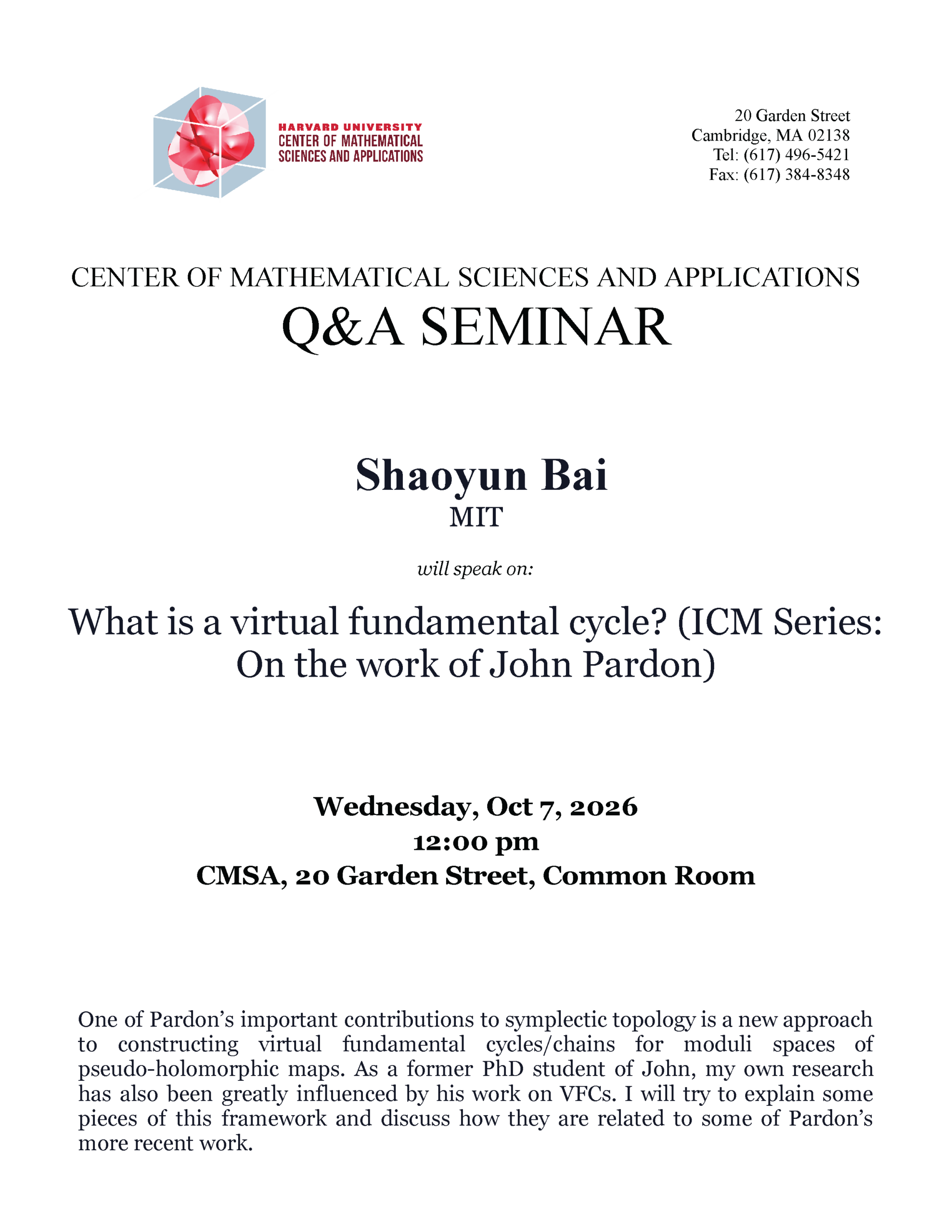
CMSA Q&A Seminar Speaker: Shaoyun Bai, MIT Title: What is a virtual fundamental cycle? (ICM Series: On the work of John Pardon) Abstract: One of Pardon’s important contribution to symplectic topology is a new approach to constructing virtual fundamental cycles/chains for moduli spaces of pseudo-holomorphic maps. As a former PhD student of John, my own […]
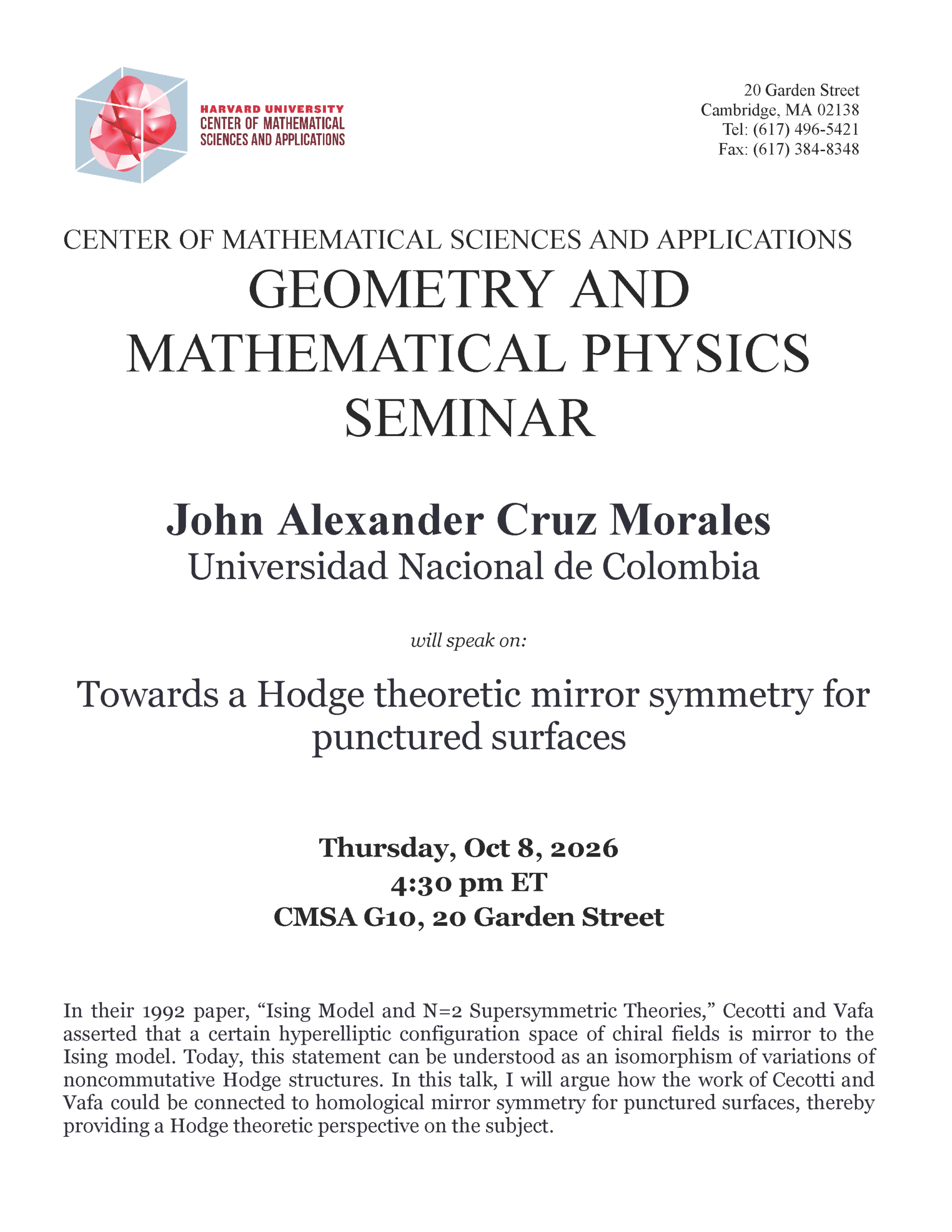
Geometry and Mathematical Physics Seminar Speaker: John Alexander Cruz Morales, Universidad Nacional de Colombia Title: Towards a Hodge theoretic mirror symmetry for punctured surfaces Abstract: In their 1992 paper, “Ising Model and N=2 Supersymmetric Theories,” Cecotti and Vafa asserted that a certain hyperelliptic configuration space of chiral fields is mirror to the Ising model. Today, this statement can […]
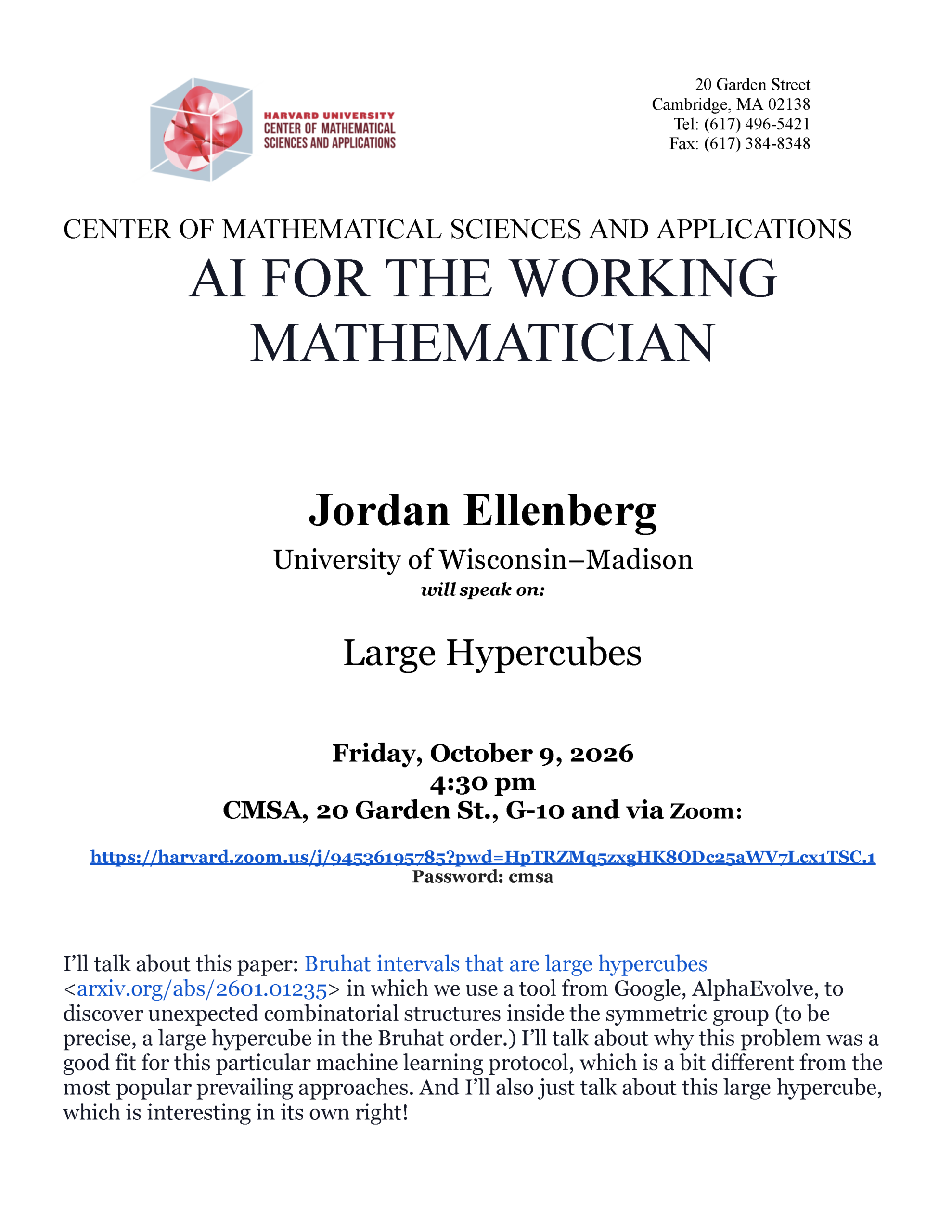
AI for the Working Mathematician Speaker: Jordan Ellenberg, University of Wisconsin-Madison Title: Large Hypercubes Abstract: I'll talk about this paper: Bruhat intervals that are large hypercubes <arxiv.org/abs/2601.01235> in which we use a tool from Google, AlphaEvolve, to discover unexpected combinatorial structures inside the symmetric group (to be precise, a large hypercube in the Bruhat order.) I'll […]
Joint Math/CMSA Geometry and Quantum Theory Seminar Speaker: Bowen Yang Title: From Random Walks to the Free Quantum Field Abstract: The free quantum field is, heuristically, a Gaussian measure with density exp(−S_E) on a space of fields. We make this precise by building the Gaussian free field from discrete objects: random walks, Brownian motion, and […]
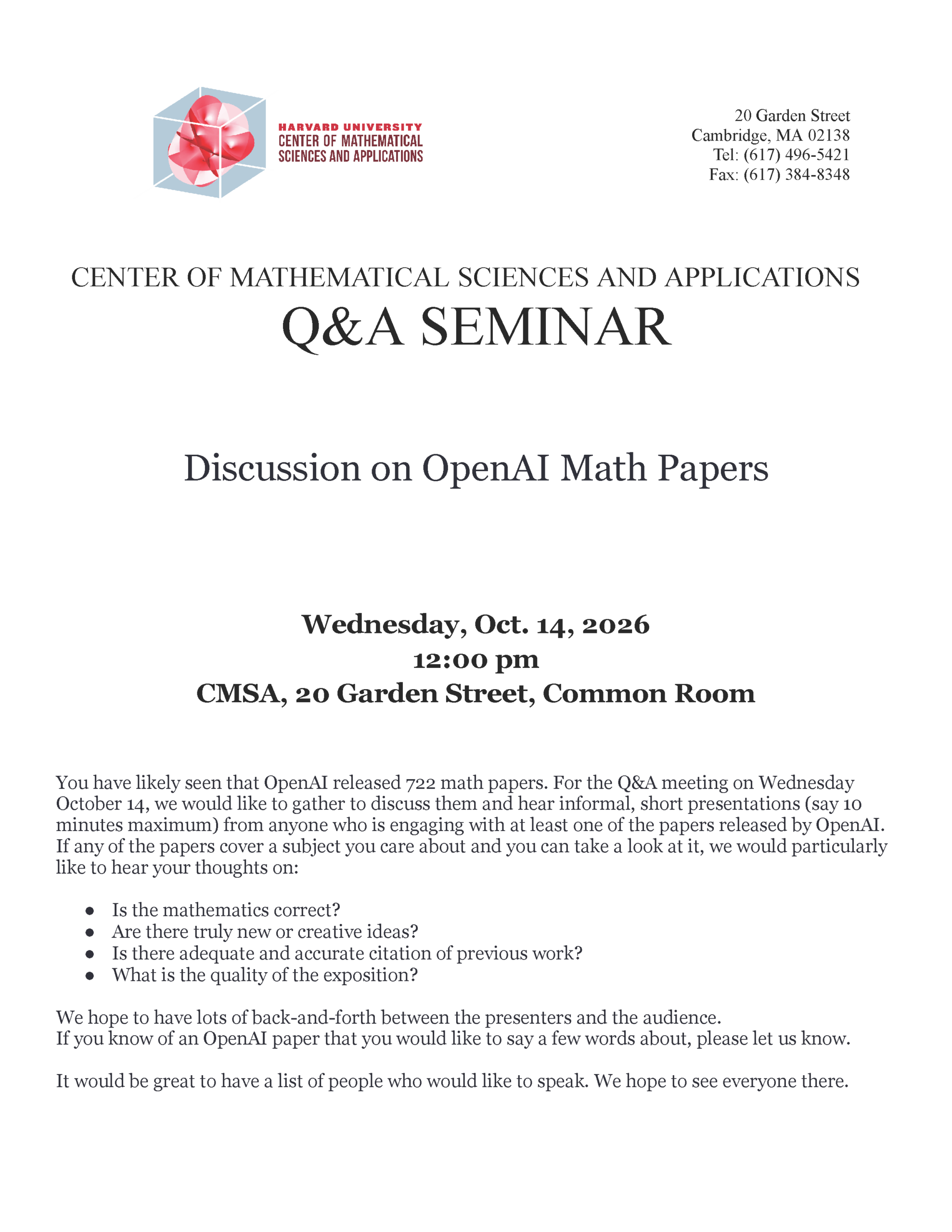
CMSA Q&A Seminar Title: Discussion on OpenAI Math Papers Abstract: You have likely seen that OpenAI released 722 math papers. For the Q&A meeting on Wednesday October 14, we would like to gather to discuss them and hear informal, short presentations (say 10 minutes maximum) from anyone who is engaging with at least one of the […]
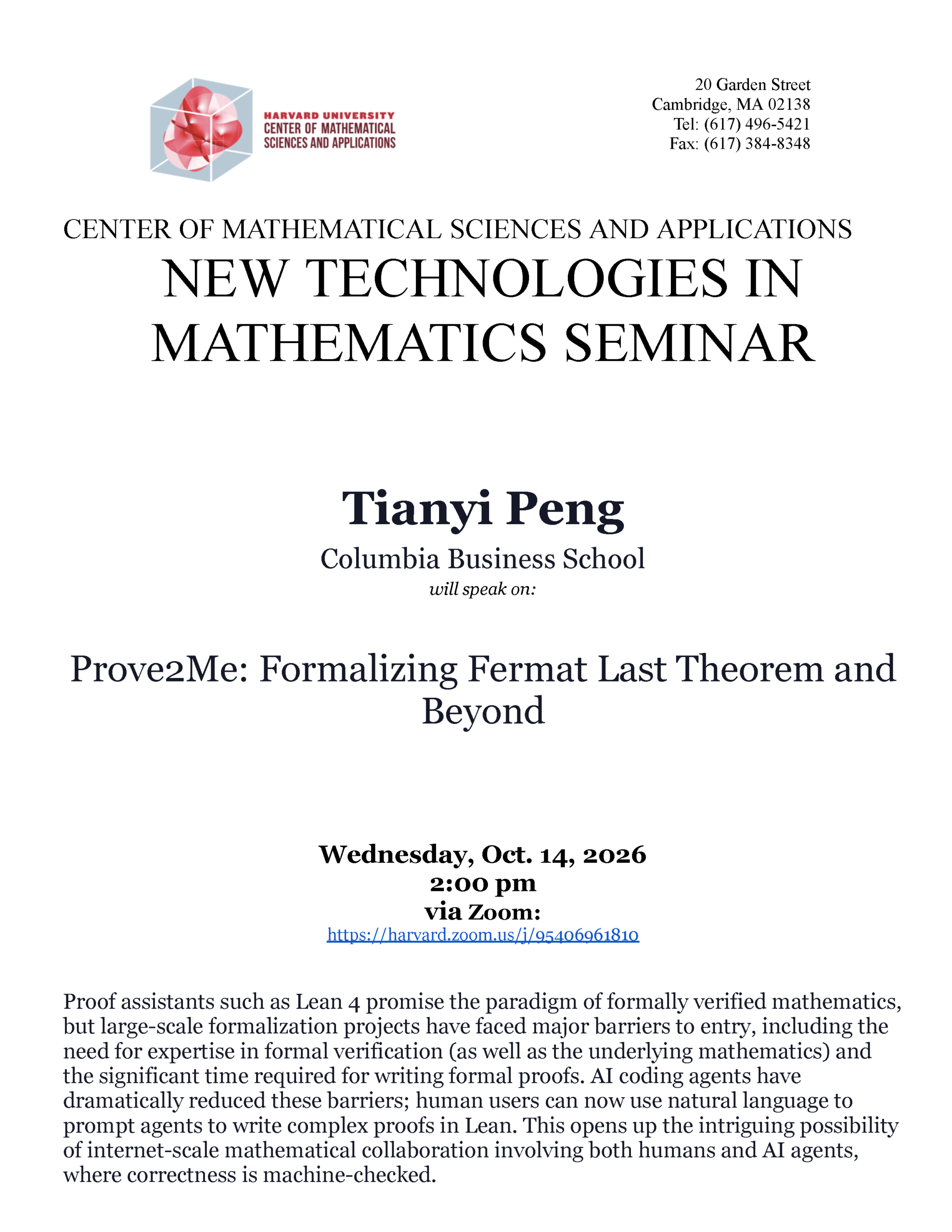
New Technologies in Mathematics Seminar Speaker: Tianyi Peng, Decision, Risk, and Operations Division, Columbia Business School Title: Prove2Me: Formalizing Fermat Last Theorem and Beyond Abstract: Proof assistants such as Lean 4 promise the paradigm of formally verified mathematics, but large-scale formalization projects have faced major barriers to entry, including the need for expertise in formal verification […]
AI for the Working Mathematician Speaker: Lauren Williams, Harvard Title: First Proof Batch 3: Mathematicians putting AI to the test Abstract: First Proof is an initiative that aims to obtain a nuanced, objective assessment about the capabilities of large language models to prove specified mathematical statements. I will report on the results of First Proof's third […]
Geometry and Mathematical Physics Seminar Speaker: Spiro Karigiannis, University of Waterloo Title: A tale of two Lie groups Abstract: The classical Lie group SO(4) is well-known to possess a very rich structure, relating in several ways to complex Euclidean spaces. This structure can be used to construct the classical twistor space Z over an oriented […]
Member Seminar Speaker: Yiqi Liu Title: An Introduction to Statistical Inference for Partially Identified Models Abstract: Classical statistical inference often relies on asymptotic approximations that are valid for each fixed data-generating process but may fail to hold uniformly over a class of relevant distributions. Starting with the familiar t-test, I will illustrate why this distinction […]
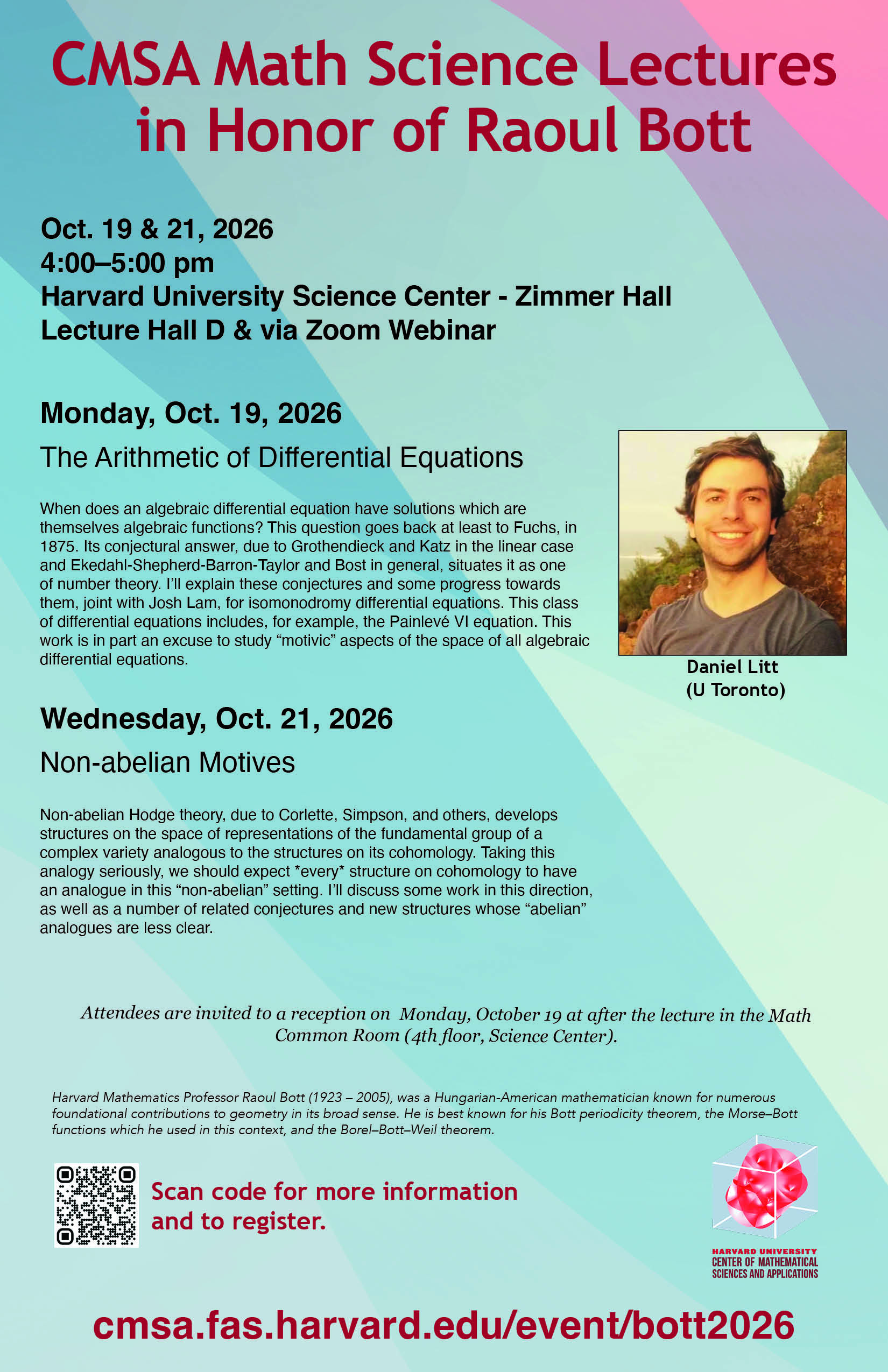
Dates: October 19 & 21, 2026 Time: 4:00–5:00 pm ET Location: Science Center - Zimmer Hall Lecture Hall D and via Zoom Webinar In-person registration Webinar Registration Speaker: Daniel Litt, University of Toronto & Benedict H. Gross Distinguished Visitor, Harvard Mathematics Department Monday, October 19, 2026 Lecture 1: The arithmetic of differential equations Abstract: […]
Joint Math/CMSA Geometry and Quantum Theory Seminar Speaker: Kason Kunkelmann Title: A Rigorous Construction of the Free Quantum Field Abstract: In this talk we will build on last week’s discrete intuition and rigorously construct our first continuum quantum field theory: the free field. Following Chapter three of Chatterjee’s notes, we will realize it as a Gaussian random […]
Dates: October 19 & 21, 2026 Time: 4:00–5:00 pm ET Location: Science Center – Zimmer Hall Lecture Hall D, 1 Oxford Street, Cambridge MA & via Zoom Webinar In-person registration Webinar Registration Speaker: Daniel Litt, University of Toronto & Benedict H. Gross Distinguished Visitor, Harvard Mathematics Department Monday, October 19, 2026 Lecture 1: The arithmetic […]
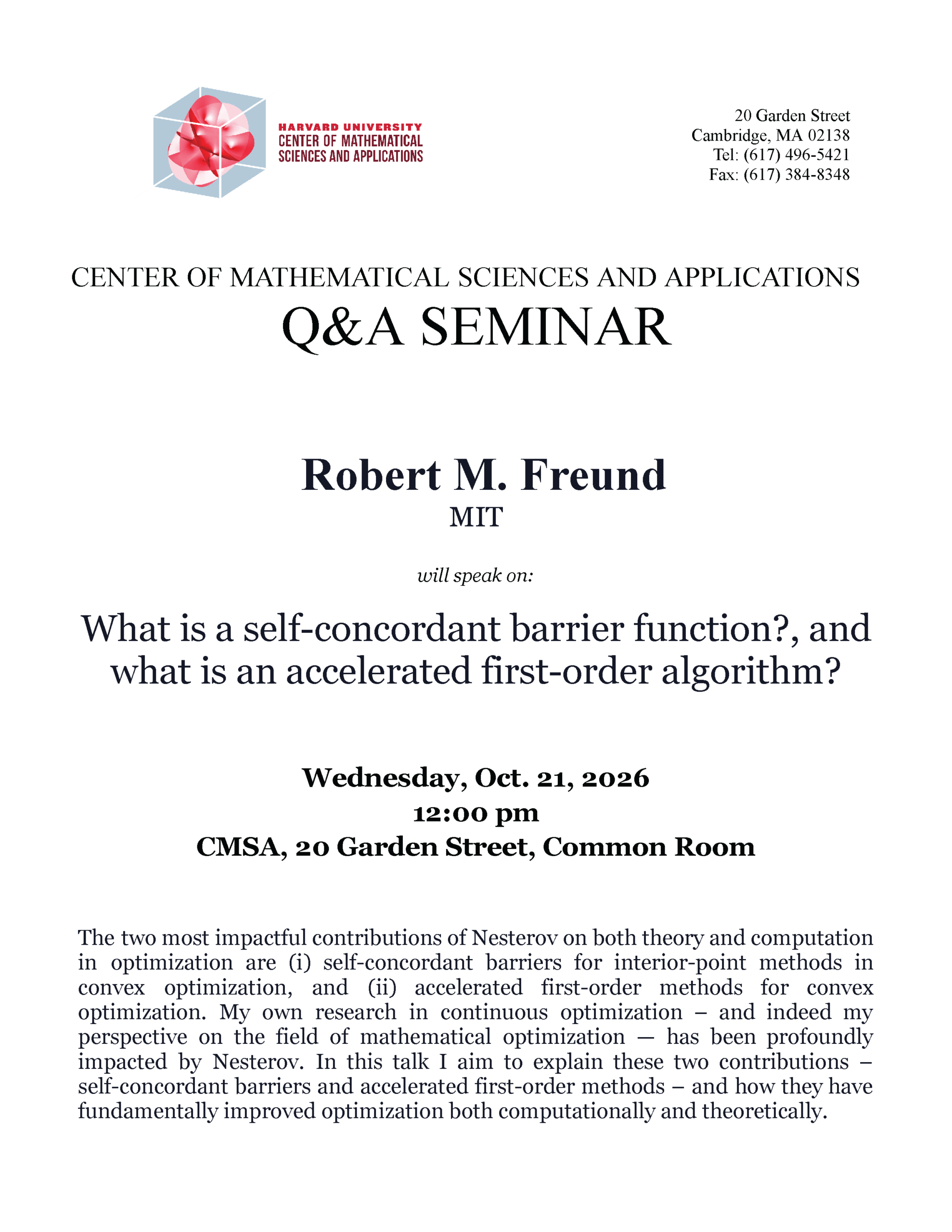
CMSA Q&A Seminar Speaker: Robert M. Freund, MIT Title: What is a self-concordant barrier function?, and what is an accelerated first-order algorithm? (ICM Series: On the work of Yurii Nesterov) Abstract: The two most impactful contributions of Nesterov on both theory and computation in optimization are (i) self-concordant barriers for interior-point methods in convex optimization, and (ii) […]
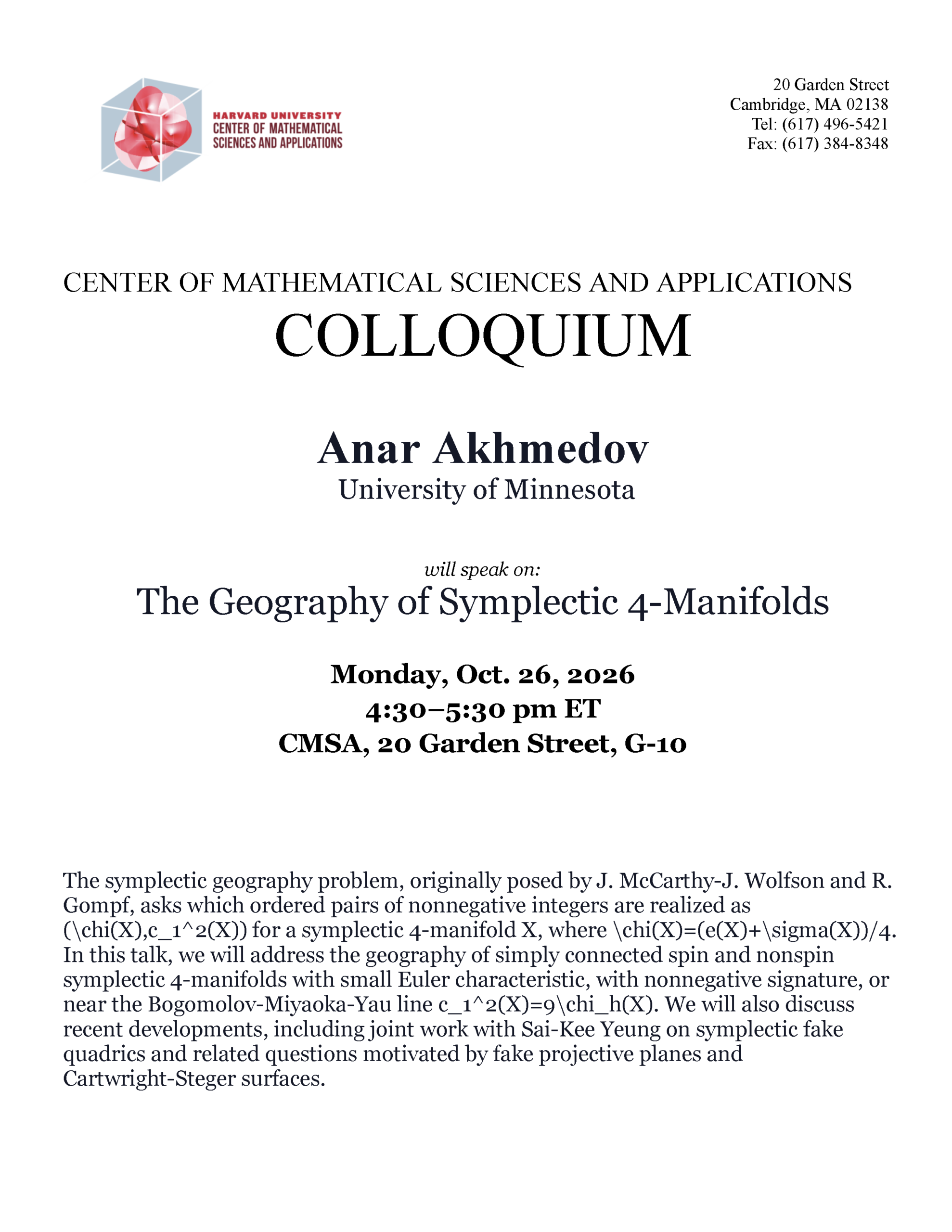
Colloquium Speaker: Anar Akhmedov, University of Minnesota Title: The Geography of Symplectic 4-Manifolds Abstract: The symplectic geography problem, originally posed by J. McCarthy-J. Wolfson and R. Gompf, asks which ordered pairs of nonnegative integers are realized as (\chi(X),c_1^2(X)) for a symplectic 4-manifold X, where \chi(X)=(e(X)+\sigma(X))/4. In this talk, we will address the geography of simply […]
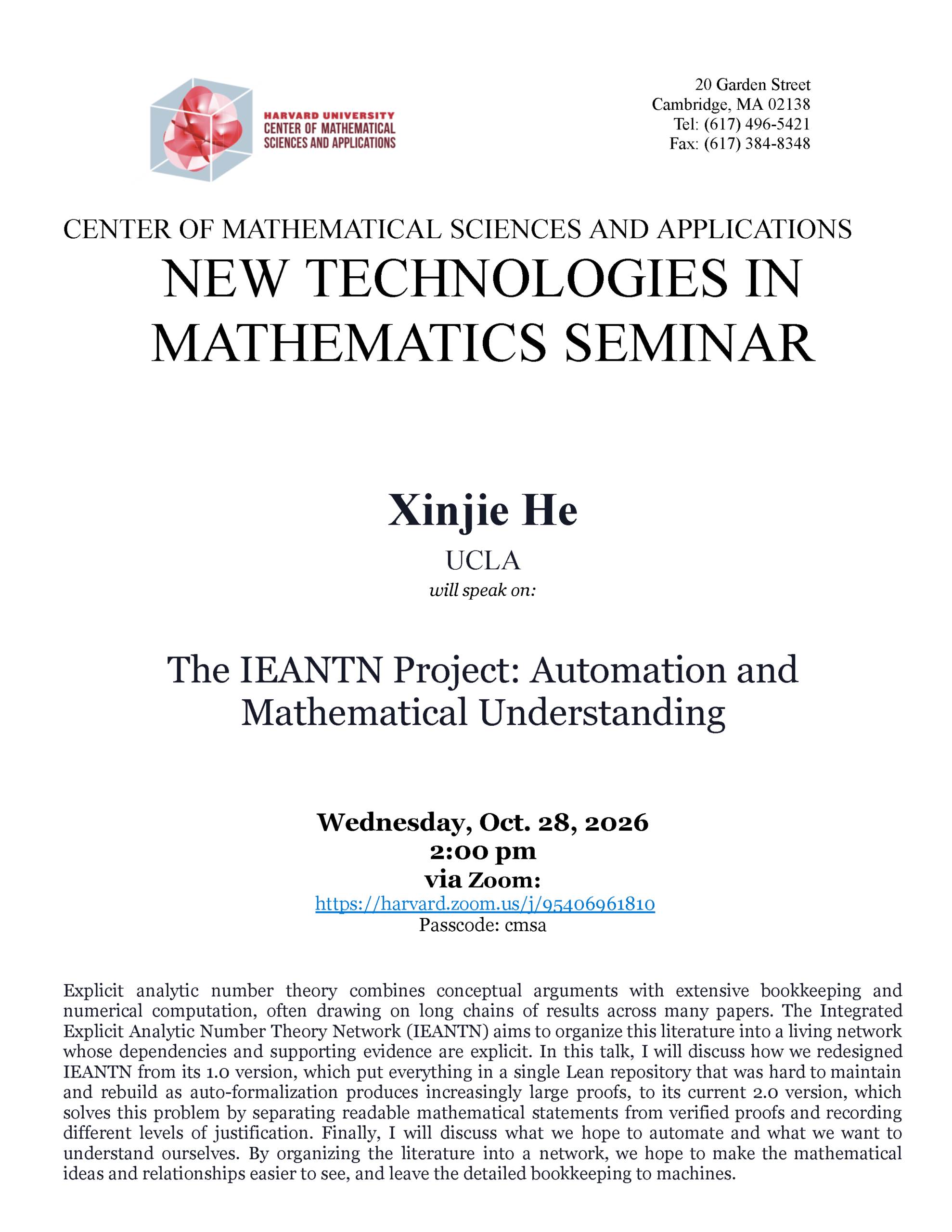
New Technologies in Mathematics Seminar Speaker: Xinjie He, UCLA Title: The IEANTN Project: Automation and Mathematical Understanding Abstract: Explicit analytic number theory combines conceptual arguments with extensive bookkeeping and numerical computation, often drawing on long chains of results across many papers. The Integrated Explicit Analytic Number Theory Network (IEANTN) aims to organize this literature into […]
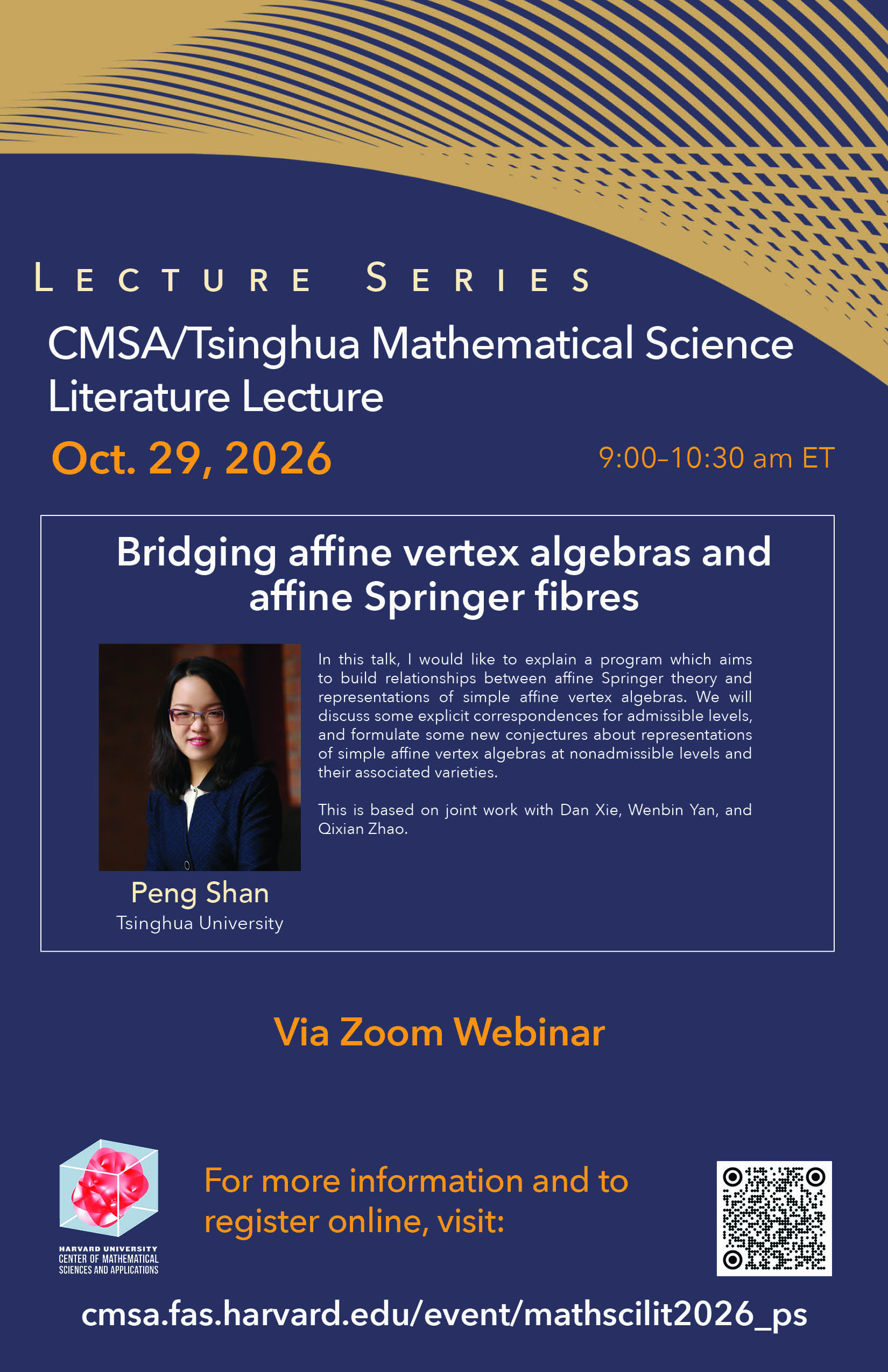
CMSA/Tsinghua Math-Science Literature Lecture Date: Thursday, October 29, 2026 Time: 9:00 - 10:30 am ET Location: online via Zoom Webinar Please register to attend. Zoom Webinar registration Speaker: Peng Shan, Tsinghua University Title: Bridging affine vertex algebras and affine Springer fibres Abstract: In this talk, I would like to explain a program which […]
Doing Mathematics with AI Agents Date: Saturday, October 31, 2026 Time: 9:00–5:00 pm ET Location: Zimmer Hall (Science Center), 1 Oxford Street, Cambridge MA This is a one day workshop for Boston-area mathematics faculty to work with AI agents in a collaborative environment (designed by Andrew Sutherland) supported by computational infrastructure and formalization tools. This […]
1 Oxford Street Cambridge,
MA
02138United States+ Google Map
CMSA Q&A Seminar Event Title: What is a self-concordant barrier function?, and what is an accelerated first-order algorithm? (ICM Series: On the work of Yurii Nesterov)