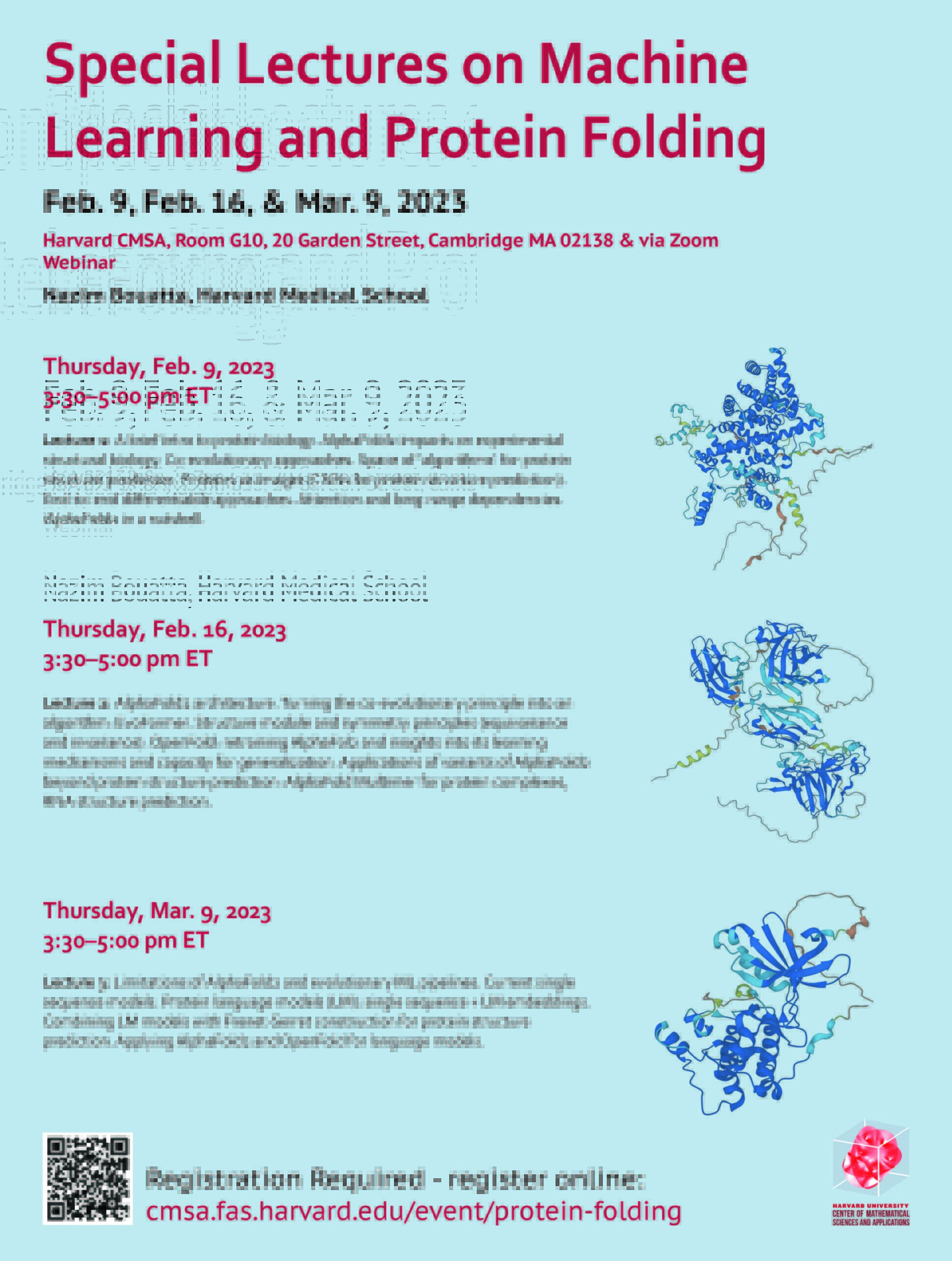
• Special Lectures on Machine Learning and Protein Folding

    CMSA Room G10 CMSA, 20 Garden Street, Cambridge, MA, United States

    The CMSA hosted a series of three 90-minute lectures on the subject of machine learning for protein folding. Thursday Feb. 9, Thursday Feb. 16, & Thursday March 9, 2023, 3:30-5:00 pm ET Location: G10, CMSA, 20 Garden Street, Cambridge MA 02138 & via Zoom     Speaker: Nazim Bouatta, Harvard Medical School Abstract: AlphaFold2, a […]
  • Quasinormal modes and Ruelle resonances: mathematician’s perspective

    CMSA Room G10 CMSA, 20 Garden Street, Cambridge, MA, United States

    https://youtu.be/FyJ6TieNQBc General Relativity Seminar Speaker: Maciej Zworski, UC Berkeley Title: Quasinormal modes and Ruelle resonances: mathematician's perspective Abstract: Quasinormal modes of gravitational waves and Ruelle resonances in hyperbolic classical dynamics share many general properties and can be considered "scattering resonances": they appear in expansions of correlations, as poles of Green functions and are associated to […]

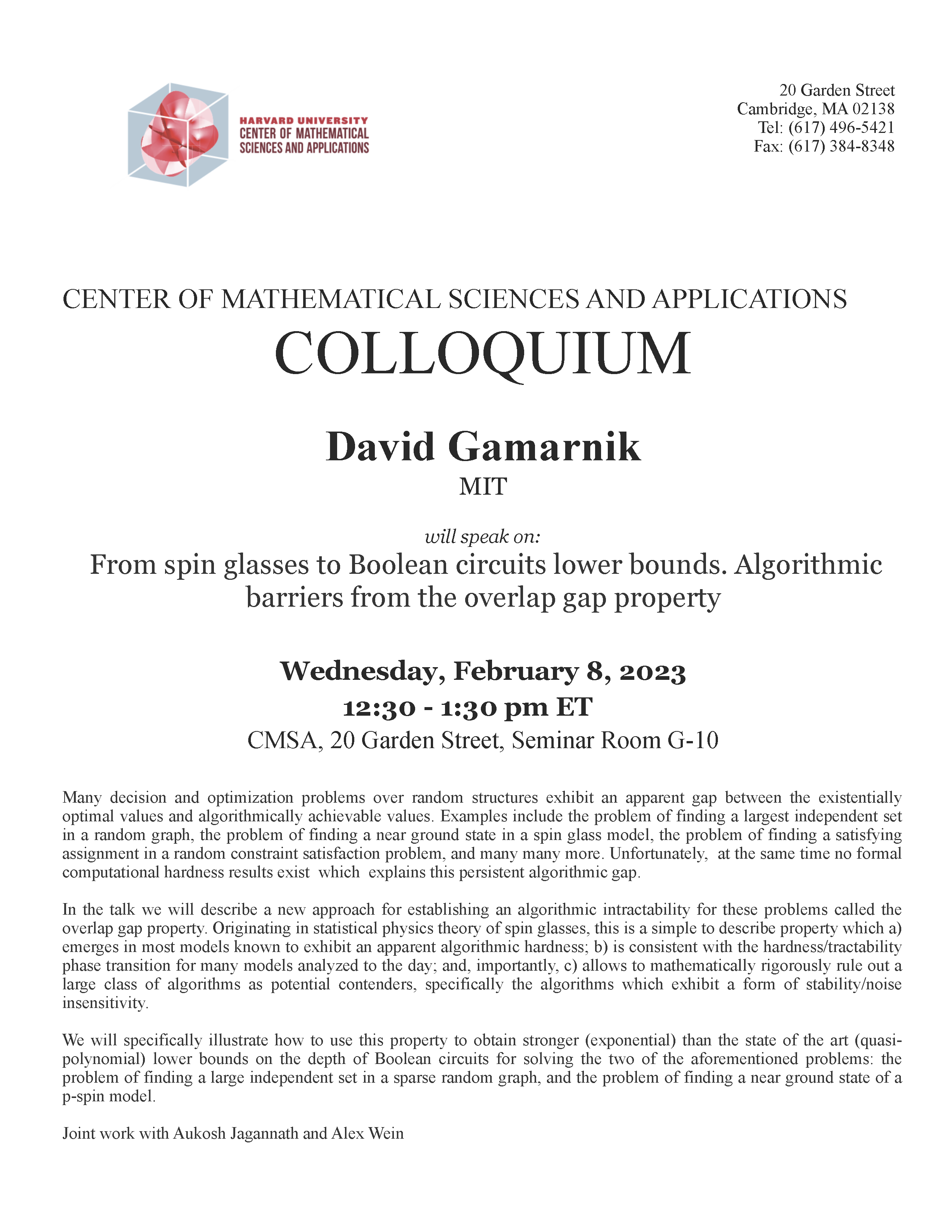
  • From spin glasses to Boolean circuits lower bounds – Algorithmic barriers from the overlap gap property

    CMSA Room G10 CMSA, 20 Garden Street, Cambridge, MA, United States

    Speaker: David Gamarnik (MIT) Title: From spin glasses to Boolean circuits lower bounds. Algorithmic barriers from the overlap gap property Abstract: Many decision and optimization problems over random structures exhibit an apparent gap between the existentially optimal values and algorithmically achievable values. Examples include the problem of finding a largest independent set in a random graph, the problem […]

  • Motivic Geometry of Two-Loop Feynman Integrals

    CMSA Room G10 CMSA, 20 Garden Street, Cambridge, MA, United States

    Member Seminar Speaker: Chuck Doran Title: Motivic Geometry of Two-Loop Feynman Integrals Abstract: We study the geometry and Hodge theory of the cubic hypersurfaces attached to two-loop Feynman integrals for generic physical parameters. We show that the Hodge structure attached to planar two-loop Feynman graphs decomposes into a mixed Tate piece and a variation of Hodge structure from […]

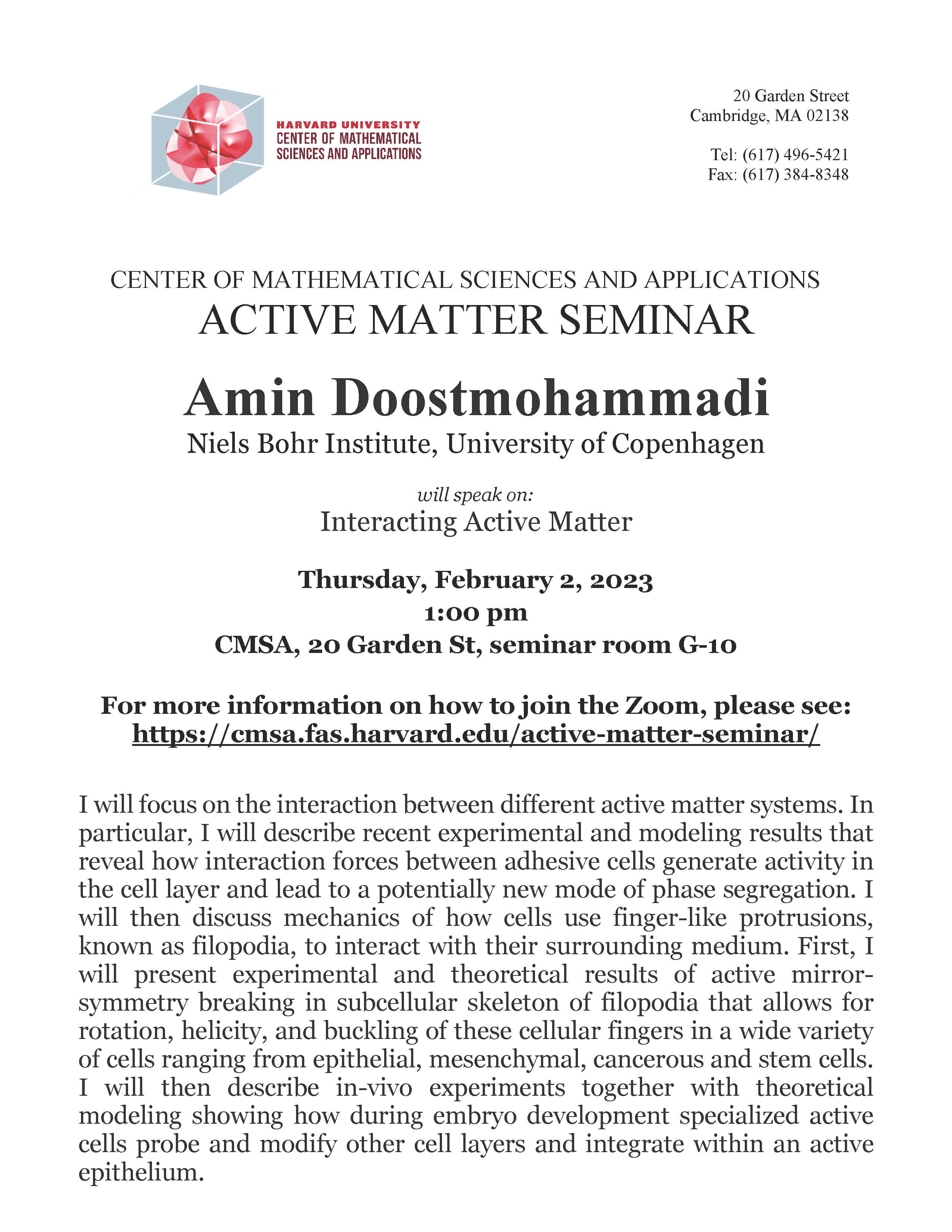
  • Interacting Active Matter

    CMSA Room G10 CMSA, 20 Garden Street, Cambridge, MA, United States

    Active Matter Seminar Speaker: Amin Doostmohammadi, Niels Bohr Institute, University of Copenhagen Title: Interacting Active Matter Abstract: I will focus on the interaction between different active matter systems. In particular, I will describe recent experimental and modeling results that reveal how interaction forces between adhesive cells generate activity in the cell layer and lead to a […]

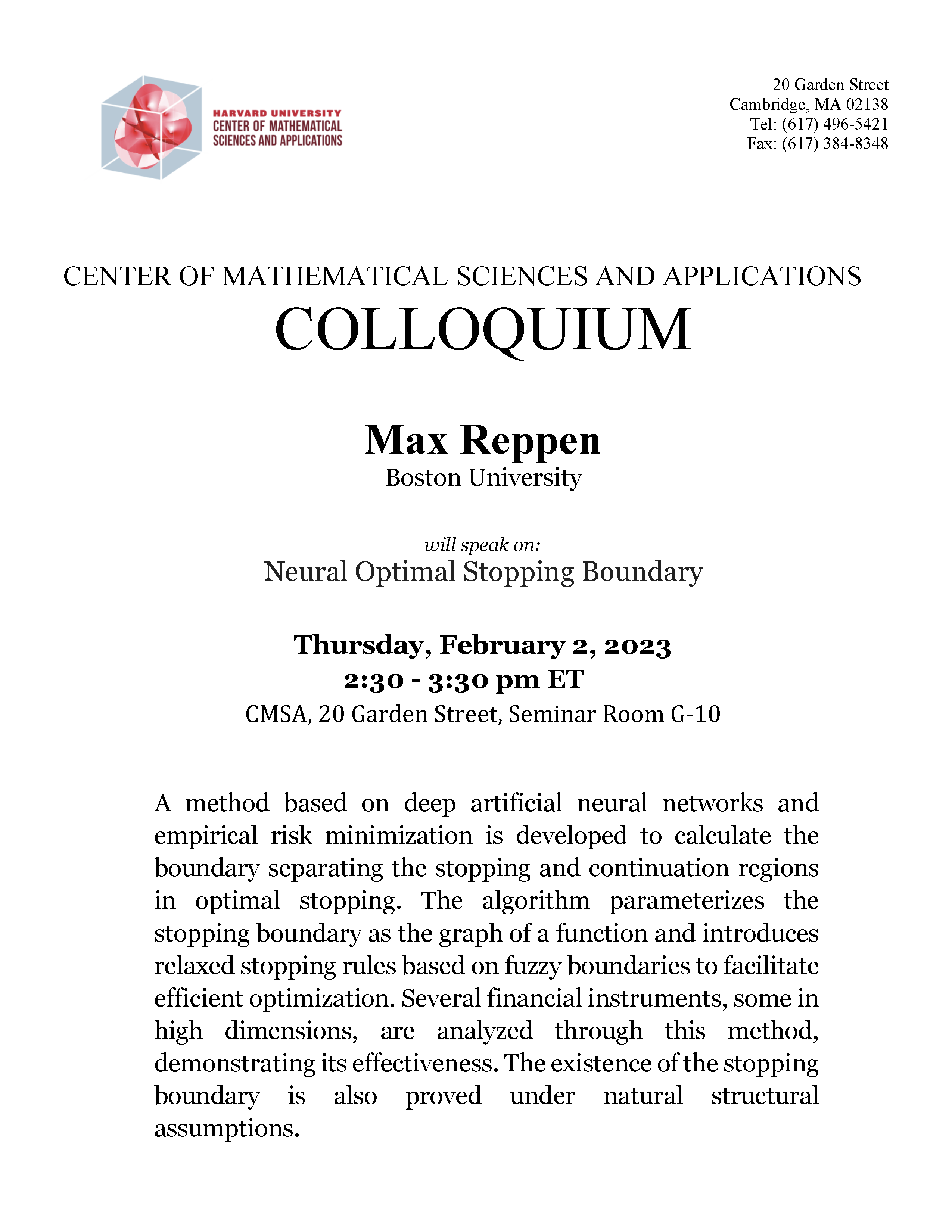
  • Neural Optimal Stopping Boundary

    CMSA Room G10 CMSA, 20 Garden Street, Cambridge, MA, United States

    Speaker: Max Reppen (Boston University) Title: Neural Optimal Stopping Boundary Abstract:  A method based on deep artificial neural networks and empirical risk minimization is developed to calculate the boundary separating the stopping and continuation regions in optimal stopping. The algorithm parameterizes the stopping boundary as the graph of a function and introduces relaxed stopping rules based on fuzzy […]

  • AI and Theorem Proving

    CMSA Room G10 CMSA, 20 Garden Street, Cambridge, MA, United States

    Member Seminar Speaker: Mike Douglas Title: AI and Theorem Proving Abstract: We survey interactive theorem proving and the Lean theorem prover, and the use of AI and large language models to improve this technology. We hope to start a discussion on projects we can do at the CMSA.

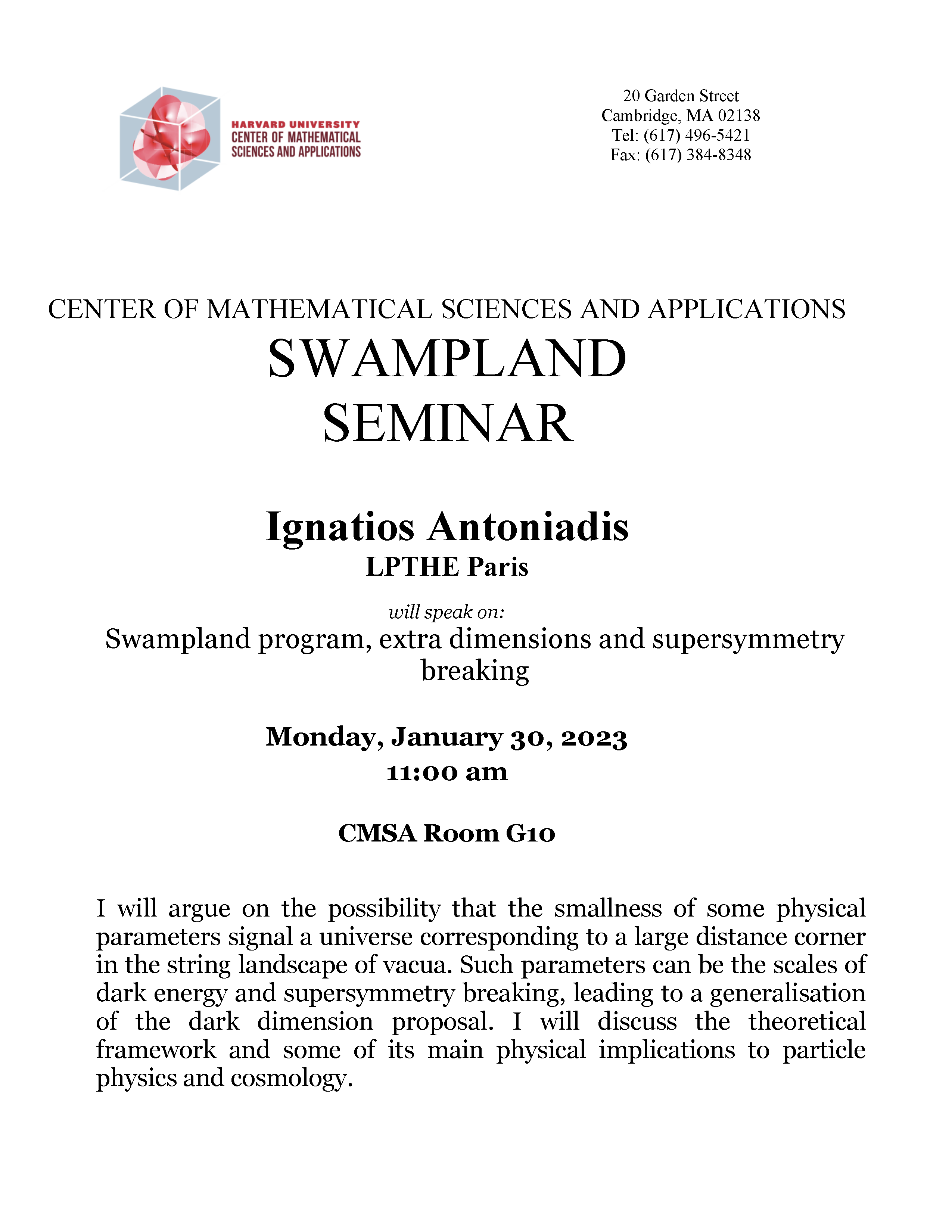
  • Swampland program, extra dimensions and supersymmetry breaking

    CMSA Room G10 CMSA, 20 Garden Street, Cambridge, MA, United States

    Swampland Seminar Speaker: Ignatios Antoniadis (LPTHE Paris) Title: Swampland program, extra dimensions and supersymmetry breaking Abstract: I will argue on the possibility that the smallness of some physical parameters signal a universe corresponding to a large distance corner in the string landscape of vacua. Such parameters can be the scales of dark energy and supersymmetry breaking, leading to […]

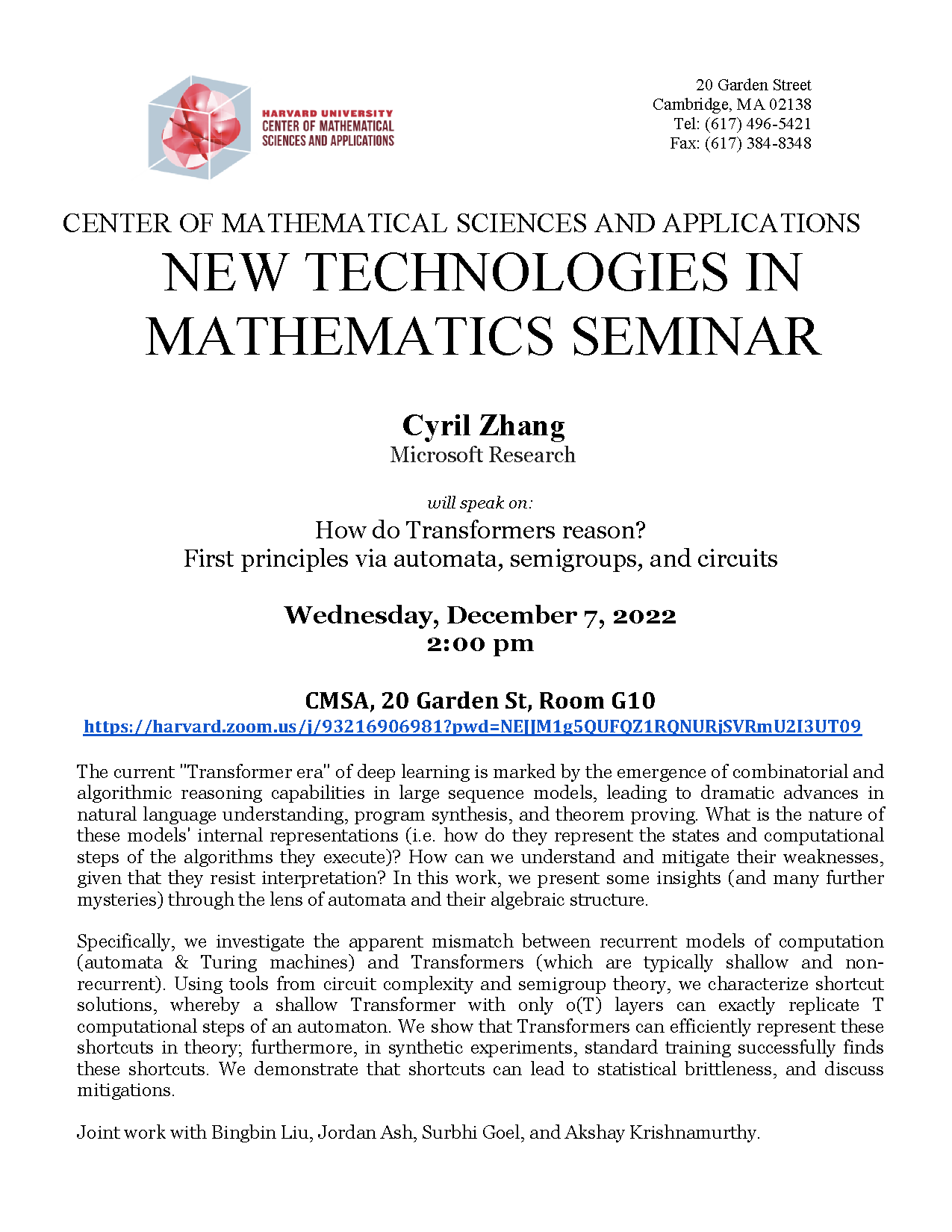
  • How do Transformers reason? First principles via automata, semigroups, and circuits

    CMSA Room G10 CMSA, 20 Garden Street, Cambridge, MA, United States

    https://youtu.be/g8zdumOAWzw New Technologies in Mathematics Seminar Speaker: Cyril Zhang, Microsoft Research Title: How do Transformers reason? First principles via automata, semigroups, and circuits Abstract: The current "Transformer era" of deep learning is marked by the emergence of combinatorial and algorithmic reasoning capabilities in large sequence models, leading to dramatic advances in natural language understanding, program synthesis, […]

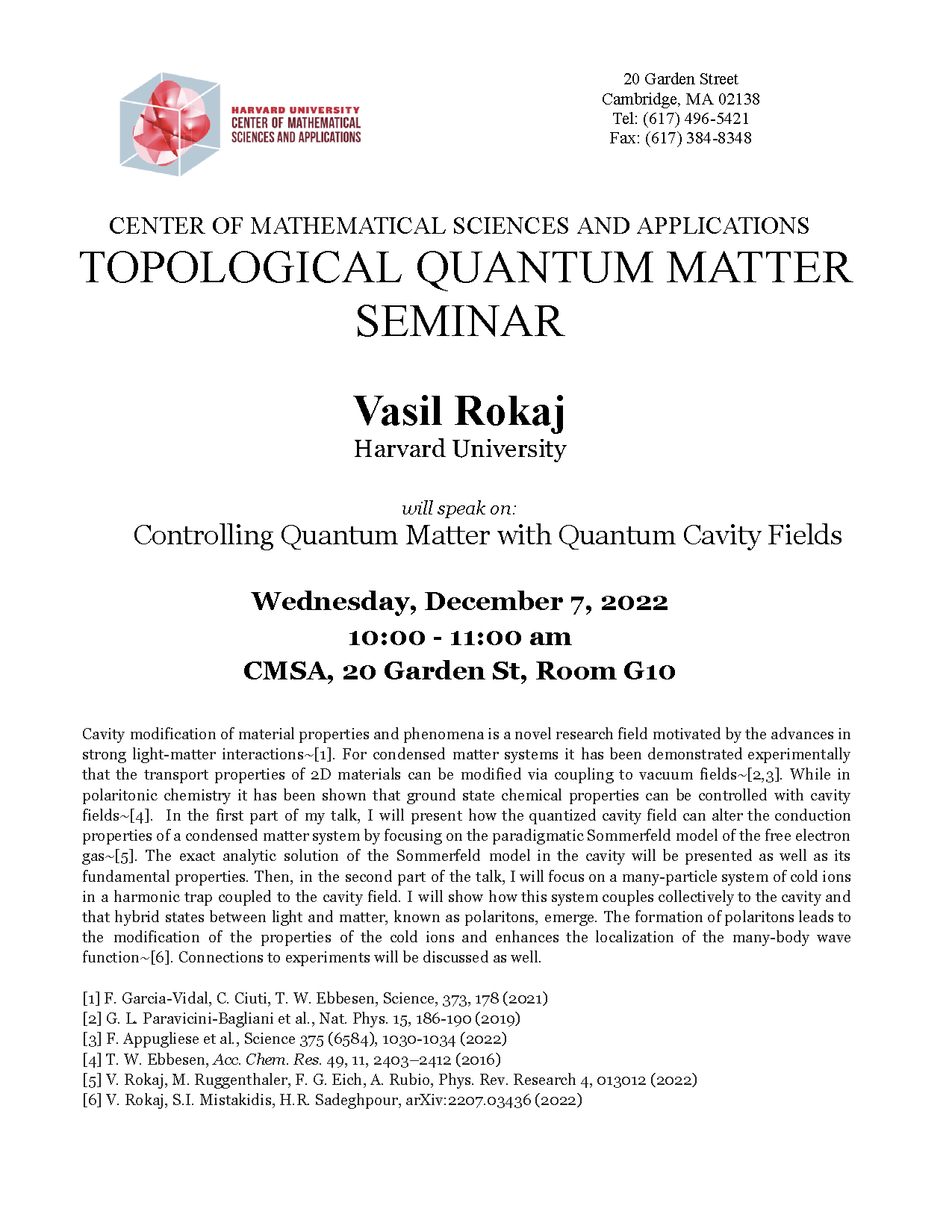
  • Controlling Quantum Matter with Quantum Cavity Fields

    CMSA Room G10 CMSA, 20 Garden Street, Cambridge, MA, United States

    https://youtu.be/Ig468DbAVGs Topological Quantum Matter Seminar Speaker: Vasil Rokaj (Harvard) Title: Controlling Quantum Matter with Quantum Cavity Fields Abstract: Cavity modification of material properties and phenomena is a novel research field motivated by the advances in strong light-matter interactions . For condensed matter systems it has been demonstrated experimentally that the transport properties of 2D materials […]

  • Compactness and Anticompactness Principles in Set Theory

    CMSA Room G10 CMSA, 20 Garden Street, Cambridge, MA, United States

    Member Seminar Speaker: Alejandro Poveda Title: Compactness and Anticompactness Principles in Set Theory Abstract: Several fundamental properties in Topology, Algebra or Logic are expressed in terms of Compactness Principles.For instance, a natural algebraic question is the following: Suppose that G is an Abelian group whose all small subgroups are free - Is the group G free? […]

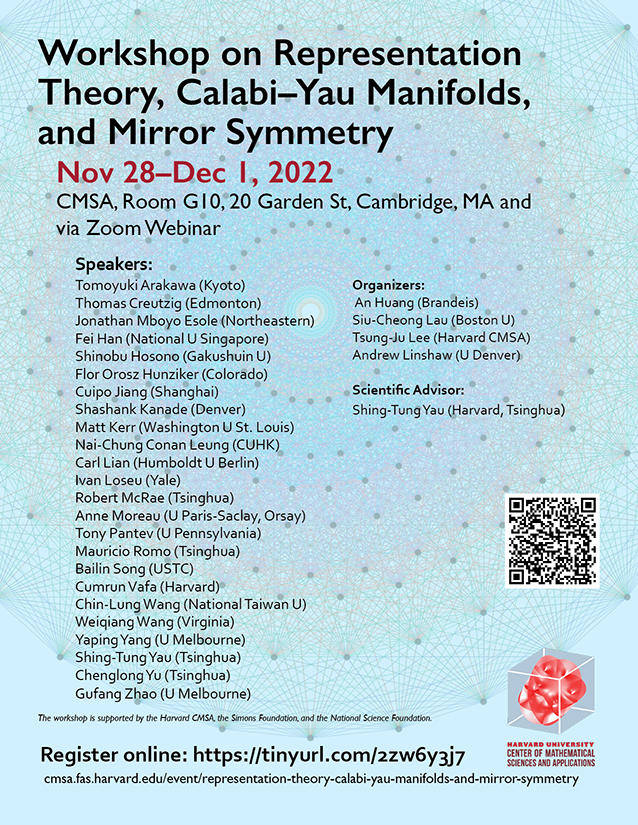
  • Representation Theory, Calabi–Yau Manifolds, and Mirror Symmetry

    CMSA Room G10 CMSA, 20 Garden Street, Cambridge, MA, United States

    Videos are available on the CMSA Youtube Playlist. On November 28 - Dec 1, 2022, the CMSA hosted a Workshop on Representation Theory, Calabi-Yau Manifolds, and Mirror Symmetry. Organizers: An Huang (Brandeis University) | Siu-Cheong Lau (Boston University) | Tsung-Ju Lee (CMSA, Harvard) | Andrew Linshaw (University of Denver) Scientific Advisor: Shing-Tung Yau (Harvard, Tsinghua) Location: […]