• The string/black hole transition in anti de Sitter space

    CMSA Room G10 CMSA, 20 Garden Street, Cambridge, MA, United States

    Speaker: Erez Urbach, Weizmann Institute of Science Title: The string/black hole transition in anti de Sitter space Abstract: String stars, or Horowitz-Polchinski solutions, are string theory saddles with normalizable condensates of thermal-winding strings. In the past, string stars were offered as a possible description of stringy (Euclidean) black holes in asymptotically flat spacetime, close to the […]
  • New bounds on lattice covering volumes, and nearly uniform covers

    CMSA Room G10 CMSA, 20 Garden Street, Cambridge, MA, United States

    Member Seminar Speaker: Barak Weiss   Title: New bounds on lattice covering volumes, and nearly uniform covers Abstract: Let L be a lattice in R^n and let K be a convex body. The covering volume of L with respect to K is the minimal volume of a dilate rK, such that L+rK = R^n, normalized by the […]

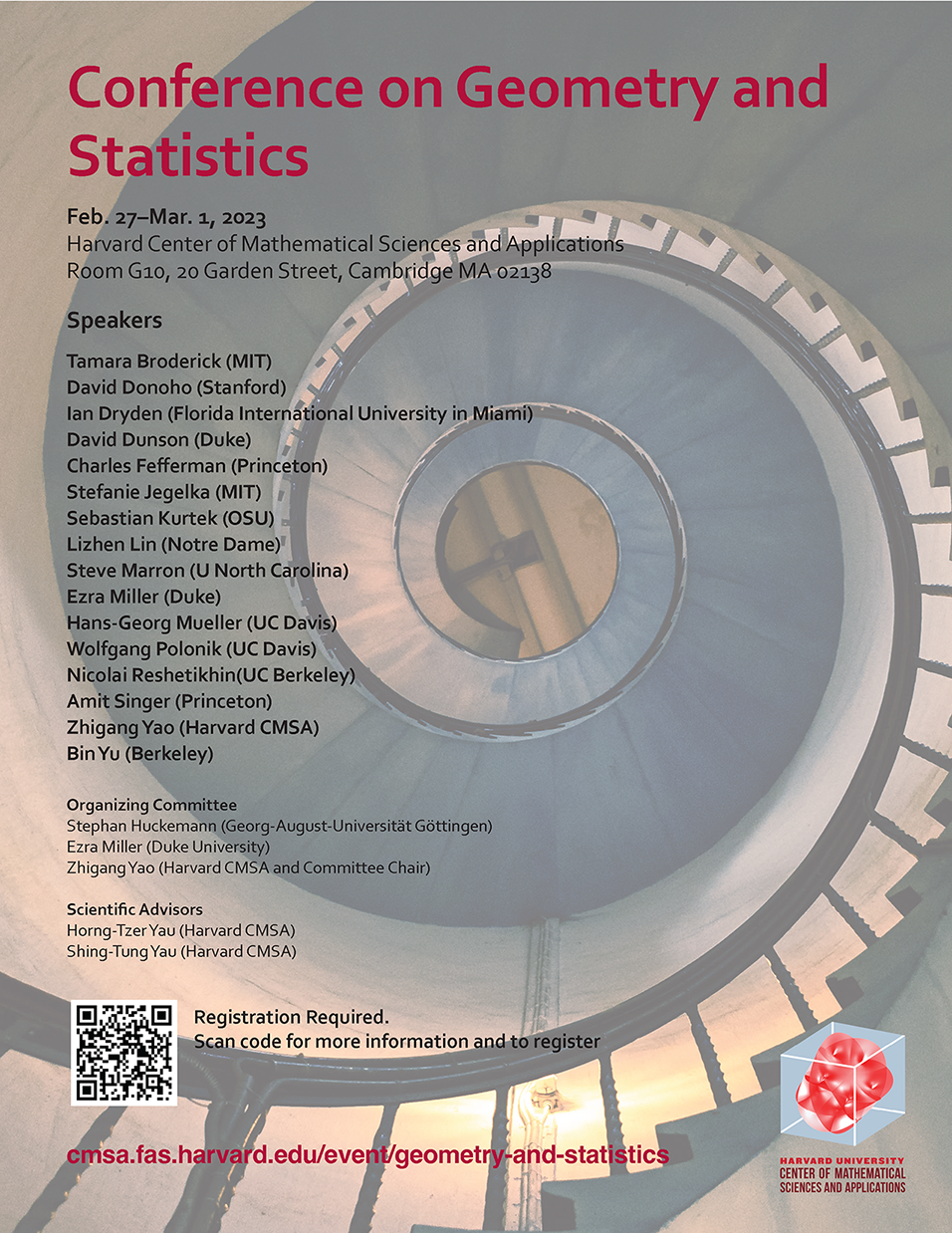
  • Conference on Geometry and Statistics

    CMSA Room G10 CMSA, 20 Garden Street, Cambridge, MA, United States

    On Feb 27-March 1, 2023 the CMSA will host a Conference on Geometry and Statistics. Location: G10, CMSA, 20 Garden Street, Cambridge MA 02138 Organizing Committee: Stephan Huckemann (Georg-August-Universität Göttingen) Ezra Miller (Duke University) Zhigang Yao (Harvard CMSA and Committee Chair) Scientific Advisors: Horng-Tzer Yau (Harvard CMSA) Shing-Tung Yau (Harvard CMSA) Speakers: Tamara Broderick (MIT) […]

  • On the convexity of general inverse $\sigma_k$ equations and some applications

    CMSA Room G10 CMSA, 20 Garden Street, Cambridge, MA, United States

    Algebraic Geometry in String Theory Seminar Speaker: Chao-Ming Lin (University of California, Irvine) Title: On the convexity of general inverse $\sigma_k$ equations and some applications Abstract: In this talk, I will show my recent work on general inverse $\sigma_k$ equations and the deformed Hermitian-Yang-Mills equation (hereinafter the dHYM equation). First, I will show my recent […]

  • The Black Hole Information Paradox: A Resolution on the Horizon?

    CMSA Room G10 CMSA, 20 Garden Street, Cambridge, MA, United States

    Speaker: Netta Engelhardt (MIT) Title: The Black Hole Information Paradox: A Resolution on the Horizon? Abstract: The black hole information paradox — whether information escapes an evaporating black hole or not — remains one of the most longstanding mysteries of theoretical physics. The apparent conflict between validity of semiclassical gravity at low energies and unitarity […]

  • Hints of Flat Space Holography

    CMSA Room G10 CMSA, 20 Garden Street, Cambridge, MA, United States

    Member Seminar Speaker: Dan Kapec Title: Hints of Flat Space Holography Abstract: Despite our detailed understanding of holography in Anti-de Sitter space, flat space holography remains somewhat mysterious. “Celestial CFT” is a formalism which attempts to recast quantum gravity in (d+2)-dimensional asymptotically flat spacetimes in terms of a d-dimensional Euclidean conformal field theory residing at the conformal […]

  • Quasinormal Modes from Penrose Limits

    CMSA Room G10 CMSA, 20 Garden Street, Cambridge, MA, United States

    https://youtu.be/taeAnXApzg4 General Relativity Seminar Speaker: Kwinten Fransen (UC Santa Barbara) Title: Quasinormal Modes from Penrose Limits Abstract: In this talk, I will explain how to describe quasinormal modes with large real frequencies using Penrose limits. To do so, I first recall relevant aspects of the Penrose limit, and its resulting plane wave spacetimes, as well as quasinormal […]

  • Towards programmable living materials and quantitative models of active matter

    CMSA Room G10 CMSA, 20 Garden Street, Cambridge, MA, United States

    Active Matter Seminar Speaker: Jörn Dunkel, MIT Title: Towards programmable living materials and quantitative models of active matter Abstract: Over the last two decades, major progress has been made in understanding the self-organization principles of active matter.  A wide variety of experimental model systems, from self-driven colloids to active elastic materials, has been established, and an extensive […]

  • Manifold Fitting: An Invitation to Statistics

    CMSA Room G10 CMSA, 20 Garden Street, Cambridge, MA, United States

    Probability Seminar Speaker: Zhigang Yao (Harvard CMSA/National University of Singapore) Title: Manifold Fitting: An Invitation to Statistics Abstract: This manifold fitting problem can go back to H. Whitney’s work in the early 1930s (Whitney (1992)), and finally has been answered in recent years by C. Fefferman’s works (Fefferman, 2006, 2005). The solution to the Whitney extension problem […]

  • Dynamics of active nematic defects on cones

    CMSA Room G10 CMSA, 20 Garden Street, Cambridge, MA, United States

    Member Seminar Speaker: Farzan Vafa Title: Dynamics of active nematic defects on cones Abstract: In the first part of the talk, we investigate the ground-state configurations of two-dimensional liquid crystals with p-fold rotational symmetry (p-atics) on cones. The cone apex develops an effective topological charge, which in analogy to electrostatics, leads to defect absorption and emission […]

  • Complete Calabi-Yau metrics: Recent progress and open problems

    CMSA Room G10 CMSA, 20 Garden Street, Cambridge, MA, United States

    Speaker: Tristan Collins, MIT Title: Complete Calabi-Yau metrics: Recent progress and open problems Abstract: Complete Calabi-Yau metrics are fundamental objects in Kahler geometry arising as singularity models or "bubbles" in degenerations of compact Calabi-Yau manifolds.  The existence of these metrics and their relationship with algebraic geometry are the subjects of several long standing conjectures due […]

  • Parity and Cobordism

    CMSA Room G10 CMSA, 20 Garden Street, Cambridge, MA, United States

    Swampland Seminar Speaker: Jake McNamara (Caltech) Title: Parity and Cobordism Abstract: The swampland cobordism conjecture provides a convenient way to discuss conserved charges associated with the topology of spacetime. However, much of the power of the cobordism conjecture comes from a mathematical black box: the Adams spectral sequence. In this talk, I will give physical meaning to […]