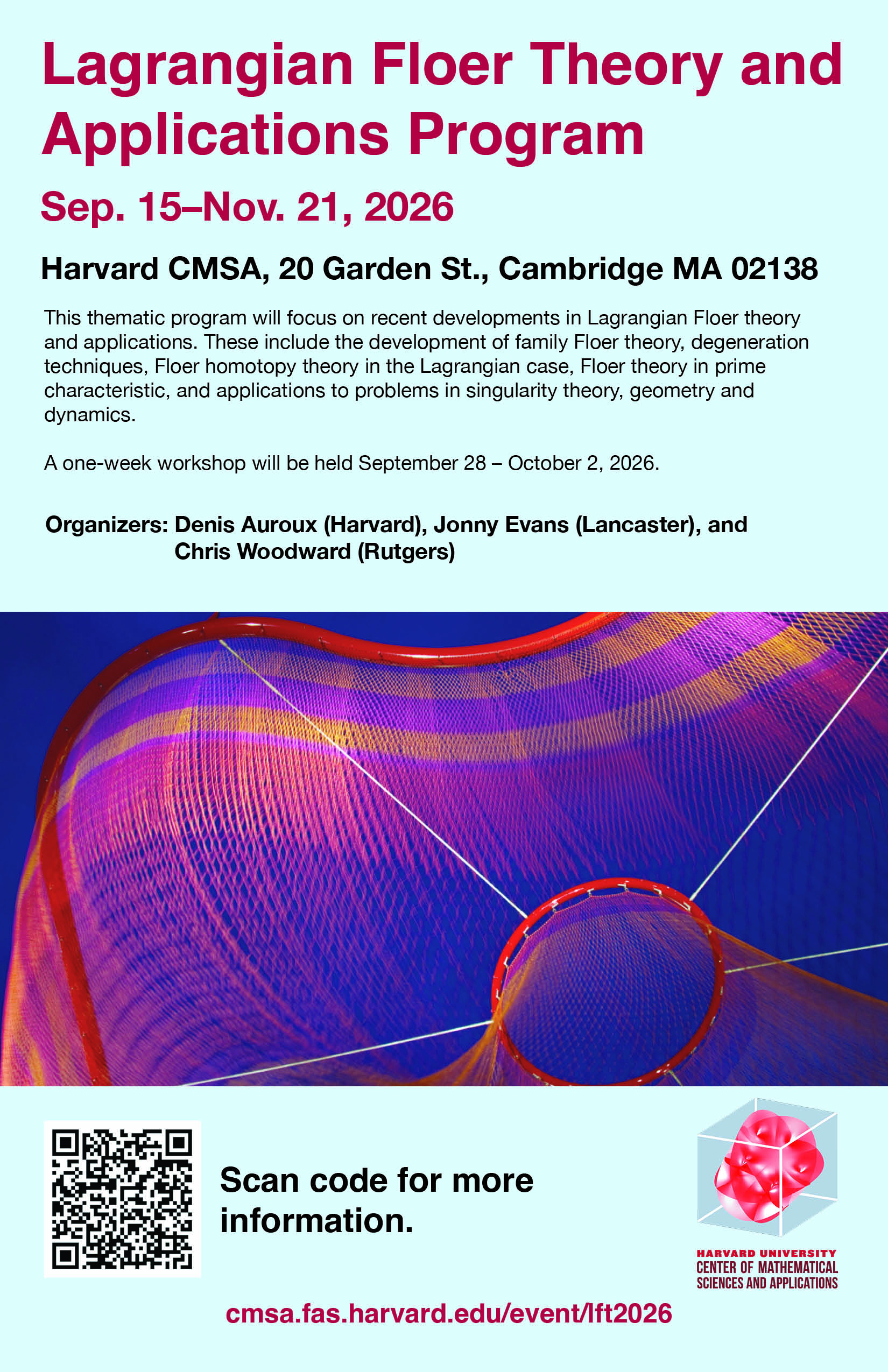
• Lagrangian Floer Theory and Applications Program

    CMSA 20 Garden Street Cambridge, Massachusetts 02138 United States

    Lagrangian Floer theory and Applications Program Dates: September 15–November 21, 2026 Location: CMSA G10, 20 Garden St., Cambridge MA 02138 This thematic program will focus on recent developments in Lagrangian Floer theory and applications.  These include the development of family Floer theory, degeneration techniques, Floer homotopy theory in the Lagrangian case, Floer theory in prime […]
  • Can Math Mend a Broken Heart?

    CMSA Q&A Seminar
    Common Room, CMSA 20 Garden Street, Cambridge, MA, United States

    CMSA Q&A Seminar Speaker: Wes Cain, Harvard Title: Can Math Mend a Broken Heart? Abstract: I will discuss an abnormal cardiac rhythm known as T-wave alternans, and a simple feedback control method (time-delay autosynchronization, TDAS) that has been used successfully to suppress alternans experimentally. Variants of TDAS have been used for chaos control and prevention […]

  • On the emergence of representational geometry from the statistics of natural language

    Virtual

    New Technologies in Mathematics Seminar Speaker: Yasaman Bahri (Google DeepMind) Title: On the emergence of representational geometry from the statistics of natural language Abstract: Large language models organize their internal representations into rich geometric structures that mirror the concepts of natural language. For example, categorical concepts often map to linear directions, while words and phrases […]

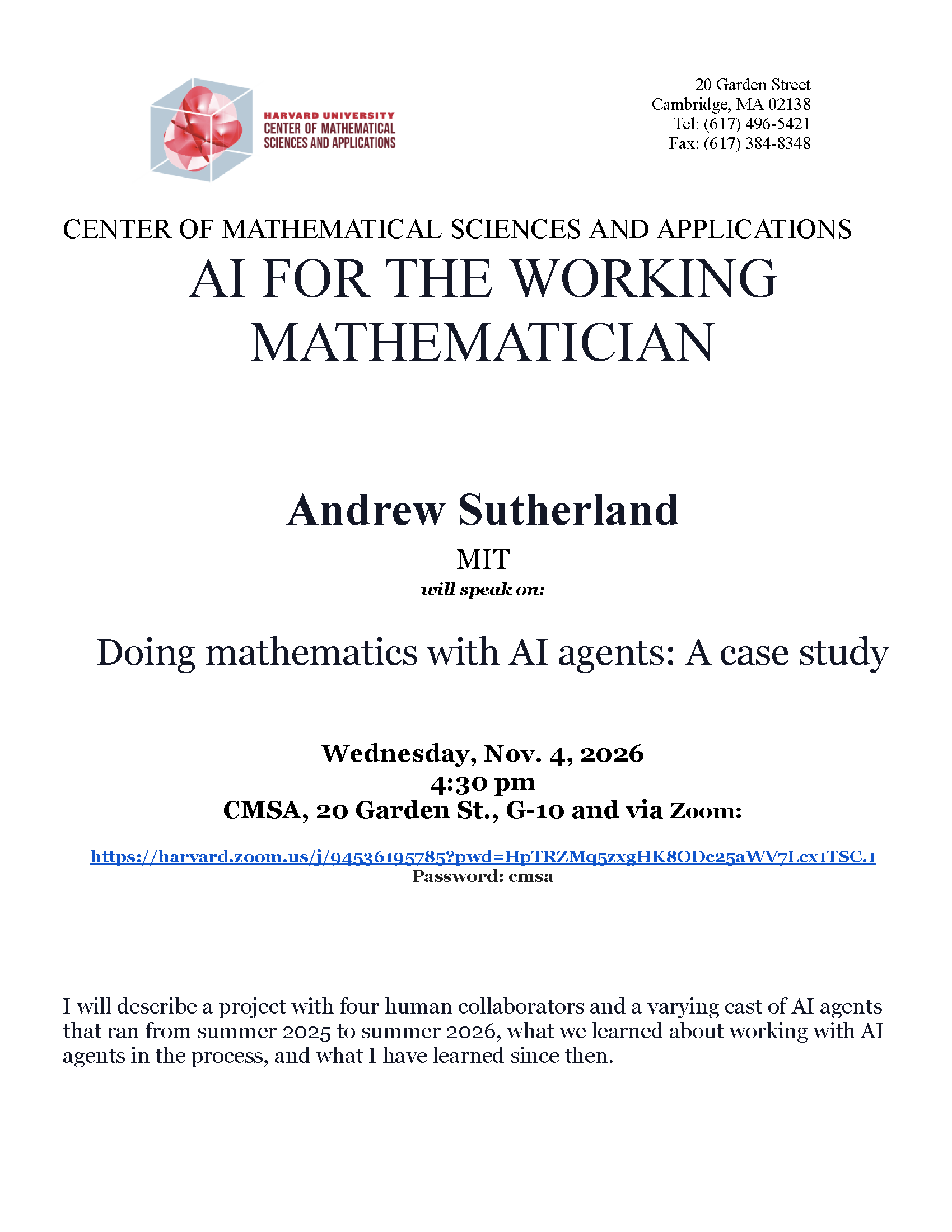
  • Doing mathematics with AI agents: A case study

    CMSA Room G10 CMSA, 20 Garden Street, Cambridge, MA, United States

    AI for the Working Mathematician Speaker: Andrew Sutherland, MIT Title: Doing mathematics with AI agents: A case study Abstract: I will describe a project with four human collaborators and a varying cast of AI agents that ran from summer 2025 to summer 2026, what we learned about working with AI agents in the process, and what I have learned since […]

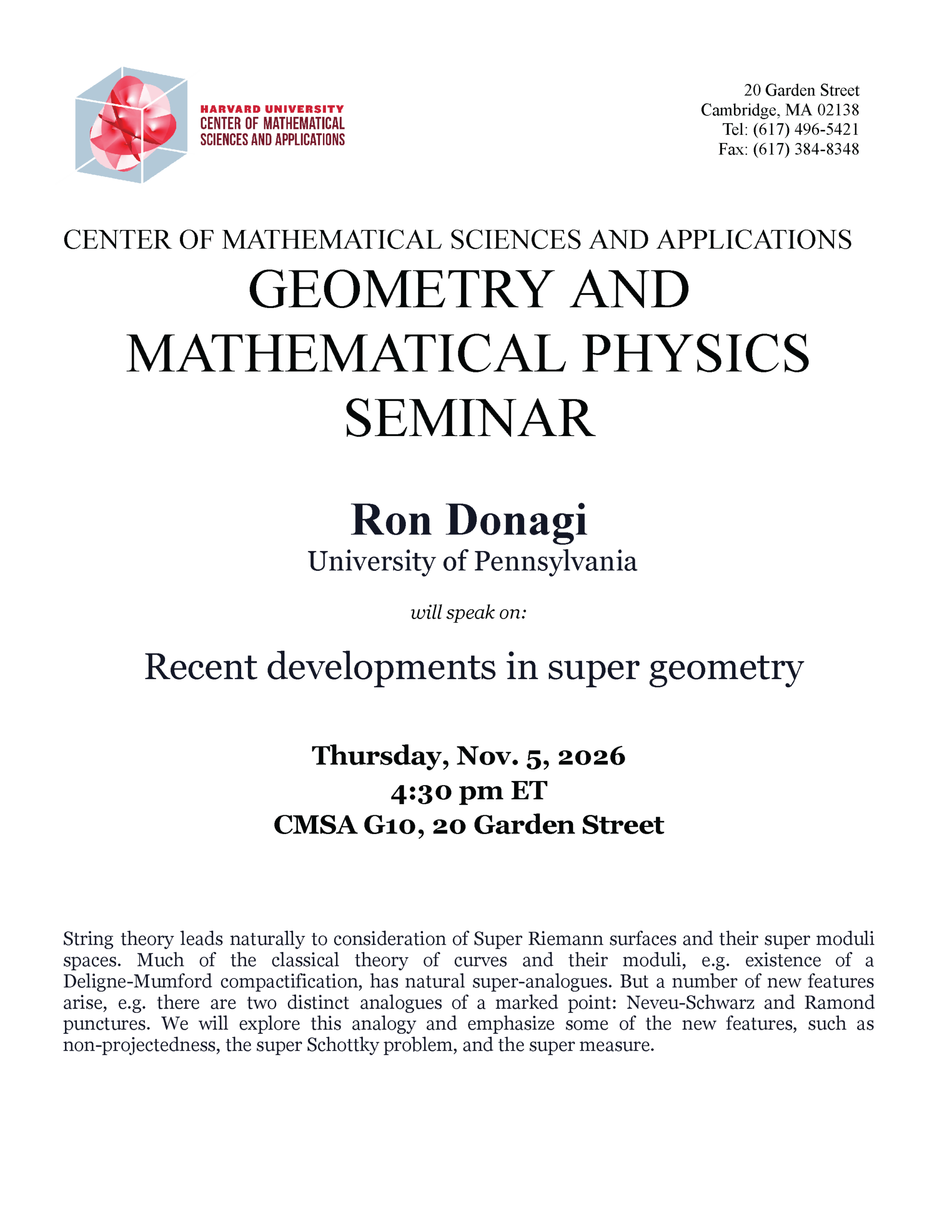
  • Recent developments in super geometry

    CMSA Room G10 CMSA, 20 Garden Street, Cambridge, MA, United States

    Geometry and Mathematical Physics Seminar Speaker: Ron Donagi, University of Pennsylvania Title: Recent developments in super geometry Abstract: String theory leads naturally to consideration of Super Riemann surfaces and their super moduli spaces. Much of the classical theory of curves and their moduli, e.g. existence of a Deligne-Mumford compactification, has natural super-analogues. But a number […]

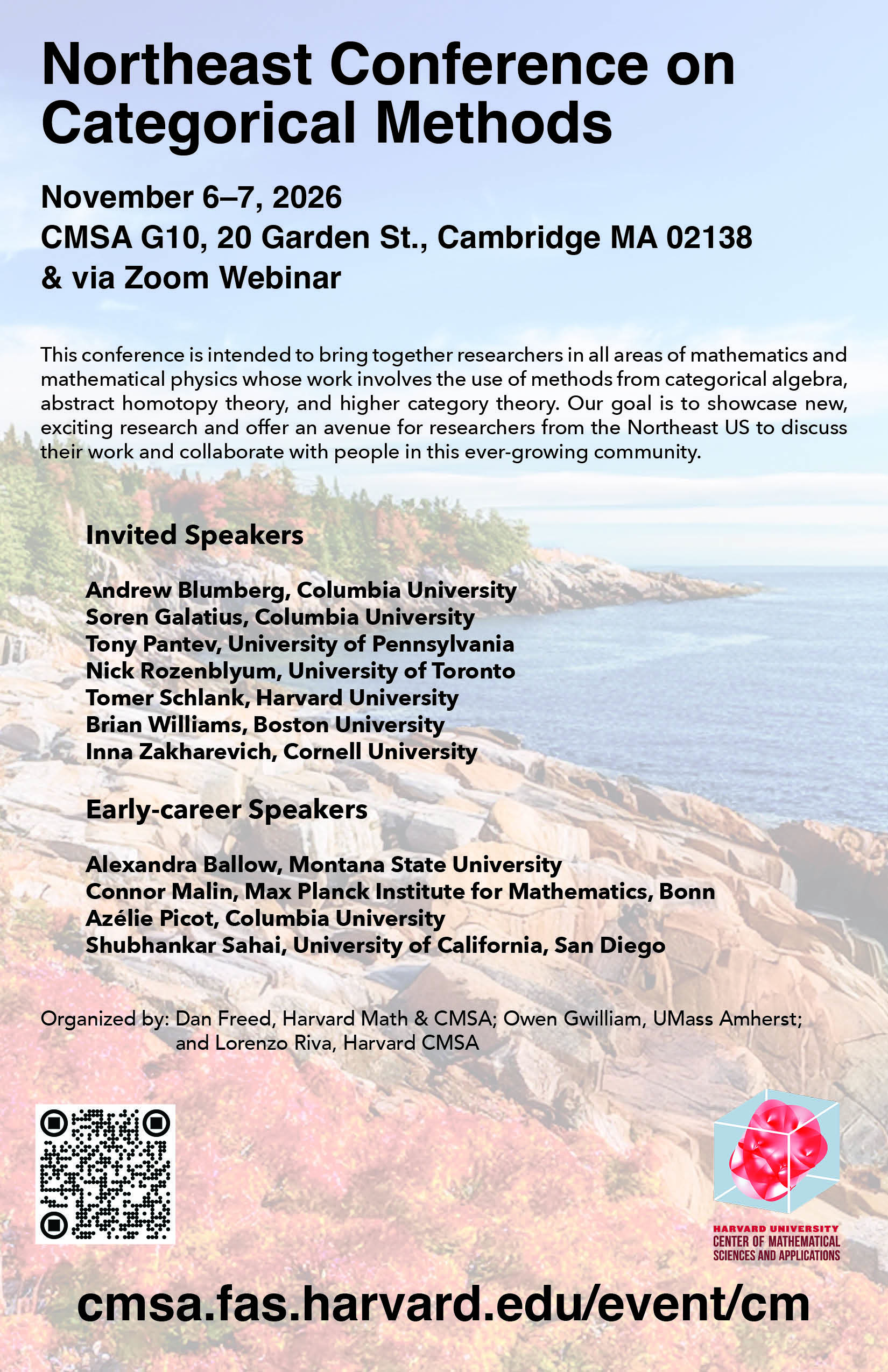
  • Northeast Conference on Categorical Methods

    CMSA Room G10 CMSA, 20 Garden Street, Cambridge, MA, United States

    Northeast Conference on Categorical Methods Dates: November 6–​7, 2026  Location: CMSA G10, 20 Garden St., Cambridge MA 02138 This conference is intended to bring together researchers in all areas of mathematics and mathematical physics whose work involves the use of methods from categorical algebra, abstract homotopy theory, and higher category theory. Our goal is to […]

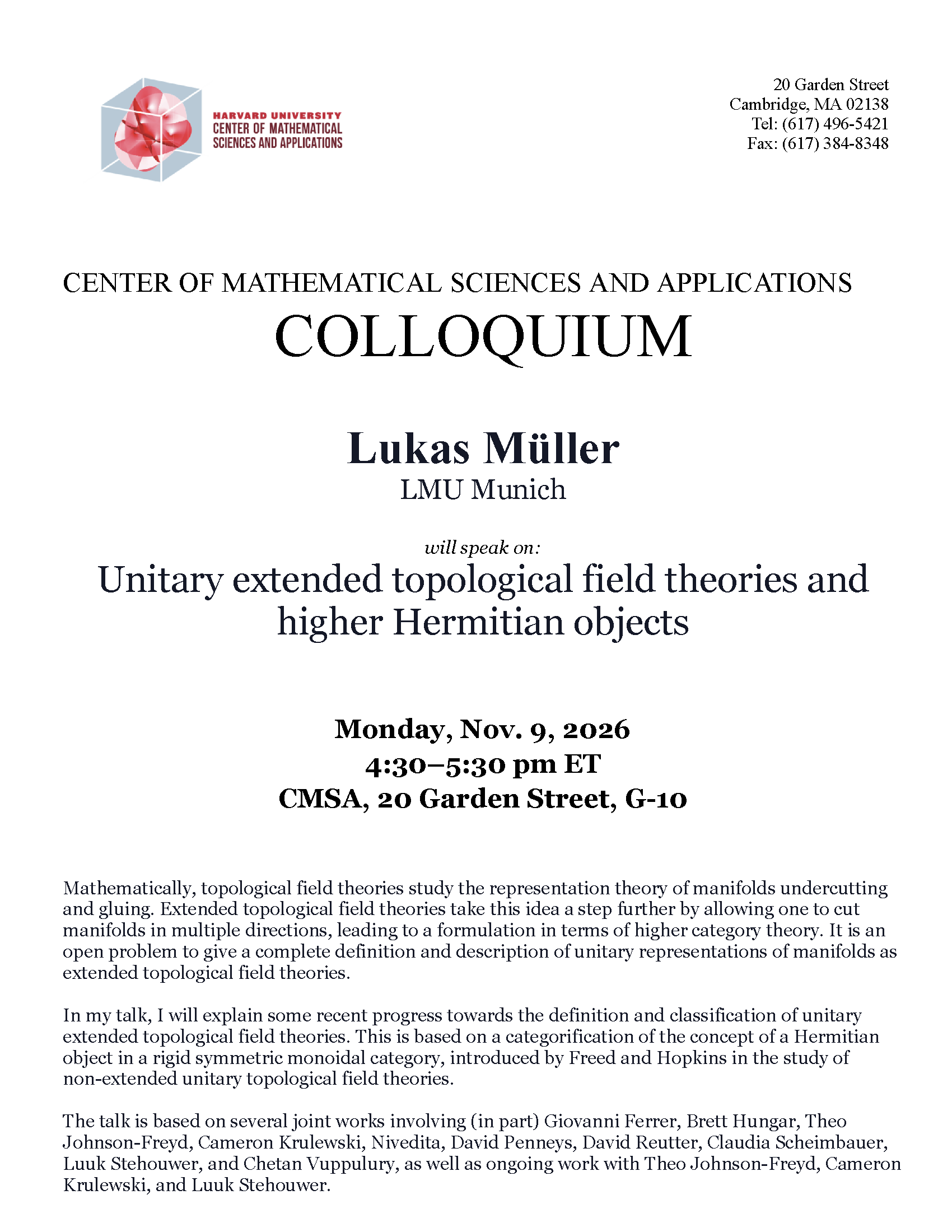
  • Unitary extended topological field theories and higher Hermitian objects

    CMSA Room G10 CMSA, 20 Garden Street, Cambridge, MA, United States

    Colloquium Speaker: Lukas Müller (LMU Munich) Title: Unitary extended topological field theories and higher Hermitian objects Abstract: Mathematically, topological field theories study the representation theory of manifolds undercutting and gluing. Extended topological field theories take this idea a step further by allowing one to cut manifolds in multiple directions, leading to a formulation in terms […]

  • Geometry and Mathematical Physics Seminar

    CMSA Room G10 CMSA, 20 Garden Street, Cambridge, MA, United States

    Geometry and Mathematical Physics Seminar Speaker: Roland Bittleston (Harvard)

  • Member Seminar

    CMSA Room G10 CMSA, 20 Garden Street, Cambridge, MA, United States

    Member Seminar Speaker: Saman Habibi Esfahani

  • Mathematical Economics Seminar: Experimental Design in Networks

    CMSA Room G10 CMSA, 20 Garden Street, Cambridge, MA, United States

    Speaker: Christopher Harshaw (c.harshaw@columbia.edu), Columbia University Title: Design-Based Minimax Theory for Network Experiments Abstract: Network experiments are used throughout the social and medical sciences to investigate causal effects under the presence of interference. While a large body of work has developed improved statistical procedures, the fundamental limits of statistical estimation in these settings is less well understood. […]