• The Black Hole Information Paradox: A Resolution on the Horizon?

    CMSA Room G10 CMSA, 20 Garden Street, Cambridge, MA, United States

    Speaker: Netta Engelhardt (MIT) Title: The Black Hole Information Paradox: A Resolution on the Horizon? Abstract: The black hole information paradox — whether information escapes an evaporating black hole or not — remains one of the most longstanding mysteries of theoretical physics. The apparent conflict between validity of semiclassical gravity at low energies and unitarity […]
  • New bounds on lattice covering volumes, and nearly uniform covers

    CMSA Room G10 CMSA, 20 Garden Street, Cambridge, MA, United States

    Member Seminar Speaker: Barak Weiss   Title: New bounds on lattice covering volumes, and nearly uniform covers Abstract: Let L be a lattice in R^n and let K be a convex body. The covering volume of L with respect to K is the minimal volume of a dilate rK, such that L+rK = R^n, normalized by the […]

  • The string/black hole transition in anti de Sitter space

    CMSA Room G10 CMSA, 20 Garden Street, Cambridge, MA, United States

    Speaker: Erez Urbach, Weizmann Institute of Science Title: The string/black hole transition in anti de Sitter space Abstract: String stars, or Horowitz-Polchinski solutions, are string theory saddles with normalizable condensates of thermal-winding strings. In the past, string stars were offered as a possible description of stringy (Euclidean) black holes in asymptotically flat spacetime, close to the […]

  • Categorical Symmetry of the Standard Model from Gravitational Anomaly 

    CMSA Room G10 CMSA, 20 Garden Street, Cambridge, MA, United States

    Member Seminar Speaker: Juven Wang Title: Categorical Symmetry of the Standard Model from Gravitational Anomaly Abstract: In the Standard Model, the total "sterile right-handed" neutrino number n_{νR} is not equal to the family number Nf. The anomaly index (-Nf+n_{νR}) had been advocated to play an important role in our previous work on Cobordism and Deformation Class of […]

  • Conformal symmetry, Optimization algorithms and the Critical Phenomena

    CMSA Room G10 CMSA, 20 Garden Street, Cambridge, MA, United States

    Speaker: Ning Su, University of Pisa Title: Conformal symmetry, Optimization algorithms and the Critical Phenomena Abstract: In the phase diagram of many substances, the critical points have emergent conformal symmetry and are described by conformal field theories. Traditionally, physical quantities near the critical point can be computed by perturbative field theory method, where conformal symmetry […]

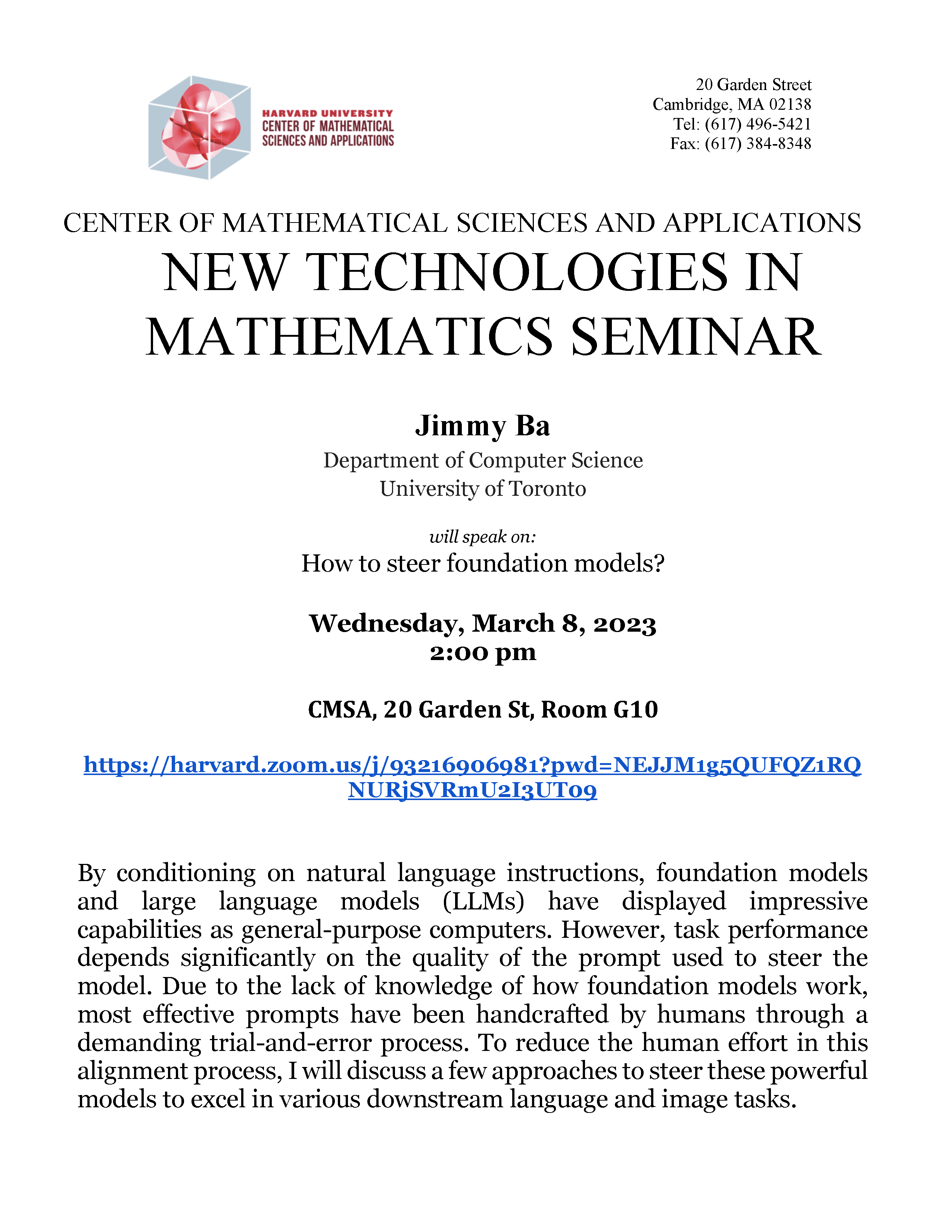
  • How to steer foundation models?

    CMSA Room G10 CMSA, 20 Garden Street, Cambridge, MA, United States

    https://youtu.be/ztk5TPYTKZA New Technologies in Mathematics Seminar Speaker: Jimmy Ba, University of Toronto Title: How to steer foundation models? Abstract: By conditioning on natural language instructions, foundation models and large language models (LLMs) have displayed impressive capabilities as general-purpose computers. However, task performance depends significantly on the quality of the prompt used to steer the model. […]

  • Randomized algorithms in combinatorics

    CMSA Room G10 CMSA, 20 Garden Street, Cambridge, MA, United States

    Member Seminar Speaker: Michael Simkin Title: Randomized algorithms in combinatorics Abstract: Randomized algorithms have been a computational workhorse for almost as long as there have been computers. Surprisingly, such algorithms can also be used to attack problems that are neither algorithmic nor probabilistic. Time permitting I will discuss the following combintorial examples: Enumerative combinatorics and the […]

  • Quantum Gravity constraints beyond asymptotic regimes

    CMSA Room G10 CMSA, 20 Garden Street, Cambridge, MA, United States

    Member Seminar Speaker: Max Wiesner Title: Quantum Gravity constraints beyond asymptotic regimes Abstract: Not every effective field theory that is consistent in the absence of gravity can be completed to a consistent theory of quantum gravity. The goal of the Swampland program is to find general criteria that distinguish effective field theories, that can be obtained […]

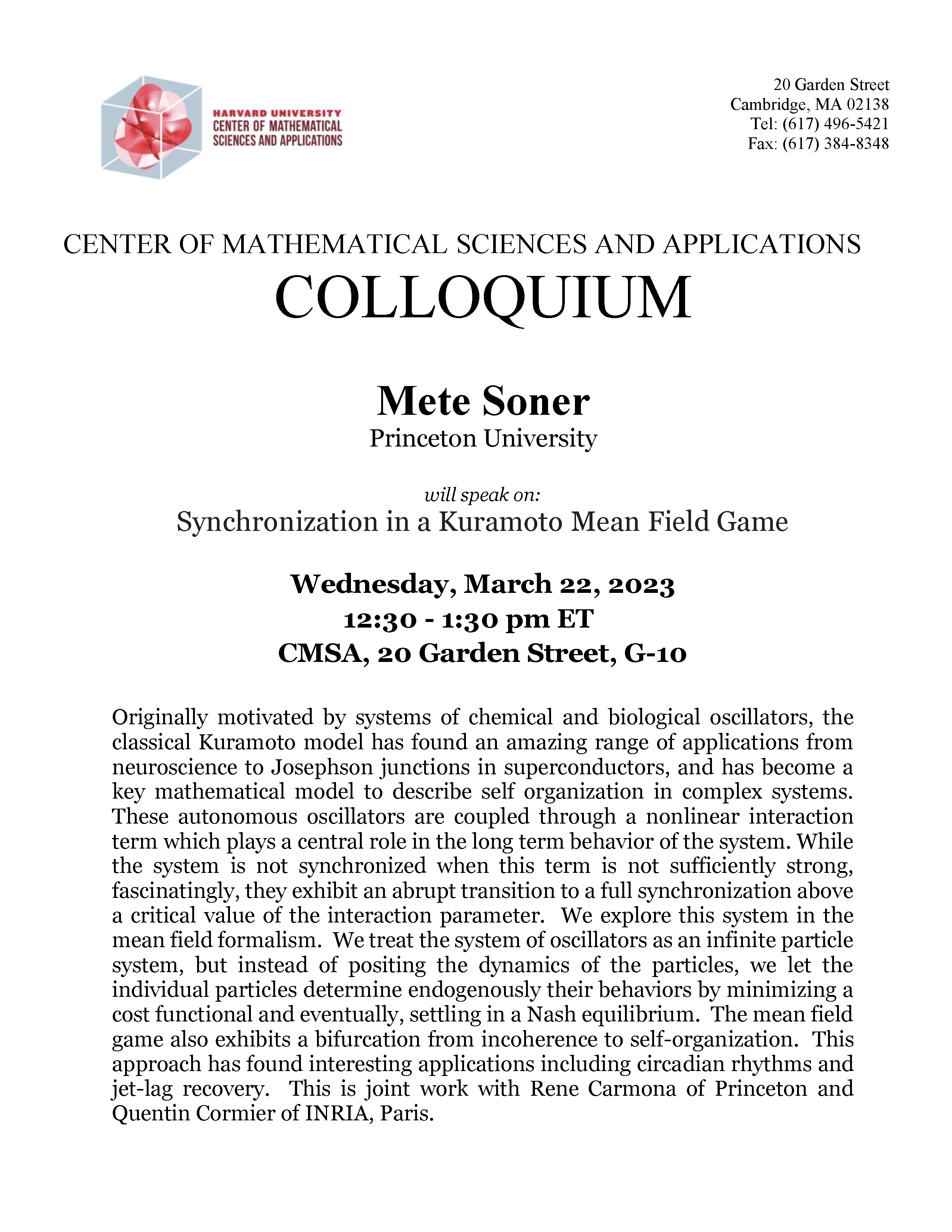
  • Synchronization in a Kuramoto Mean Field Game

    CMSA Room G10 CMSA, 20 Garden Street, Cambridge, MA, United States

    Speaker: Mete Soner (Princeton University) Title: Synchronization in a Kuramoto Mean Field Game Abstract:  Originally motivated by systems of chemical and biological oscillators, the classical Kuramoto model has found an amazing range of applications from neuroscience to Josephson junctions in superconductors, and has become a  key mathematical model to describe self organization in complex systems. These autonomous oscillators are […]

  • Monotonicity of quasilocal mass for asymptotically flat Riemannian manifolds

    CMSA Room G10 CMSA, 20 Garden Street, Cambridge, MA, United States

    Member Seminar Speaker: Jue Liu Title: Monotonicity of quasilocal mass for asymptotically flat Riemannian manifolds Abstract: The study of quasilocal mass in general relativity has a long history. In previous papers by many authors we have a deep understanding of the properties of quasilocal mass such as positivity, rigidity and asymptotics etc. In this talk I will focus […]

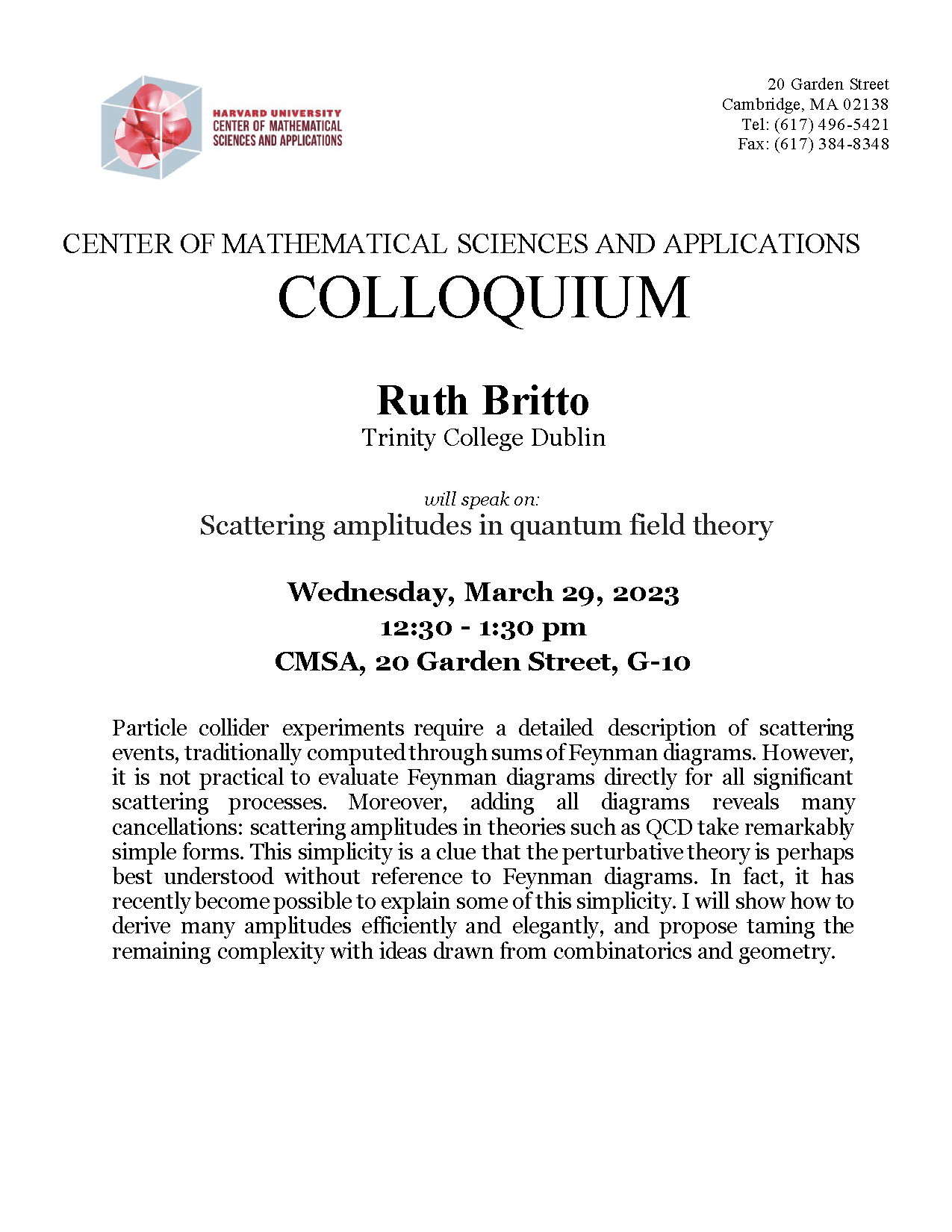
  • Scattering amplitudes in quantum field theory

    CMSA Room G10 CMSA, 20 Garden Street, Cambridge, MA, United States

    Speaker: Ruth Britto (Trinity College Dublin) Title: Scattering amplitudes in quantum field theory Abstract: Particle collider experiments require a detailed description of scattering events, traditionally computed through sums of Feynman diagrams. However, it is not practical to evaluate Feynman diagrams directly for all significant scattering processes. Moreover, adding all diagrams reveals many cancellations: scattering amplitudes […]

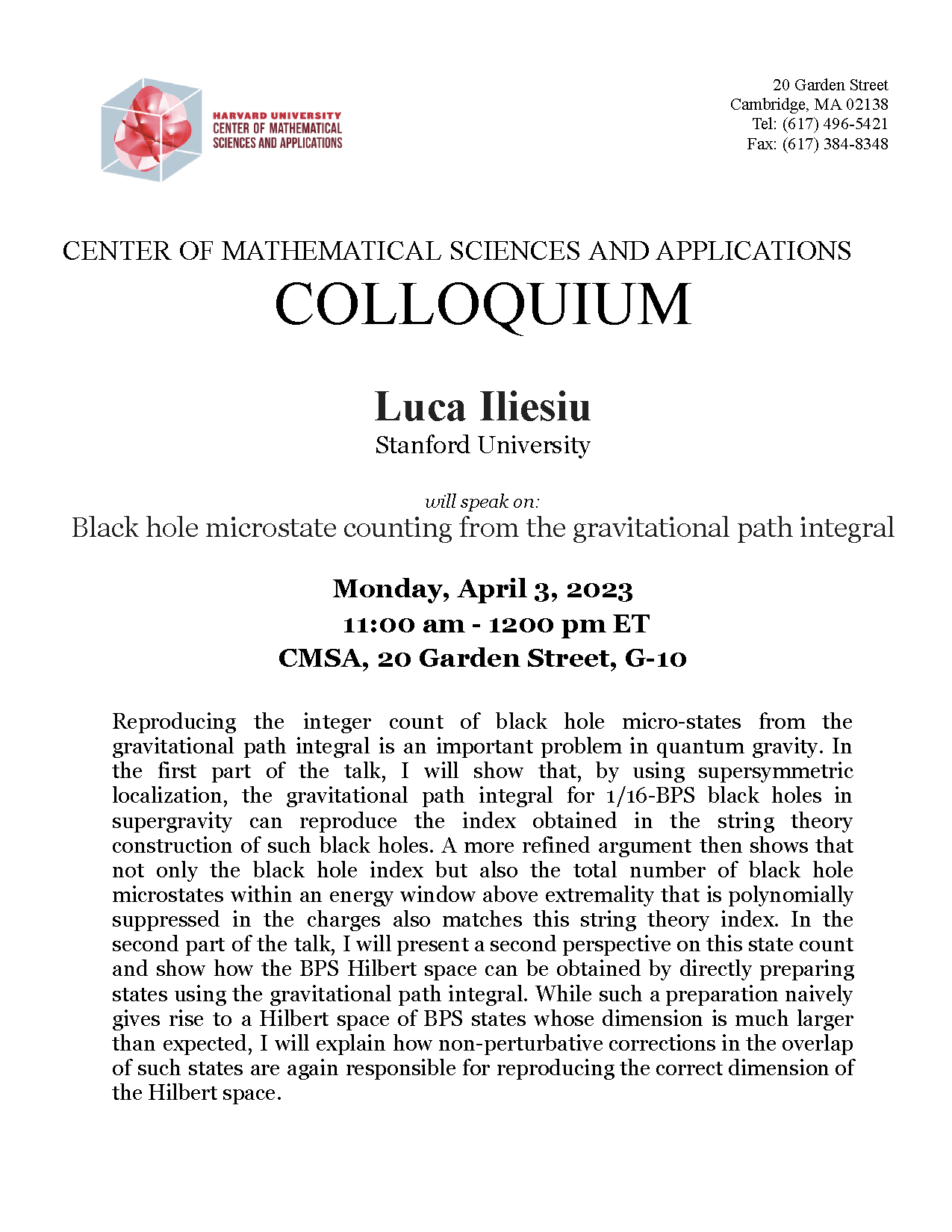
  • Black hole microstate counting from the gravitational path integral

    CMSA Room G10 CMSA, 20 Garden Street, Cambridge, MA, United States

    Colloquium Speaker: Luca Iliesiu, Stanford Title: Black hole microstate counting from the gravitational path integral Abstract: Reproducing the integer count of black hole micro-states from the gravitational path integral is an important problem in quantum gravity. In the first part of the talk, I will show that, by using supersymmetric localization, the gravitational path integral for 1/16-BPS black […]