• Optimal Dynamic Allocation: Simplicity through Information Design

    CMSA Room G10 CMSA, 20 Garden Street, Cambridge, MA, United States

    Member Seminar Speaker: Faidra Monachou Title: Optimal Dynamic Allocation: Simplicity through Information Design Abstract: We study dynamic nonmonetary markets where objects are allocated to unit-demand agents with private types. An agent’s value for an object is supermodular in her type and the quality of the object, and her payoff is quasilinear in her waiting cost. The […]
  • Spectral gap and two-point functions in spin glasses

    CMSA Room G10 CMSA, 20 Garden Street, Cambridge, MA, United States

    Member Seminar Speaker: Changji Xu Title: Spectral gap and two-point functions in spin glasses Abstract: Many have worked on spin glass models over the past 50 years, including physicists, mathematicians, and computers. A question that arises is whether computers yield dependable simulation results. In this talk, I will discuss some recent mathematical progress on spectral […]

  • Unexpected Uses of Neural Networks: Field Theory and Metric Flows  

    CMSA Room G10 CMSA, 20 Garden Street, Cambridge, MA, United States

    Speaker: James Halverson (Northeastern University)   Title: Unexpected Uses of Neural Networks: Field Theory and Metric Flows Abstract:  We are now quite used to the idea that deep neural networks may be trained in a variety of ways to tackle cutting-edge problems in physics and mathematics, sometimes leading to rigorous results. In this talk, however, I will argue […]

  • Recent progress on coupled Einstein-Yang-Mills dynamics

    Common Room, CMSA 20 Garden Street, Cambridge, MA, United States

    Member Seminar Speaker: Puskar Mondal Title: Recent progress on coupled Einstein-Yang-Mills dynamics Abstract: I will discuss my recent work with prof. S.T. Yau on Einstein-Yang-Mills theory. I’ll discuss the main ideas behind the stability of the Minkowski and Milne space time under coupled gauge-gravity perturbations. Construction of the gauge invariant energies that control the suitable […]

  • Black hole collider physics

    CMSA Room G10 CMSA, 20 Garden Street, Cambridge, MA, United States

    Speaker: Julio Parra Martinez, Caltech Title: Black hole collider physics Abstract: Despite more than a century since the development of Einstein’s theory, the general relativistic two-body problem remains unsolved. A precise description of its solution is now essential, as it is necessary for understanding the strong-gravity dynamics of compact binaries observed at LIGO/VIRGO/KAGRA and in […]

  • On complete Calabi-Yau metrics and some related Monge-Ampere equations

    CMSA Room G10 CMSA, 20 Garden Street, Cambridge, MA, United States

    Member Seminar Speaker: Freid Tong Title: On complete Calabi-Yau metrics and some related Monge-Ampere equations Abstract: We will give a basic introduction to constructions for complete Calabi-Yau metrics. A systematic approach to construct such metrics using PDE methods was proposed in the work of Tian-Yau in the 90s and have attracted a lot of attention […]

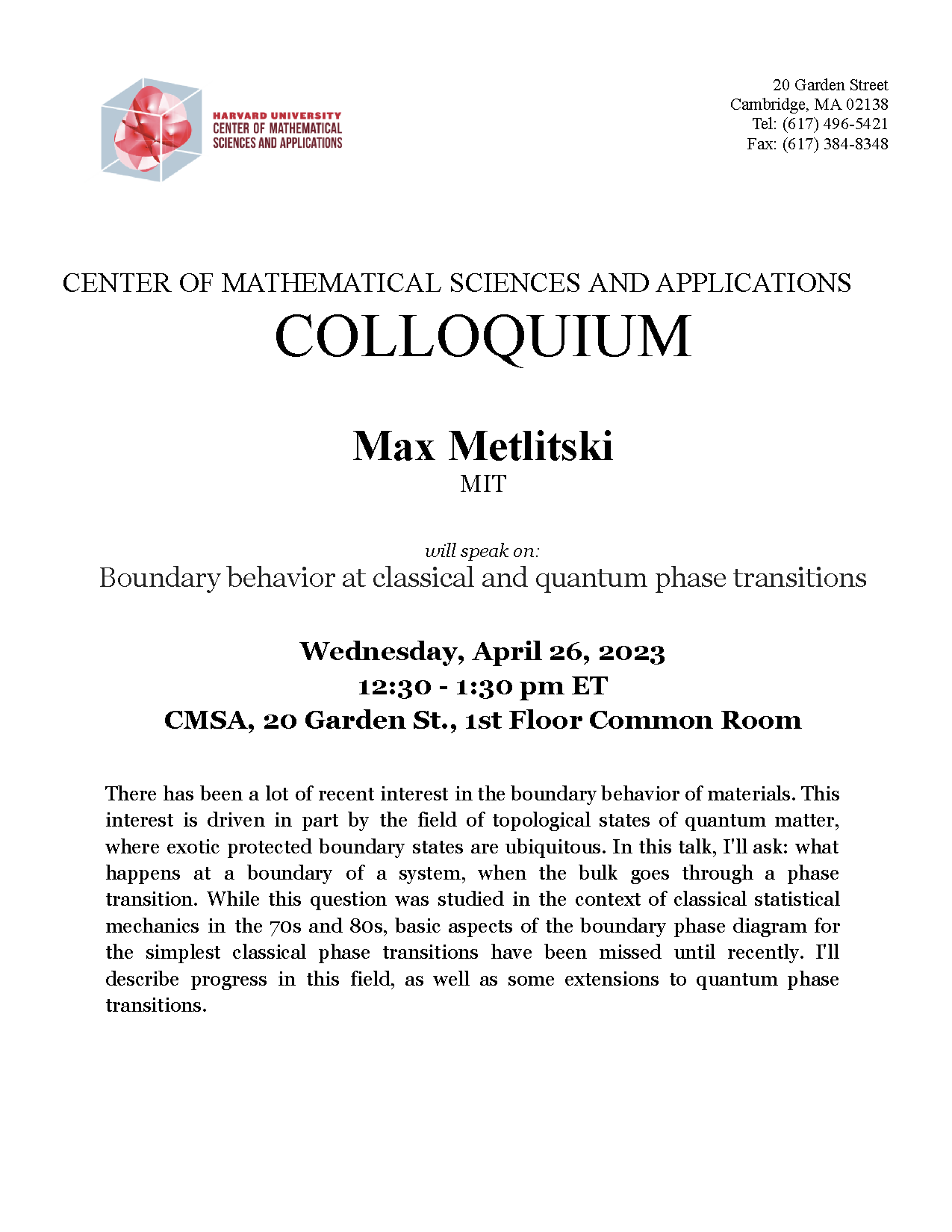
  • Boundary behavior at classical and quantum phase transitions

    CMSA Room G10 CMSA, 20 Garden Street, Cambridge, MA, United States

    Speaker: Max Metlitski (MIT) Title: Boundary behavior at classical and quantum phase transitions Abstract: There has been a lot of recent interest in the boundary behavior of materials. This interest is driven in part by the field of topological states of quantum matter, where exotic protected boundary states are ubiquitous. In this talk, I'll ask: what happens […]

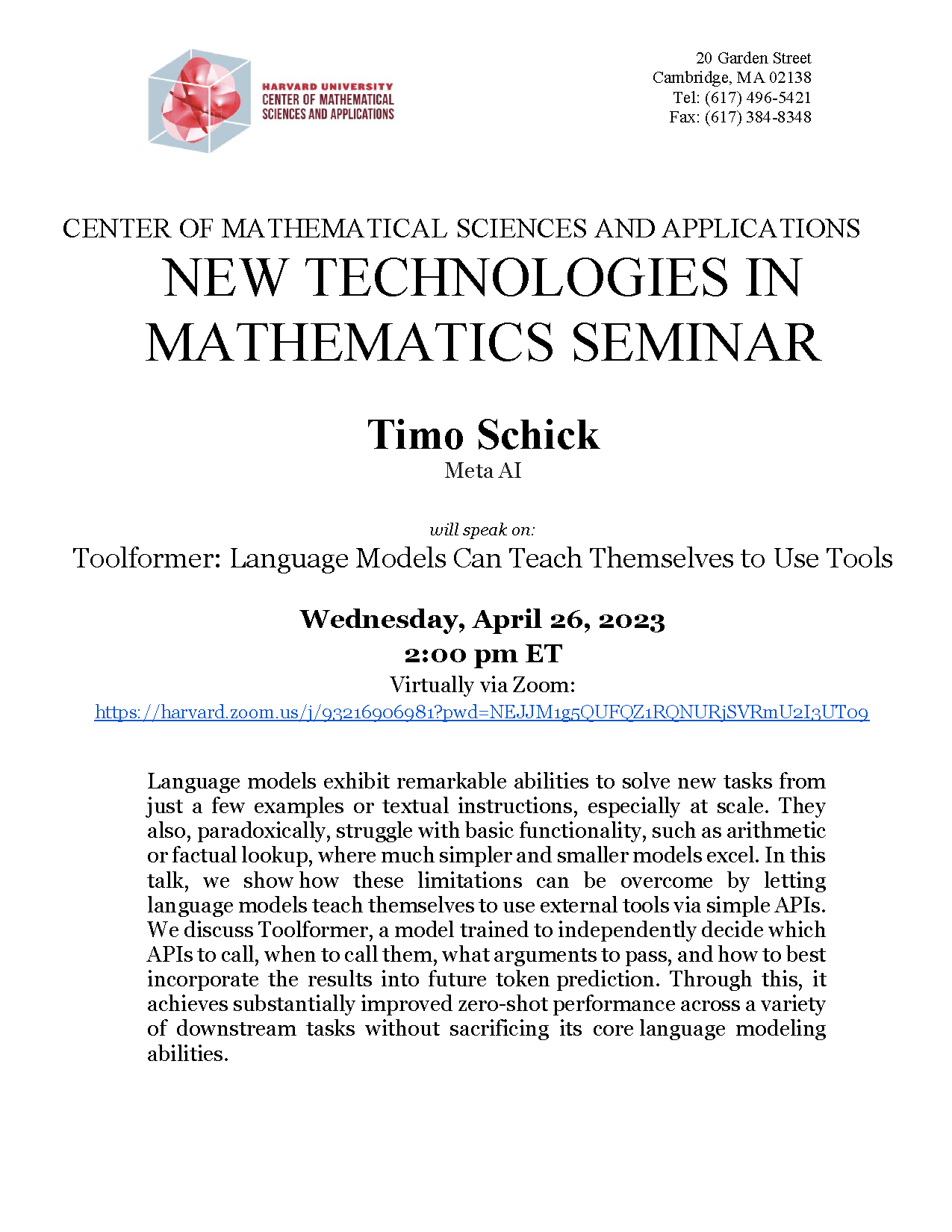
  • Toolformer: Language Models Can Teach Themselves to Use Tools

    Virtual

    https://youtu.be/UID_oXuN-0Y New Technologies in Mathematics Seminar Speaker: Timo Schick, Meta AI Title: Toolformer: Language Models Can Teach Themselves to Use Tools Abstract: Language models exhibit remarkable abilities to solve new tasks from just a few examples or textual instructions, especially at scale. They also, paradoxically, struggle with basic functionality, such as arithmetic or factual lookup, where […]

  • Toroidal Positive Mass Theorem

    CMSA Room G10 CMSA, 20 Garden Street, Cambridge, MA, United States

    Member Seminar Speaker: Aghil Alaee Title: Toroidal Positive Mass Theorem Abstract: In this talk, we review the positive mass conjecture in general relativity and prove a toroidal version of this conjecture in an asymptotically hyperbolic setting.

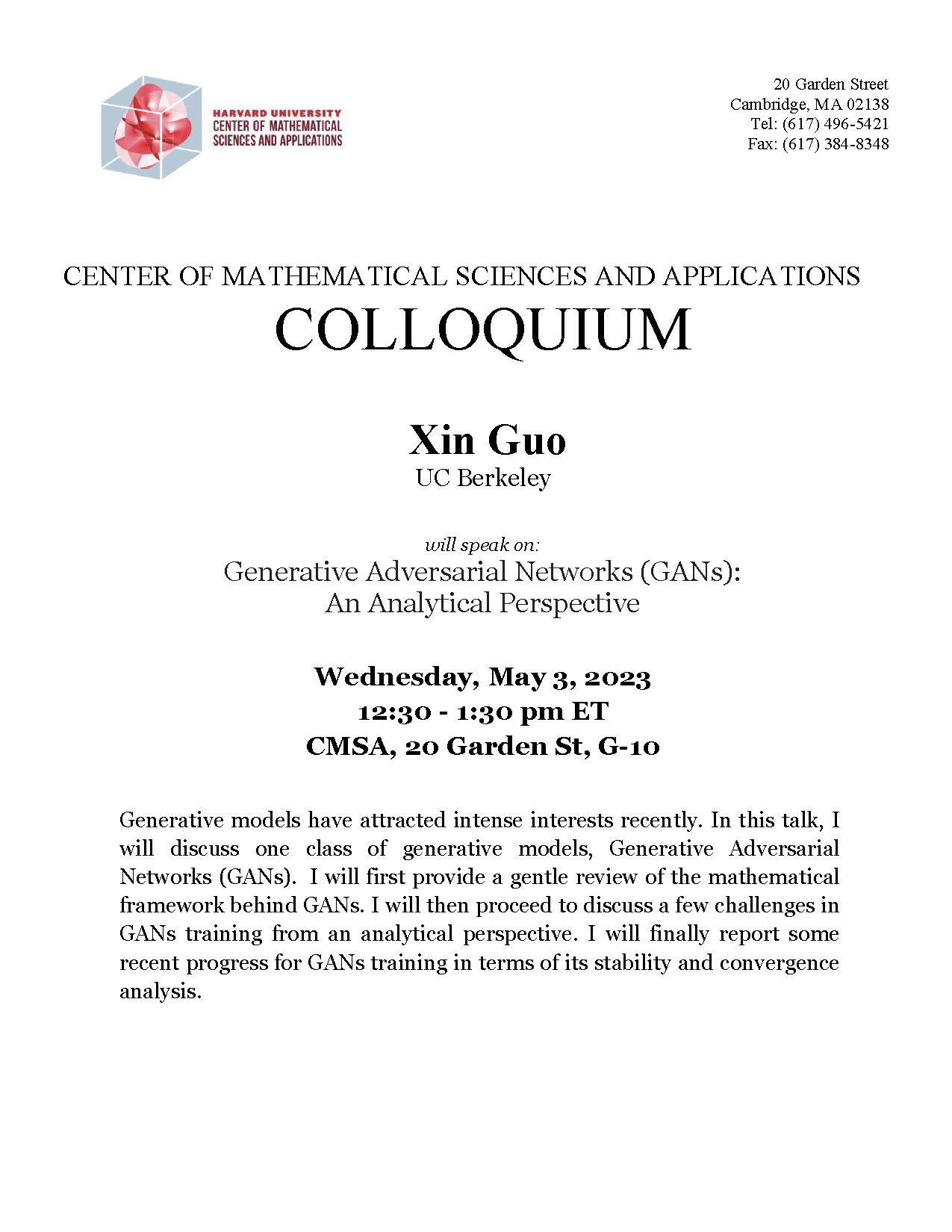
  • Generative Adversarial Networks (GANs): An Analytical Perspective

    CMSA Room G10 CMSA, 20 Garden Street, Cambridge, MA, United States

    Speaker: Xin Guo, UC Berkeley Title: Generative Adversarial Networks (GANs): An Analytical Perspective Abstract: Generative models have attracted intense interests recently. In this talk, I will discuss one class of generative models, Generative Adversarial Networks (GANs).  I will first provide a gentle review of the mathematical framework behind GANs. I will then proceed to discuss a few […]

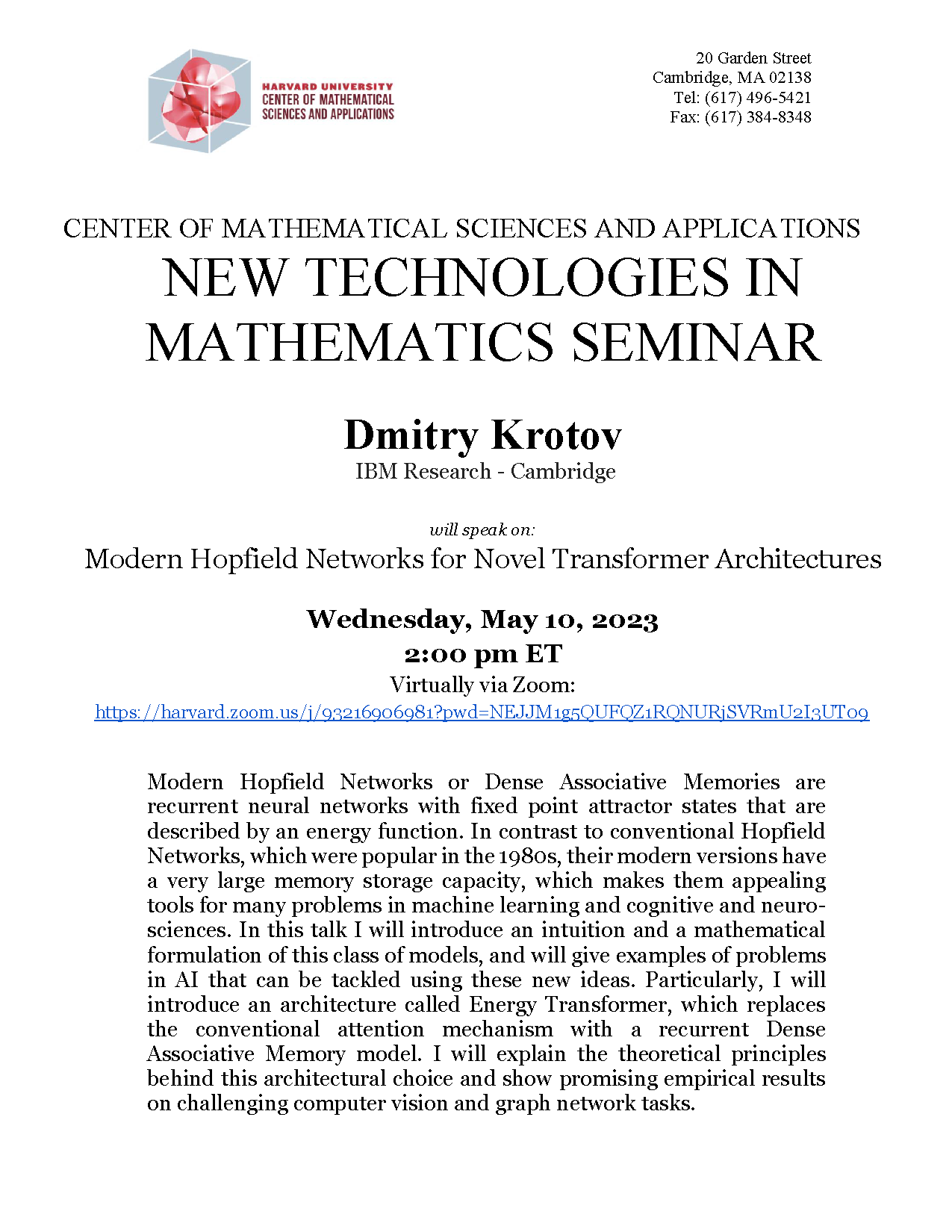
  • Modern Hopfield Networks for Novel Transformer Architectures

    Virtual

    https://youtu.be/5LXiQUsnHrI New Technologies in Mathematics Seminar Speaker: Dmitry Krotov, IBM Research - Cambridge Title: Modern Hopfield Networks for Novel Transformer Architectures Abstract: Modern Hopfield Networks or Dense Associative Memories are recurrent neural networks with fixed point attractor states that are described by an energy function. In contrast to conventional Hopfield Networks, which were popular in […]

  • Quantum information and extended topological quantum field theory 

    CMSA Room G10 CMSA, 20 Garden Street, Cambridge, MA, United States

    Member Seminar Speaker: Gabriel Wong Title: Quantum information and extended topological quantum field theory Abstract: Recently, ideas from quantum information theory have played an important role in condensed matter and quantum gravity research. Most of these applications focus on the entanglement structure of quantum states, and the computation of entanglement measures such as entanglement entropy has […]