
Colloquia & Seminar
Events
Calendar of Events
|
Monday
|
Tuesday
|
Wednesday
|
Thursday
|
Friday
|
Saturday
|
Sunday
|
|---|---|---|---|---|---|---|
|
0 events,
|
0 events,
|
1 event, |
0 events,
|
0 events,
|
0 events,
|
|
|
0 events,
|
3 events,
-
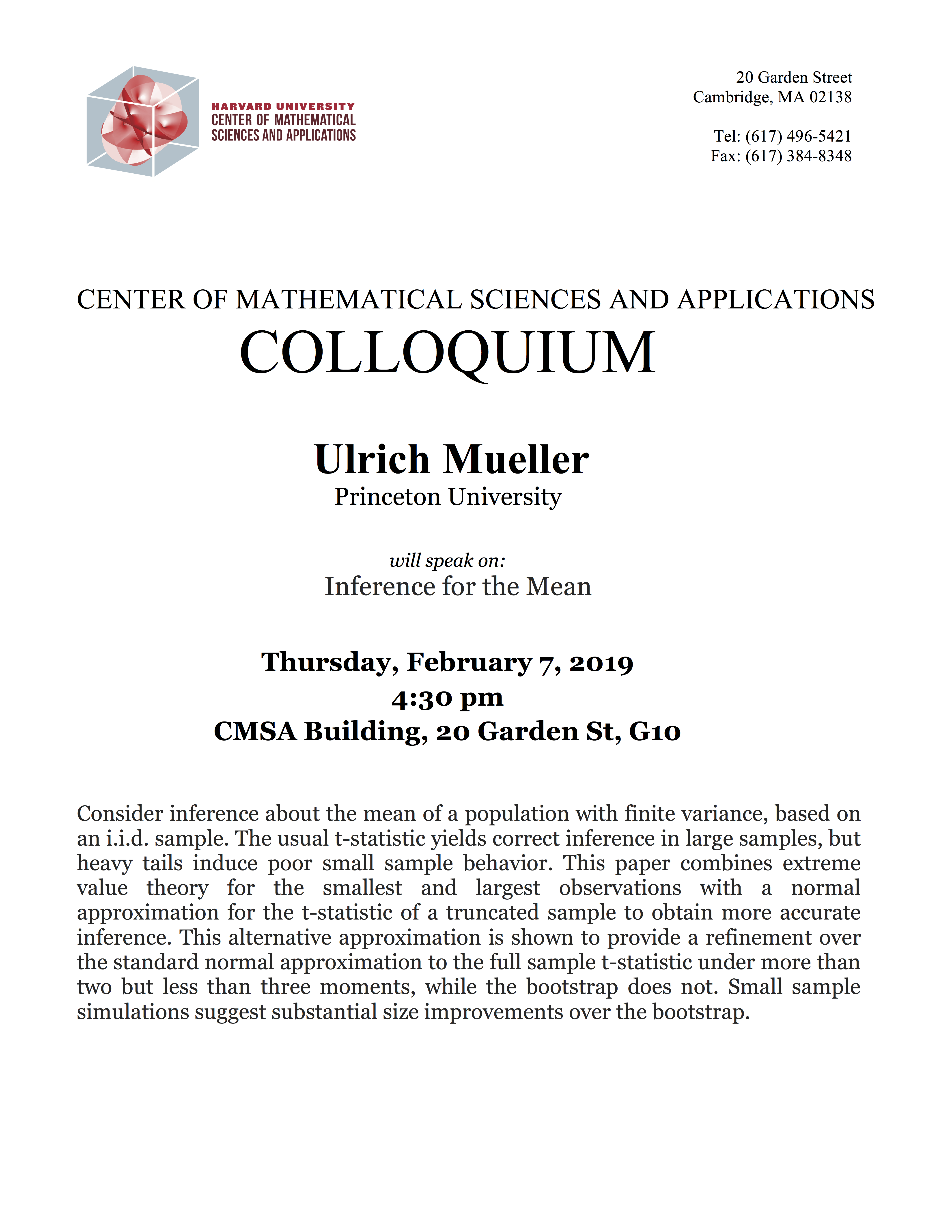
Speaker: Ulrich Mueller (Princeton) Title: Inference for the Mean Abstract: Consider inference about the mean of a population with finite variance, based on an i.i.d. sample. The usual t-statistic yields correct inference in large samples, but heavy tails induce poor small sample behavior. This paper combines extreme value theory for the smallest and largest observations with a normal approximation for […] |
0 events,
|
0 events,
|
0 events,
|
||
|
0 events,
|
0 events,
|
0 events,
|
0 events,
|
|||
|
0 events,
|
0 events,
|
2 events,
-
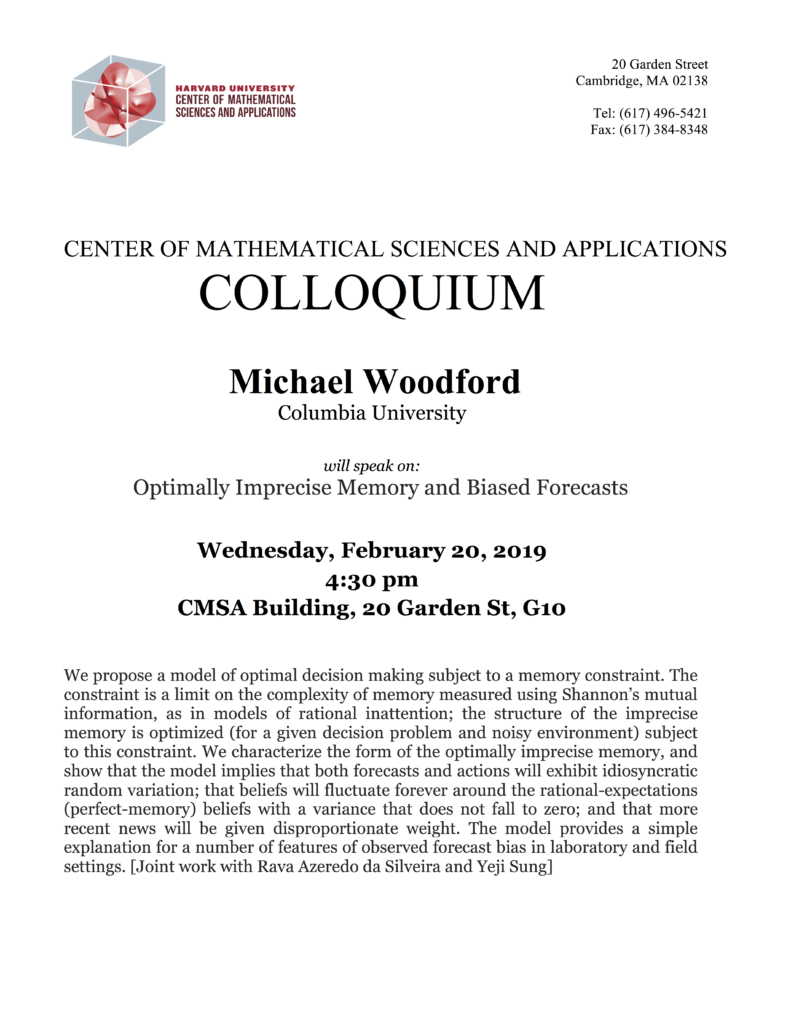
Speaker: Michael Woodford (Columbia) Title: Optimally Imprecise Memory and Biased Forecasts Abstract: We propose a model of optimal decision making subject to a memory constraint. The constraint is a limit on the complexity of memory measured using Shannon’s mutual information, as in models of rational inattention; the structure of the imprecise memory is optimized (for a given decision problem and […] |
0 events,
|
0 events,
|
||
|
0 events,
|
1 event,
-
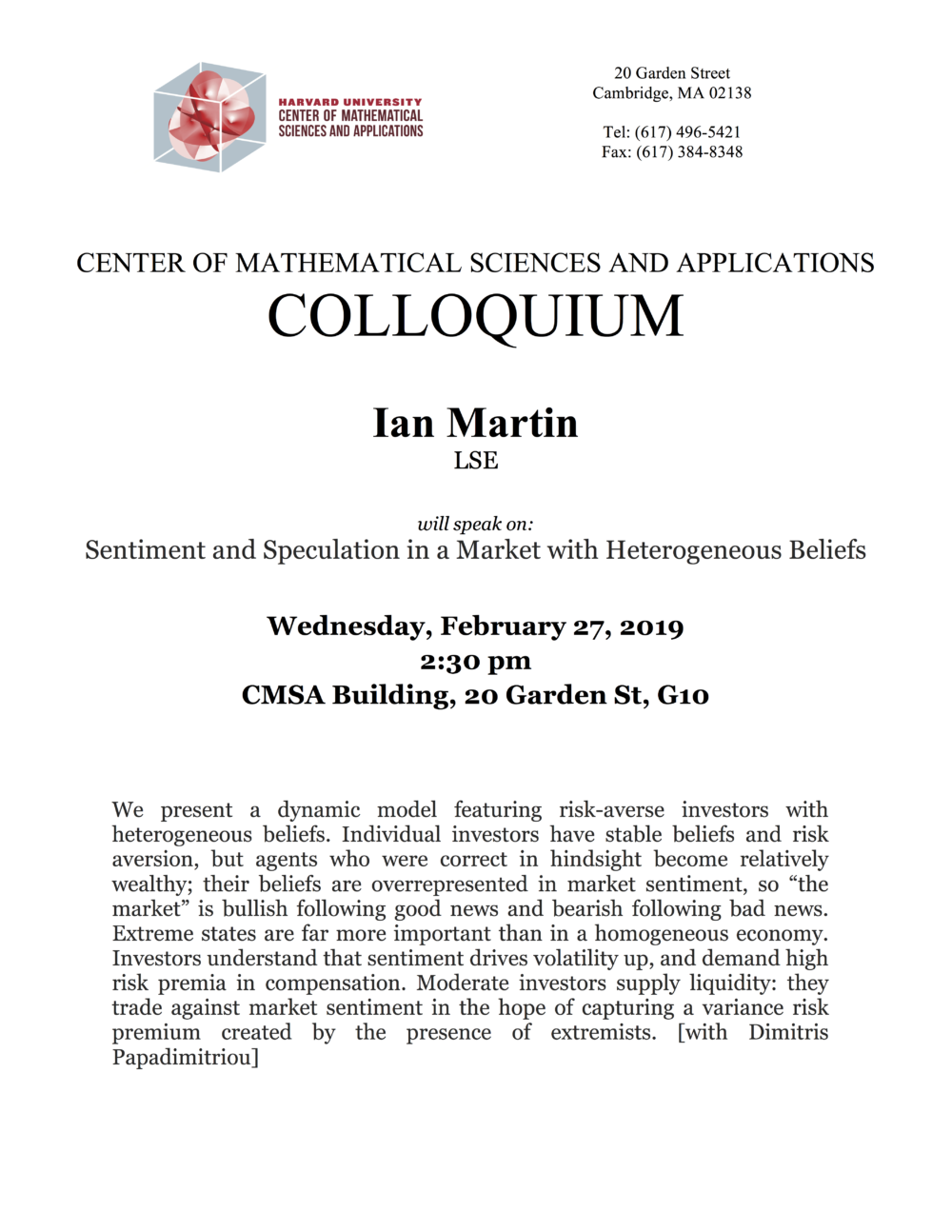
Speaker: Ian Martin (LSE) Title: Sentiment and Speculation in a Market with Heterogeneous Beliefs Abstract: We present a dynamic model featuring risk-averse investors with heterogeneous beliefs. Individual investors have stable beliefs and risk aversion, but agents who were correct in hindsight become relatively wealthy; their beliefs are overrepresented in market sentiment, so “the market” is bullish following good news and […] |
1 event,
-
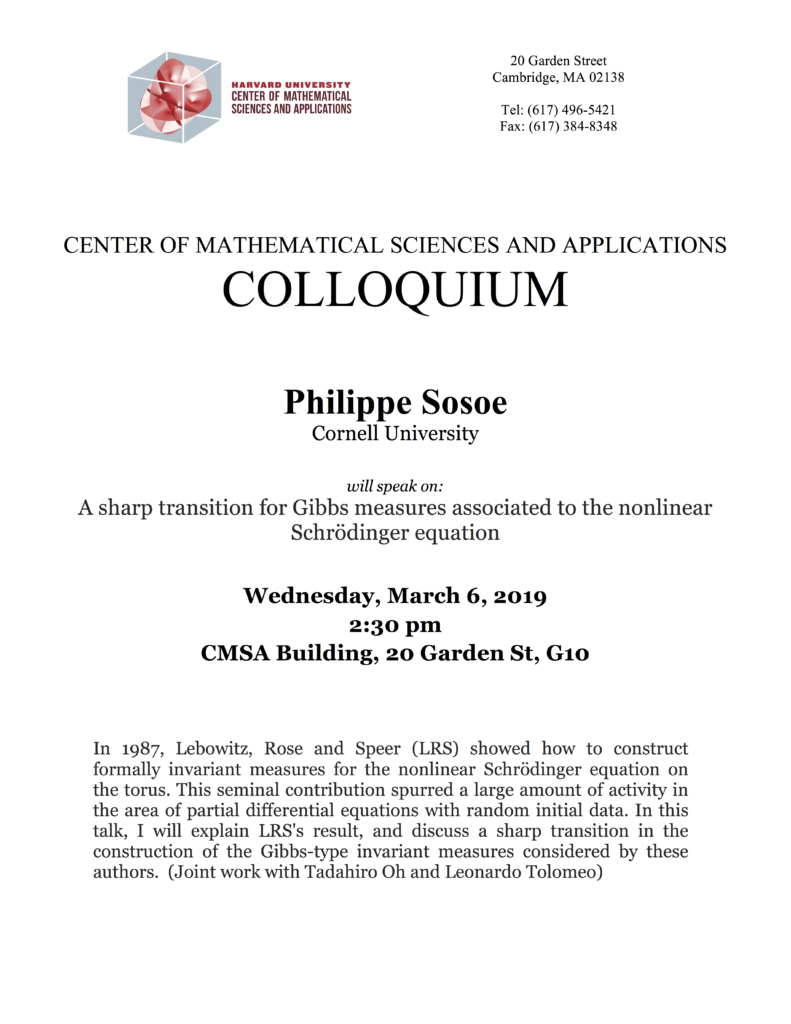
Speaker: Philippe Sosoe (Cornell) Title: A sharp transition for Gibbs measures associated to the nonlinear Schrödinger equation Abstract: In 1987, Lebowitz, Rose and Speer (LRS) showed how to construct formally invariant measures for the nonlinear Schrödinger equation on the torus. This seminal contribution spurred a large amount of activity in the area of partial differential equations […] |
0 events,
|
0 events,
|
0 events,
|