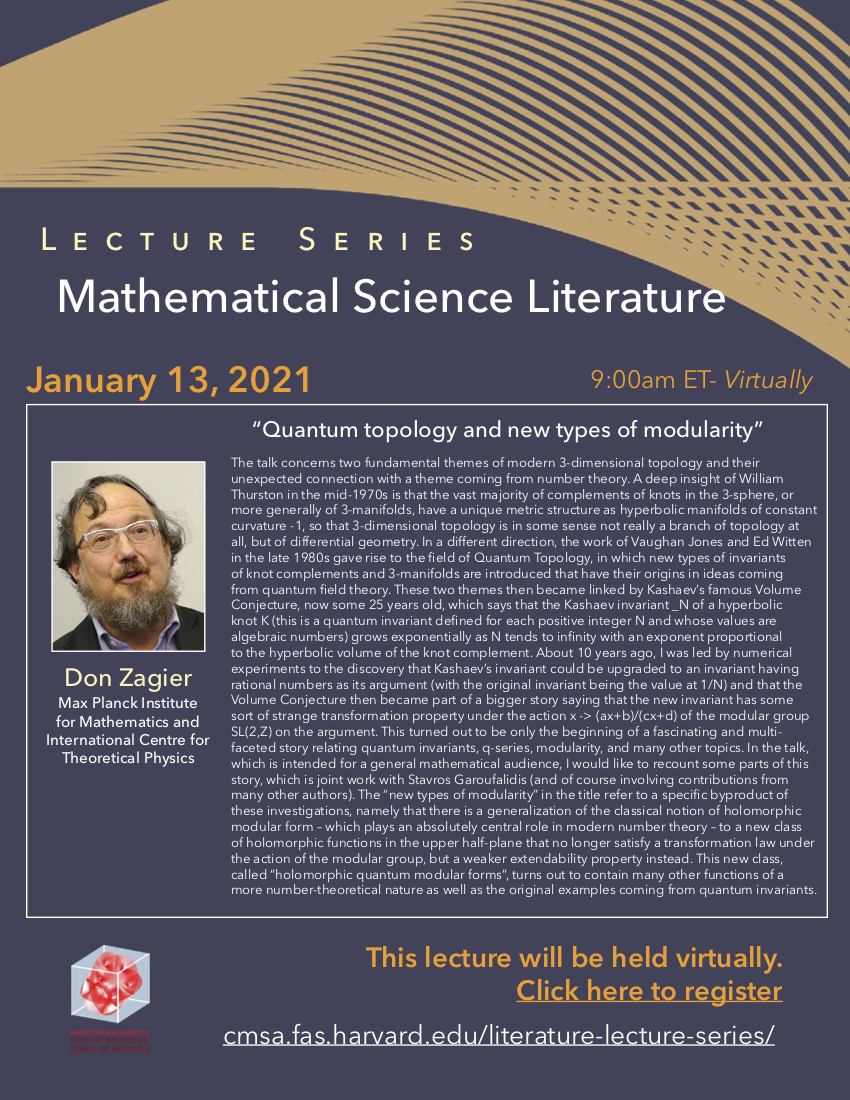
• CMSA Math-Science Literature Lecture: Quantum topology and new types of modularity

    Virtual

    Don Zagier (Max Planck Institute for Mathematics and International Centre for Theoretical Physics) Title: Quantum topology and new types of modularity Abstract: The talk concerns two fundamental themes of modern 3-dimensional topology and their unexpected connection with a theme coming from number theory. A deep insight of William Thurston in the mid-1970s is that the […]
  • A universal triangulation for flat tori

    Virtual

    Speaker:Francis Lazarus, CNRS / Grenoble University Title: A universal triangulation for flat tori Abstract: A celebrated theorem of Nash completed by Kuiper implies that every smooth Riemannian surface has a C¹ isometric embedding in the Euclidean 3-space E³. An analogous result, due to Burago and Zalgaller, states that every polyhedral surface, obtained by gluing Euclidean […]

  • Machine learning and su(3) structures on six manifolds

    Virtual

    Speaker: James Gray - Virginia Tech Title: Machine learning and su(3) structures on six manifolds Abstract: In this talk we will discuss the application of Machine Learning techniques to obtain numerical approximations to various metrics of SU(3) structure on six manifolds. More precisely, we will be interested in SU(3) structures whose torsion classes make them suitable […]

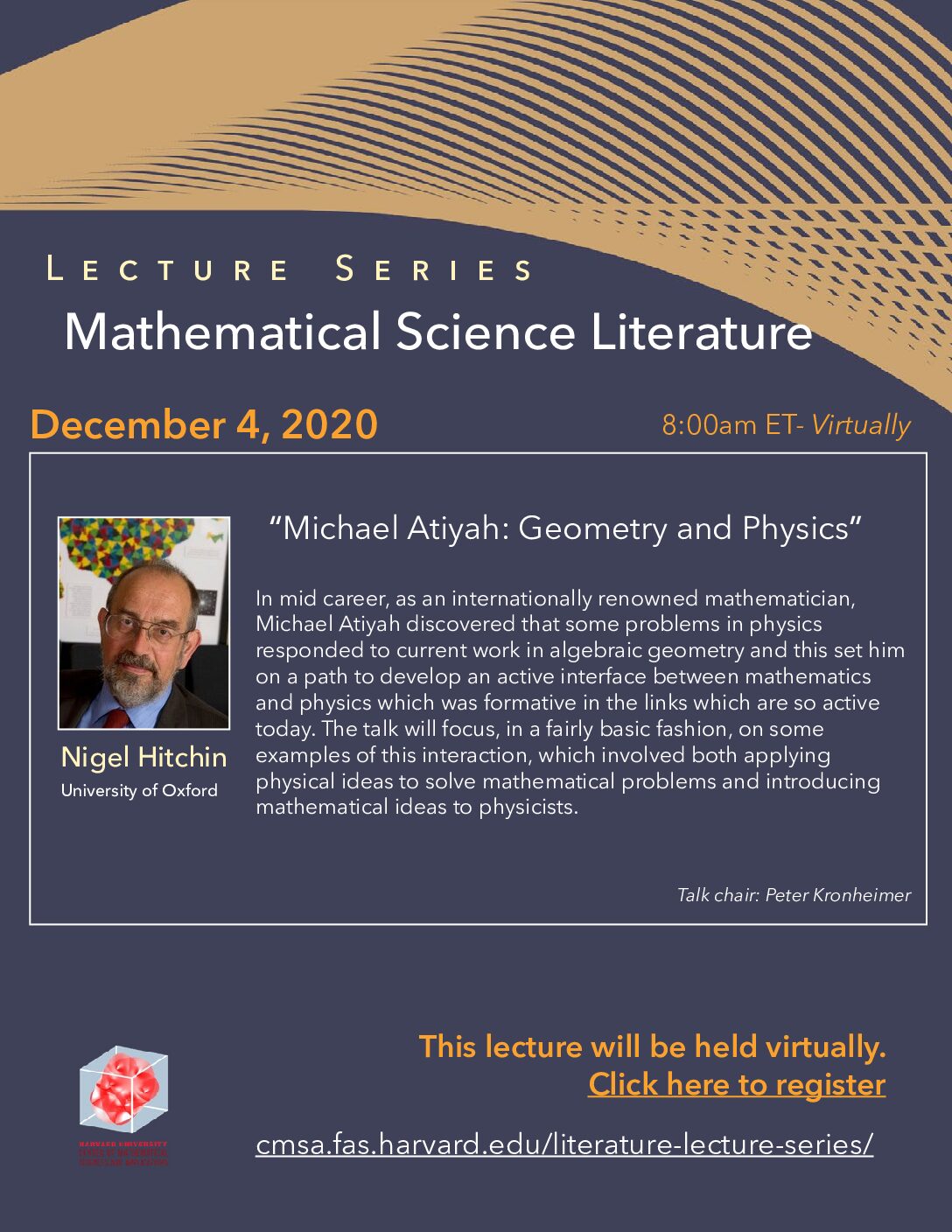
  • CMSA Math-Science Literature Lecture: Michael Atiyah: Geometry and Physics

    Virtual

    Nigel Hitchin (University of Oxford) Title: Michael Atiyah: Geometry and Physics Abstract: In mid-career, as an internationally renowned mathematician, Michael Atiyah discovered that some problems in physics responded to current work in algebraic geometry and this set him on a path to develop an active interface between mathematics and physics which was formative in the links […]

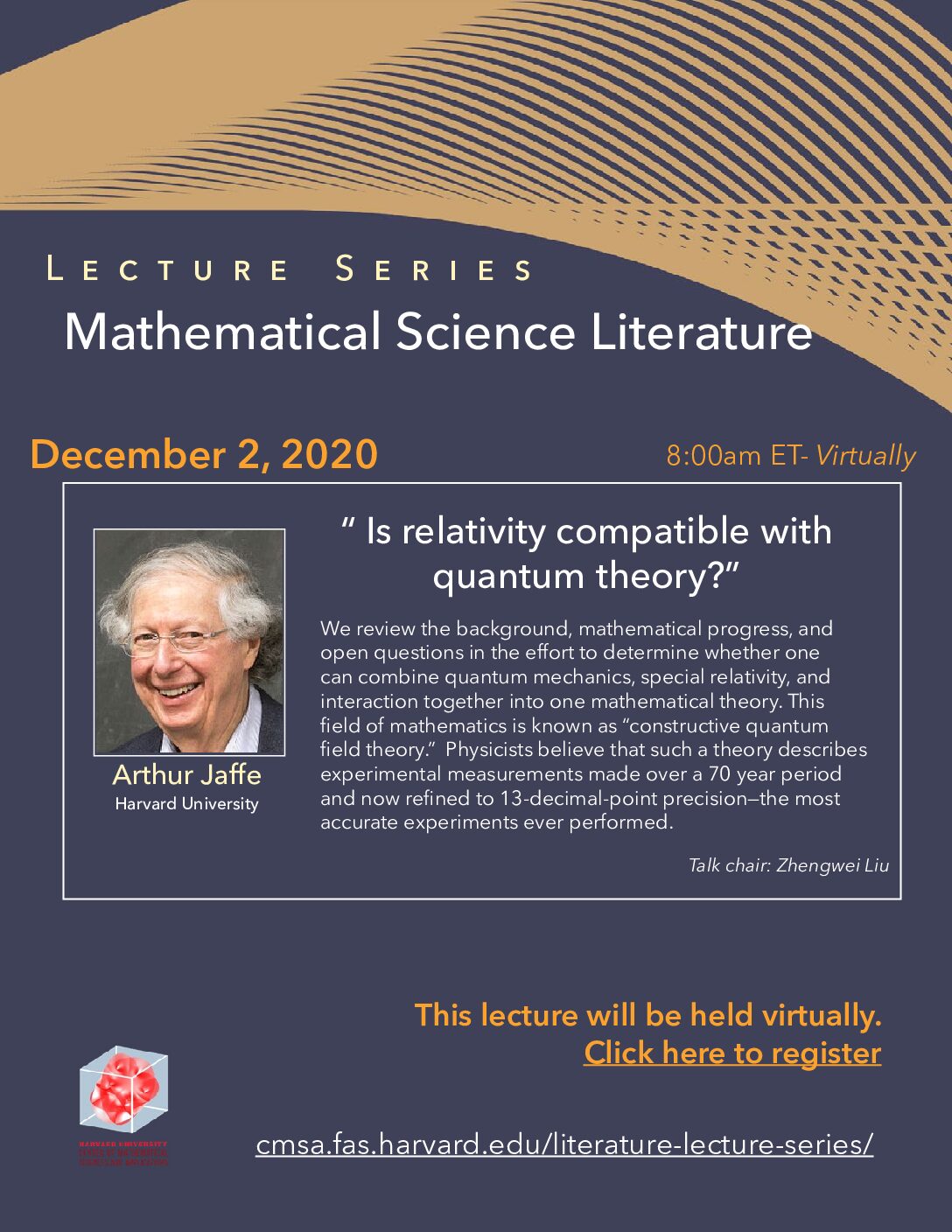
  • CMSA Math-Science Literature Lecture: Is relativity compatible with quantum theory?

    Virtual

    Arthur Jaffe (Harvard University) Title: Is relativity compatible with quantum theory? Abstract: We review the background, mathematical progress, and open questions in the effort to determine whether one can combine quantum mechanics, special relativity, and interaction together into one mathematical theory. This field of mathematics is known as “constructive quantum field theory.”  Physicists believe that such […]

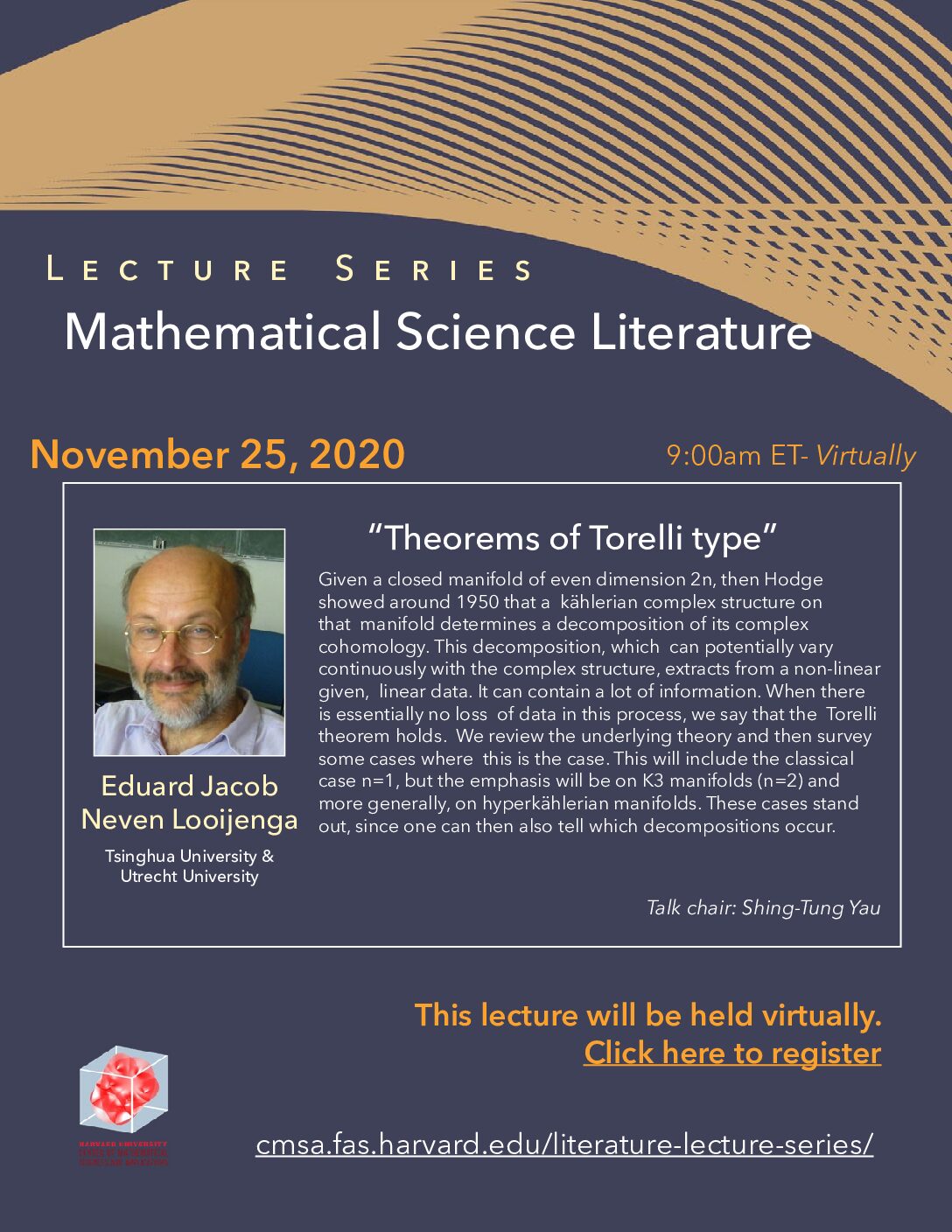
  • CMSA Math-Science Literature Lecture: Theorems of Torelli type

    Virtual

    Eduard Jacob Neven Looijenga (Tsinghua University & Utrecht University) Title: Theorems of Torelli type Abstract: Given a closed manifold of even dimension 2n, then Hodge showed around 1950 that a  kählerian complex structure on that manifold determines a decomposition of its complex cohomology. This decomposition, which can potentially vary continuously with the complex structure, extracts from a […]

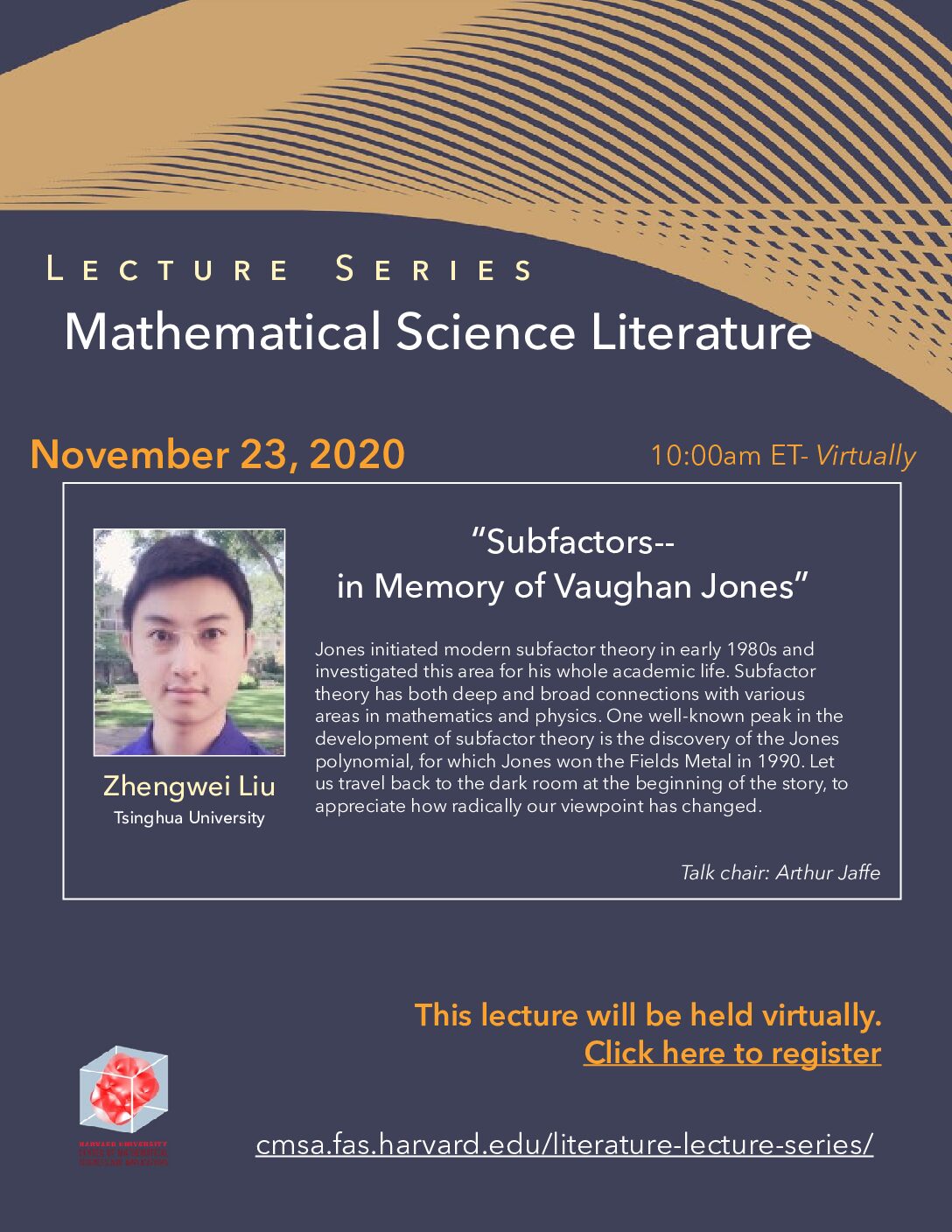
  • CMSA Math-Science Literature Lecture: Subfactors–in Memory of Vaughan Jones

    Virtual

    Zhengwei Liu (Tsinghua University) Title: Subfactors–in Memory of Vaughan Jones Abstract: Jones initiated modern subfactor theory in the early 1980s and investigated this area for his whole academic life. Subfactor theory has both deep and broad connections with various areas in mathematics and physics. One well-known peak in the development of subfactor theory is the discovery […]

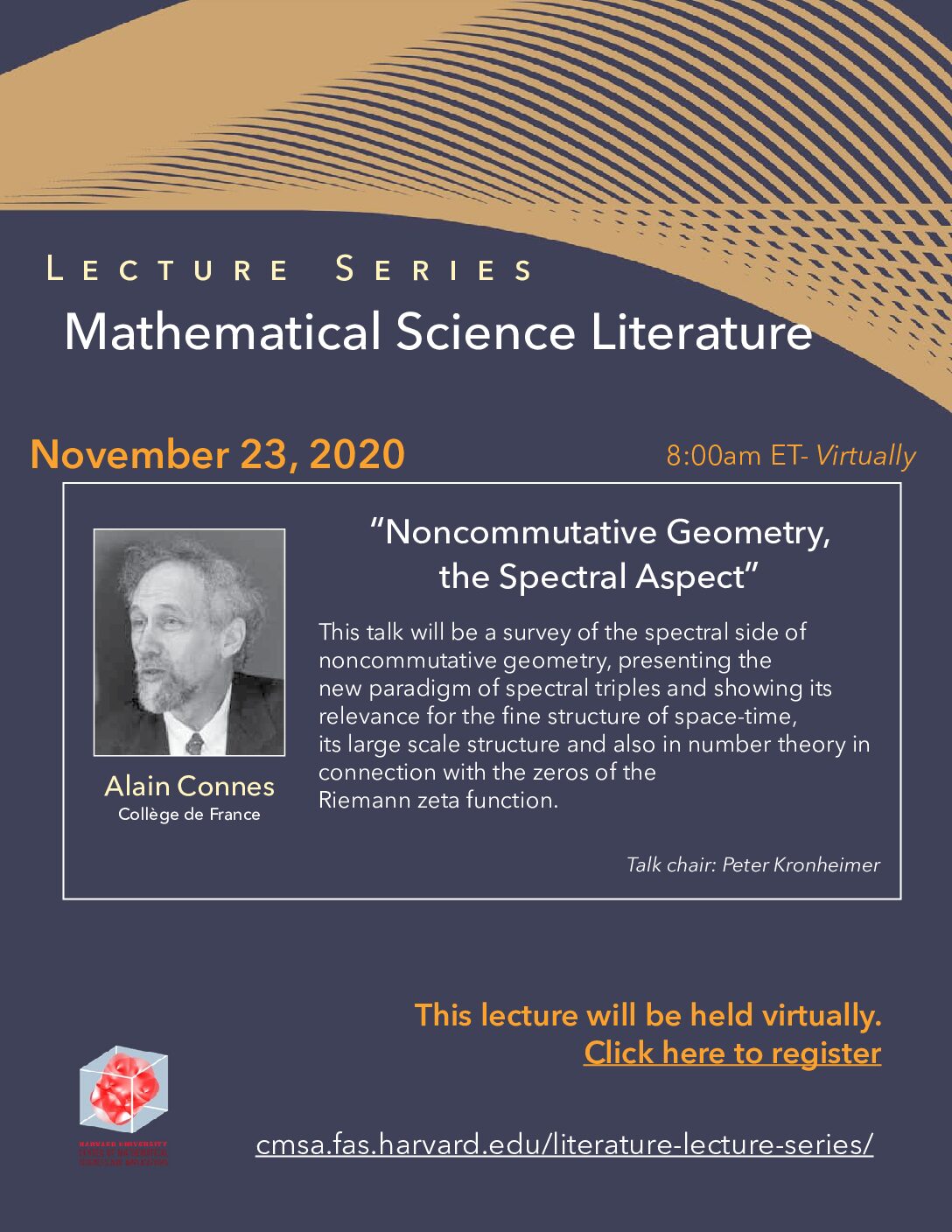
  • CMSA Math-Science Literature Lecture: Noncommutative Geometry, the Spectral Aspect

    Virtual

    Alain Connes (Collège de France) Title: Noncommutative Geometry, the Spectral Aspect Abstract: This talk will be a survey of the spectral side of noncommutative geometry, presenting the new paradigm of spectral triples and showing its relevance for the fine structure of space-time, its large scale structure and also in number theory in connection with the zeros […]

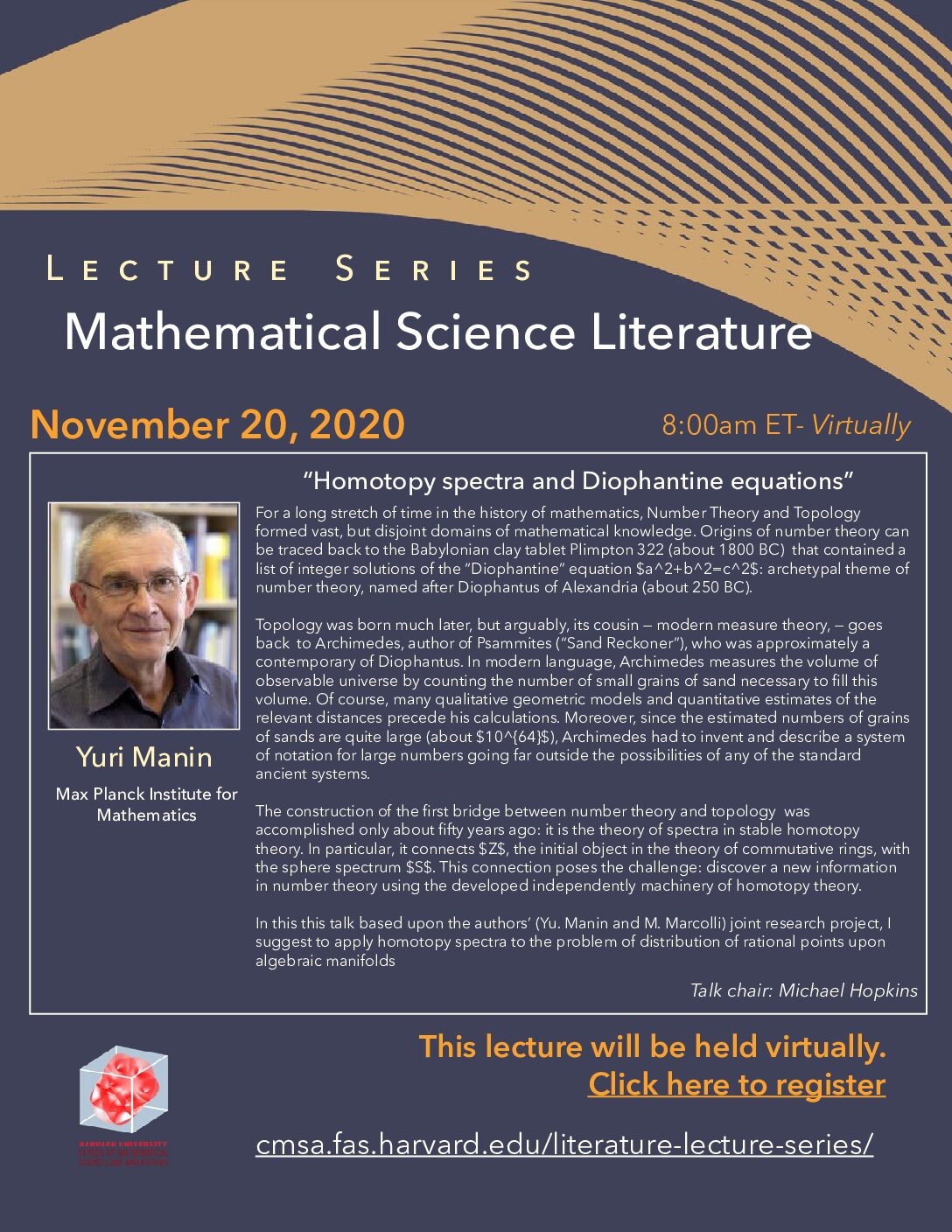
  • CMSA Math-Science Literature Lecture: Homotopy spectra and Diophantine equations

    Virtual

    Yuri Manin (Max Planck Institute for Mathematics) Title: Homotopy spectra and Diophantine equations Abstract: For a long stretch of time in the history of mathematics, Number Theory and Topology formed vast, but disjoint domains of mathematical knowledge. Origins of number theory can be traced back to the Babylonian clay tablet Plimpton 322 (about 1800 BC)  that […]

  • Universes as Big Data, or Machine-Learning Mathematical Structures

    Virtual

    https://youtu.be/zj_Xc2QG-vw Speaker: Yang-Hui He, Oxford University, City University of London and Nankai University Title: Universes as Big Data, or Machine-Learning Mathematical Structures Abstract: We review how historically the problem of string phenomenology lead theoretical physics first to algebraic/differetial geometry, and then to computational geometry, and now to data science and AI. With the concrete playground […]

  • Re-pricing avalanches

    Virtual

    Speaker: Jose A. Scheinkman (Columbia) Title: Re-pricing avalanches Abstract: Monthly aggregate price changes exhibit chronic fluctuations but the aggregate shocks that drive these fluctuations are often elusive.  Macroeconomic models often add stochastic macro-level shocks such as technology shocks or monetary policy shocks to produce these aggregate fluctuations. In this paper, we show that a state-dependent  pricing model with a large but […]