• CMSA Math-Science Literature Lecture – Karen Uhlenbeck

    Virtual

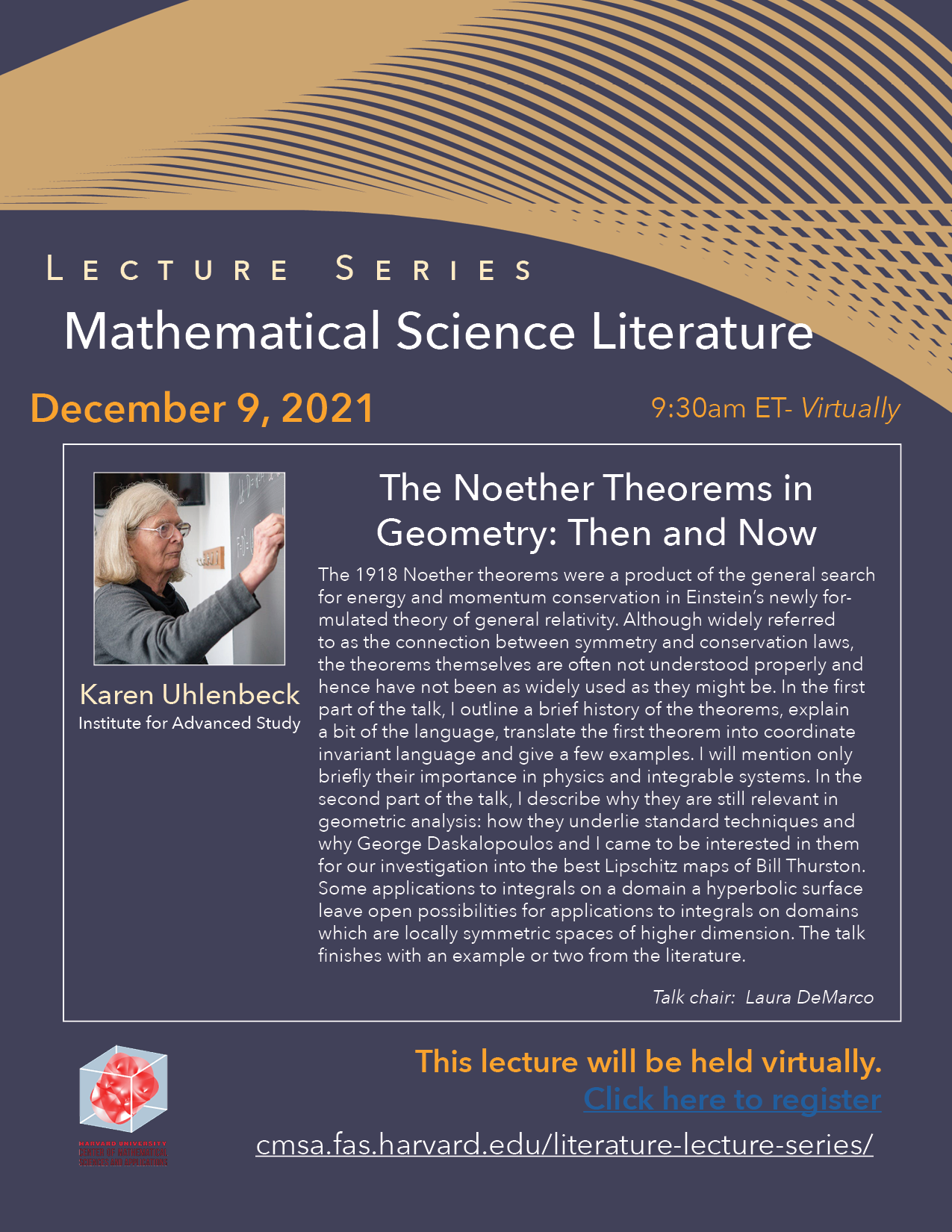
    Karen Uhlenbeck (Institute for Advanced Study) Title: The Noether Theorems in Geometry: Then and Now Abstract: The 1918 Noether theorems were a product of the general search for energy and momentum conservation in Einstein’s newly formulated theory of general relativity. Although widely referred to as the connection between symmetry and conservation laws, the theorems themselves […]
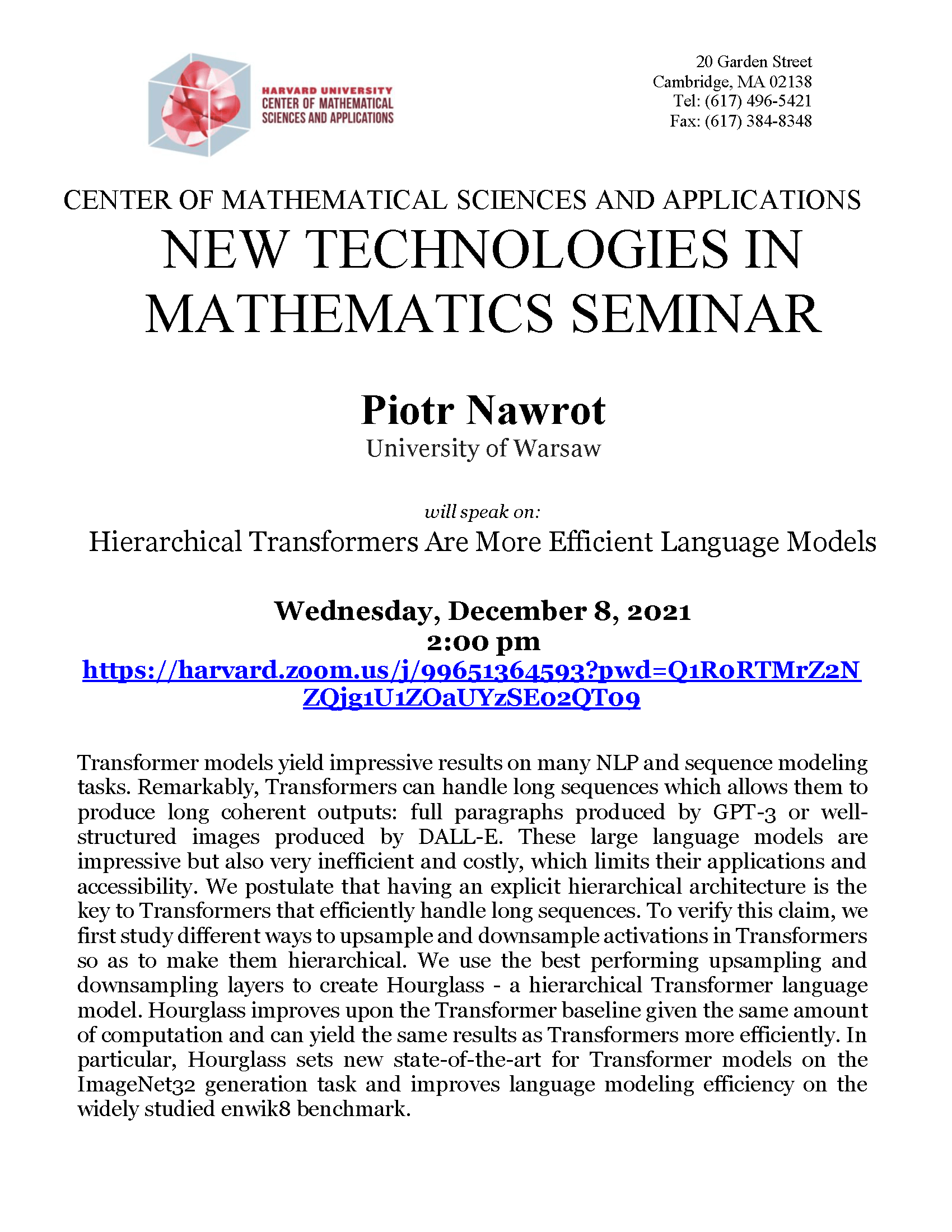
  • Hierarchical Transformers are More Efficient Language Models

    Virtual

    https://youtu.be/soqWNyrdjkw Speaker: Piotr Nawrot, University of Warsaw Title: Hierarchical Transformers are More Efficient Language Models Abstract: Transformer models yield impressive results on many NLP and sequence modeling tasks. Remarkably, Transformers can handle long sequences which allows them to produce long coherent outputs: full paragraphs produced by GPT-3 or well-structured images produced by DALL-E. These large language […]

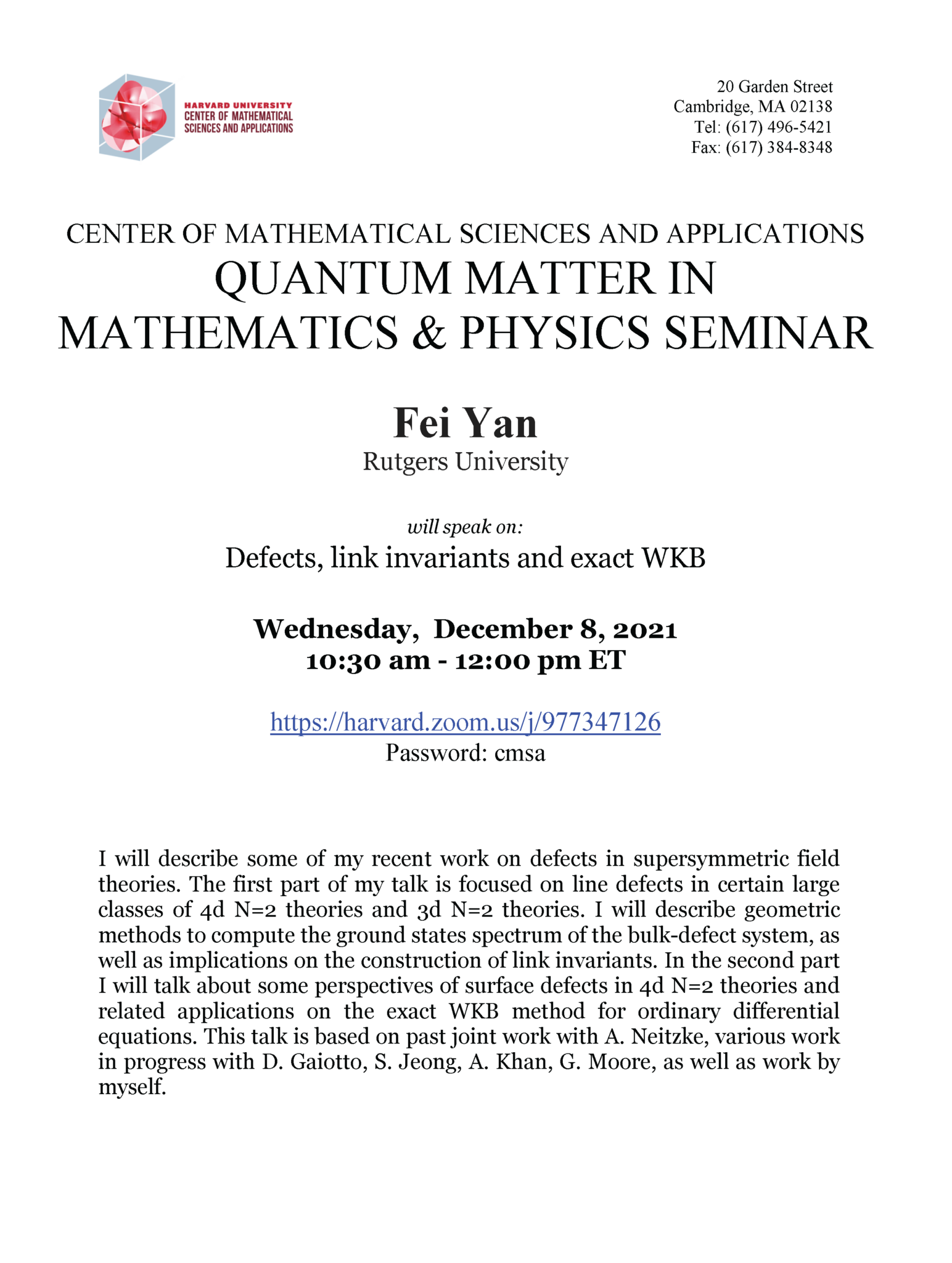
  • Defects, link invariants and exact WKB

    Virtual

    Speaker: Fei Yan (Rutgers) Title: Defects, link invariants and exact WKB Abstract: I will describe some of my recent work on defects in supersymmetric field theories. The first part of my talk is focused on line defects in certain large classes of 4d N=2 theories and 3d N=2 theories. I will describe geometric methods to compute the […]

  • The Principles of Deep Learning Theory

    Virtual

    https://youtu.be/wXZKoHEzASg Speaker: Dan Roberts, MIT & Salesforce Title: The Principles of Deep Learning Theory Abstract: Deep learning is an exciting approach to modern artificial intelligence based on artificial neural networks. The goal of this talk is to provide a blueprint — using tools from physics — for theoretically analyzing deep neural networks of practical relevance. This […]

  • Multipartitioning topological phases and quantum entanglement

    Virtual

    Speaker: Shinsei Ryu (Princeton University) Title: Multipartitioning topological phases and quantum entanglement Abstract: We discuss multipartitions of the gapped ground states of (2+1)-dimensional topological liquids into three (or more) spatial regions that are adjacent to each other and meet at points. By considering the reduced density matrix obtained by tracing over a subset of the regions, we […]

  • Exact Eigenstates in Non-Integrable Systems: A violation of the ETH

    Virtual

    Speaker: B. Andrei Bernevig (Princeton University) Title: Exact Eigenstates in Non-Integrable Systems: A violation of the ETH Abstract: We find that several non-integrable systems exhibit some exact eigenstates that span the energy spectrum from lowest to the highest state. In the AKLT Hamiltonian and in several others “special” non-integrable models, we are able to obtain the analytic […]

  • Quantum Geometric Aspects of Chiral Twisted Graphene Models

    Virtual

    Speaker: Jie Wang (Simons Foundation) Title: Quantum Geometric Aspects of Chiral Twisted Graphene Models Abstract: “Moire” materials produced by stacking monolayers with small relative twist angles are of intense current interest for the range of correlated electron phenomena they exhibit. The quench of the kinetic energy means that the interacting physics is controlled by the interplay between […]

  • Non-Invertible Duality Defects in 3+1 Dimensions

    Virtual

    Speaker: Clay Cordova (U Chicago) Title: Non-Invertible Duality Defects in 3+1 Dimensions Abstract:  For any quantum system invariant under gauging a higher-form global symmetry, we construct a non-invertible topological defect by gauging in only half of spacetime. This generalizes the Kramers-Wannier duality line in 1+1 dimensions to higher spacetime dimensions. We focus on the case of a […]

  • Anomaly resolution via decomposition

    Virtual

    Speaker: Eric Sharpe (Virginia Tech) Title: Anomaly resolution via decomposition Abstract: In this talk we will discuss a method of anomaly resolution due to Wang-Wen-Witten in the special case of (1+1) dimensional theories. Briefly, for our purposes, Wang-Wen-Witten argued that an ill-defined anomalous orbifold could be resolved by extending G to a larger group and […]