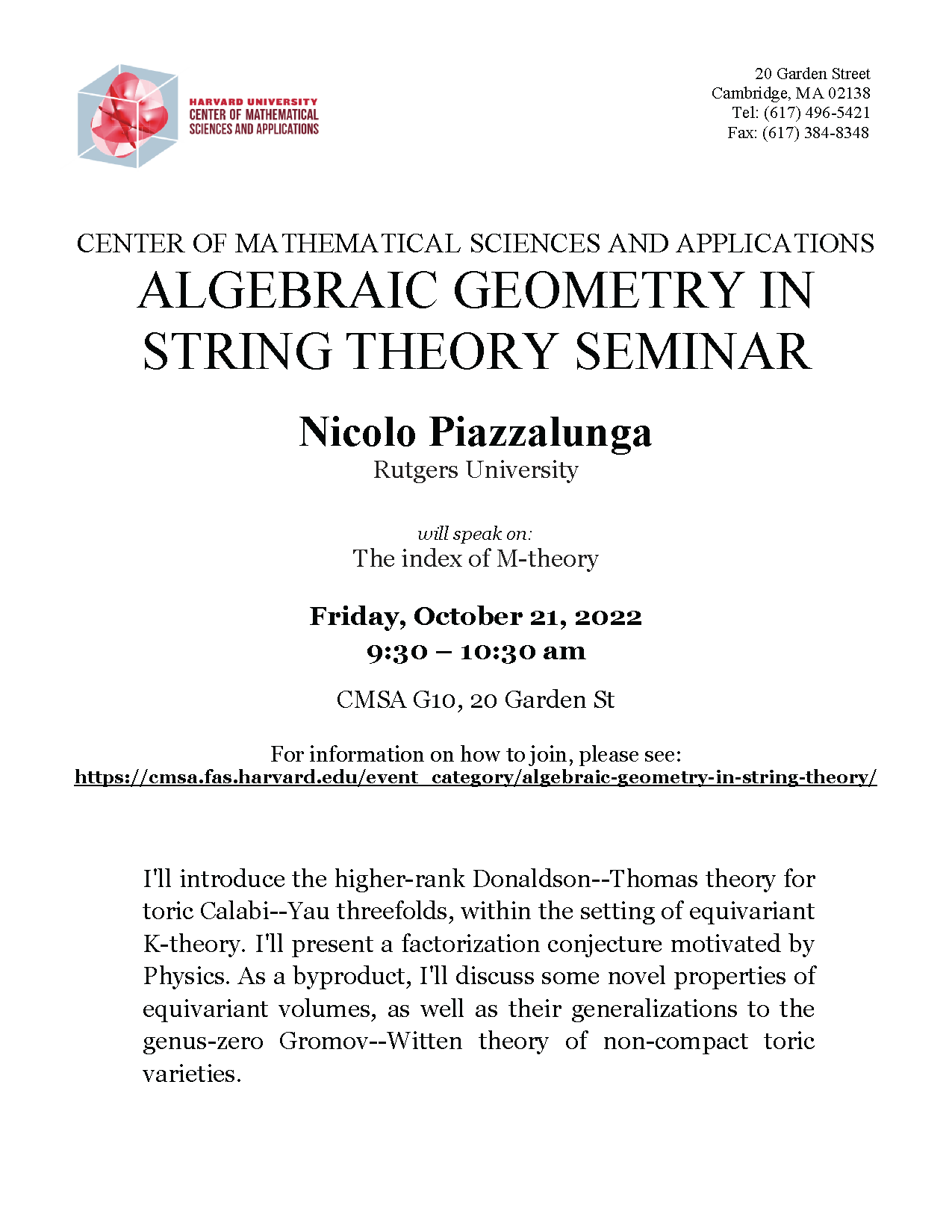
• Doping and inverting Mott insulators on semiconductor moire superlattices

    CMSA Room G10 CMSA, 20 Garden Street, Cambridge, MA, United States

    https://youtu.be/-NisBM-2a2I Speaker: Liang Fu (MIT) Title: Doping and inverting Mott insulators on semiconductor moire superlattices Abstract: Semiconductor bilayer heterostructures provide a remarkable platform for simulating Hubbard models on an emergent lattice defined by moire potential minima. As a hallmark of Hubbard model physics, the Mott insulator state with local magnetic moments has been observed at […]
  • Optical axion electrodynamics

    CMSA Room G10 CMSA, 20 Garden Street, Cambridge, MA, United States

    https://youtu.be/T1x60gYry4I Topological Quantum Matter Seminar Speaker: Junyeong Ahn (Harvard) Title: Optical axion electrodynamics Abstract: Electromagnetic fields in a magneto-electric medium behave in close analogy to photons coupled to the hypothetical elementary particle, the axion. This emergent axion electrodynamics is expected to provide novel ways to detect and control material properties with electromagnetic fields. Despite having […]

  • Some non-concave dynamic optimization problems in finance

    CMSA Room G10 CMSA, 20 Garden Street, Cambridge, MA, United States

    Member Seminar Speaker: Shuaijie Qian (Harvard CMSA) Title: Some non-concave dynamic optimization problems in finance Abstract: Non-concave dynamic optimization problems appear in many areas of finance and economics. Most of existing literature solves these problems using the concavification principle, and derives equivalent, concave optimization problems whose value functions are still concave. In this talk, I will present […]

  • 2-Categories and the Massive 3d A-Model

    CMSA Room G10 CMSA, 20 Garden Street, Cambridge, MA, United States

    Algebraic Geometry in String Theory Seminar Speaker: Ahsan Khan, IAS Title: 2-Categories and the Massive 3d A-Model Abstract: I will outline the construction of a 2-category associated to a hyperKahler moment map. The construction is based on partial differential equations in one, two, and three dimensions combined with a three-dimensional version of the Gaiotto-Moore-Witten web formalism. […]

  • From Engine to Auto

    CMSA Room G10 CMSA, 20 Garden Street, Cambridge, MA, United States

    https://youtu.be/h3jcSg359E8 New Technologies in Mathematics Seminar Speakers: João Araújo, Mathematics Department, Universidade Nova de Lisboa and Michael Kinyon, Department of Mathematics, University of Denver Title: From Engine to Auto Abstract: Bill McCune produced the program EQP that deals with first order logic formulas and in 1996 managed to solve Robbins' Conjecture. This very powerful tool reduces […]

  • Clique listing algorithms

    CMSA Room G10 CMSA, 20 Garden Street, Cambridge, MA, United States

    Speaker: Virginia Vassilevska Williams (MIT) Title: Clique listing algorithms Abstract: A k-clique in a graph G is a subgraph of G on k vertices in which every pair of vertices is linked by an edge. Cliques are a natural notion of social network cohesiveness with a long history. A fundamental question, with many applications, is […]

  • Kähler bands—Chern insulators, holomorphicity and induced quantum geometry

    CMSA Room G10 CMSA, 20 Garden Street, Cambridge, MA, United States

    https://youtu.be/2BF5q6d_Zo4 Topological Quantum Matter Seminar Speaker: Bruno Mera, Tohoku University Title: Kähler bands—Chern insulators, holomorphicity and induced quantum geometry Abstract: The notion of topological phases has dramatically changed our understanding of insulators. There is much to learn about a band insulator beyond the assertion that it has a gap separating the valence bands from the conduction […]

  • Anomalies of Discrete Gauge Symmetries and their Cancellation in 6D F-theory

    CMSA Room G10 CMSA, 20 Garden Street, Cambridge, MA, United States

    Swampland Seminar Speaker: Paul-Konstantin Oehlmann(Northeastern) Title: Anomalies of Discrete Gauge Symmetries and their Cancellation in 6D F-theory Abstract: We consider 6D SUGRAs with a discrete gauge group G, engineered via F-theory compactifications on genus-one fibered threefolds. We argue that group G suffers from Dai-Freed anomalies that can be canceled via a discrete Green-Schwarz mechanism. We comment […]

  • Explicit Ramsey Graphs and Two Source Extractors

    CMSA Room G10 CMSA, 20 Garden Street, Cambridge, MA, United States

    Speaker: David Zuckerman, Harvard CMSA/University of Texas at Austin Title: Explicit Ramsey Graphs and Two Source Extractors Abstract: Ramsey showed that any graph on N nodes contains a clique or independent set of size (log N)/2.  Erdos showed that there exist graphs on N nodes with no clique or independent set of size 2 log N, […]

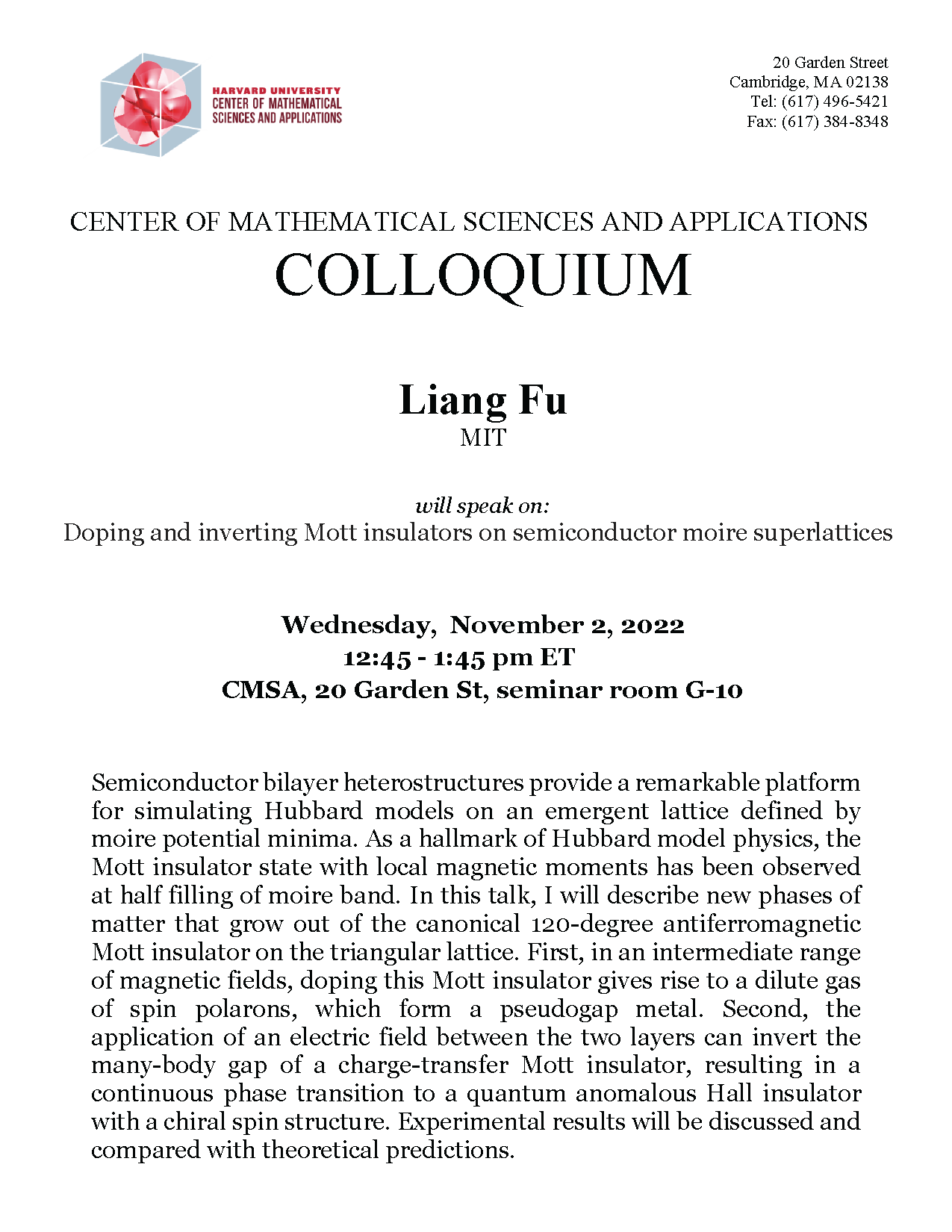
  • The index of M-theory

    CMSA Room G10 CMSA, 20 Garden Street, Cambridge, MA, United States

    Algebraic Geometry in String Theory Seminar Speaker: Nicolo Piazzalunga, Rutgers Title: The index of M-theory Abstract: I’ll introduce the higher-rank Donaldson-Thomas theory for toric Calabi-Yau threefolds, within the setting of equivariant K-theory. I’ll present a factorization conjecture motivated by Physics. As a byproduct, I’ll discuss some novel properties of equivariant volumes, as well as their generalizations to the […]

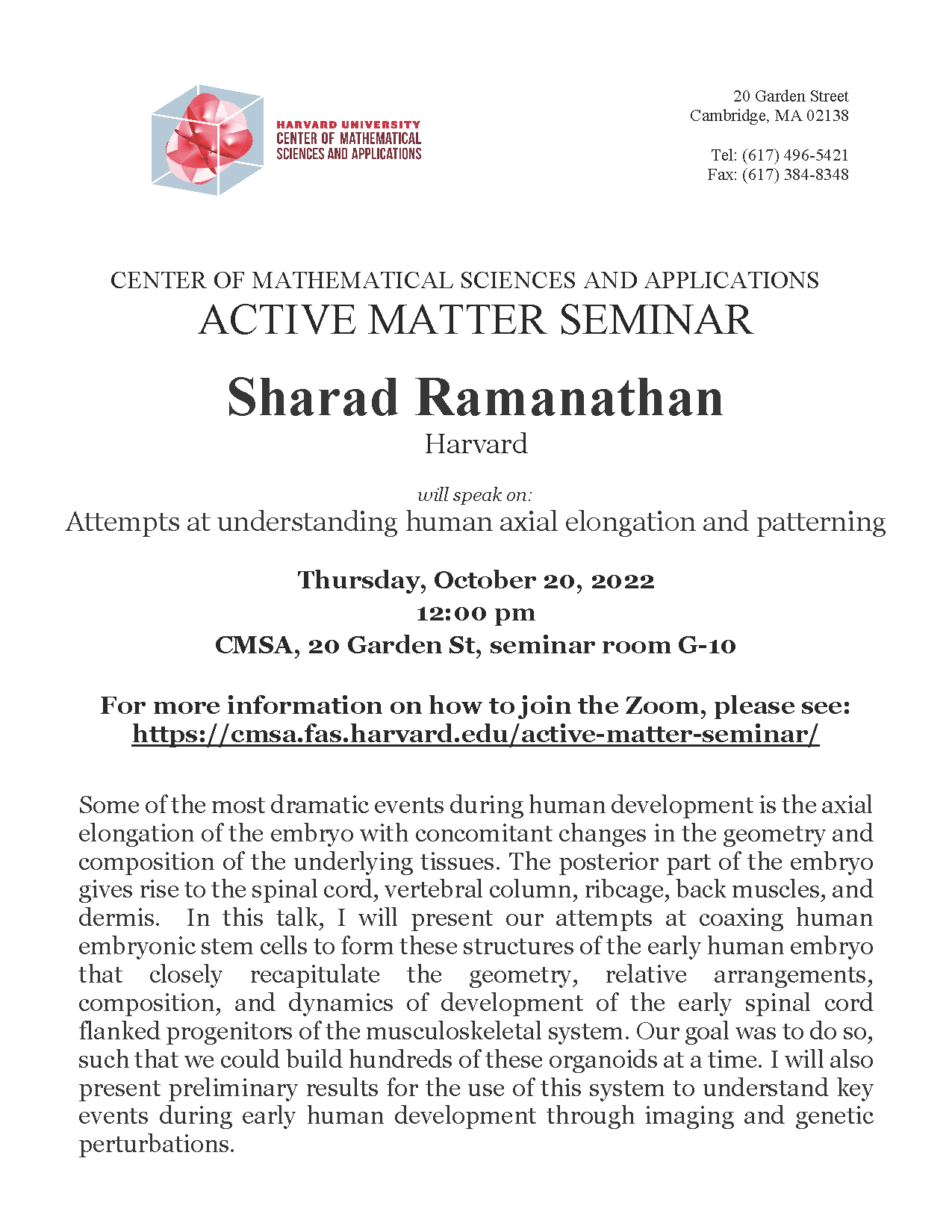
  • Attempts at understanding human axial elongation and patterning

    CMSA Room G10 CMSA, 20 Garden Street, Cambridge, MA, United States

    Active Matter Seminar Speaker: Sharad Ramanathan, Harvard Title: Attempts at understanding human axial elongation and patterning Abstract: Some of the most dramatic events during human development is the axial elongation of the embryo with concomitant changes in the geometry and composition of the underlying tissues. The posterior part of the embryo gives rise to the spinal cord, […]

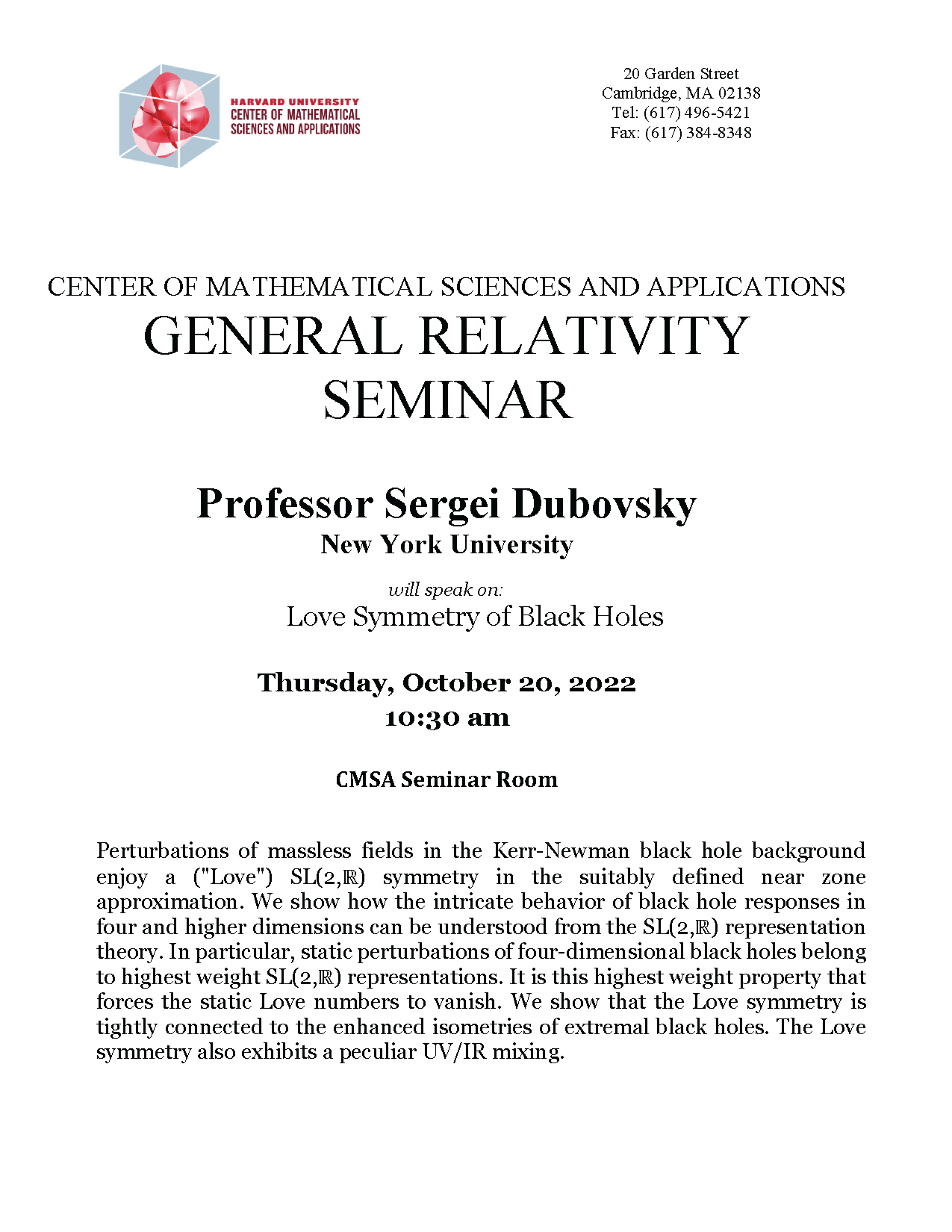
  • Love Symmetry of Black Holes

    CMSA Room G10 CMSA, 20 Garden Street, Cambridge, MA, United States

    https://youtu.be/tpmm618NjtE General Relativity Seminar Speaker: Sergei Dubovsky (New York University) Title: Love Symmetry of Black Holes Abstract: Perturbations of massless fields in the Kerr-Newman black hole background enjoy a ("Love") SL(2,ℝ) symmetry in the suitably defined near zone approximation. We show how the intricate behavior of black hole responses in four and higher dimensions can be […]