Quantum Field Theory and Physical Mathematics
Quantum Field Theory and Physical Mathematics Seminar

Quantum Field Theory and Physical Mathematics Seminar
Member Seminar Speaker: Han Shao, Harvard CMSA Title: Incentives for data sharing in federated learning Abstract: Federated learning has recently emerged as a powerful approach for enabling collaboration across large populations of learning agents. However, agents may have incentives to defect from the collaboration—that is, to withdraw or contribute less data than expected—due to the […]
Mathematical Physics and Algebraic Geometry Seminar Speaker: Fabian Hahner, University of Washington Title: From superspace to twisted supergravity Abstract: In this talk, I will present a geometric perspective on the pure spinor superfield formalism, which proves fruitful for studying twisted supergravity. For eleven-dimensional supergravity, we use this technique to construct the full interacting theory together with […]
Colloquium Speaker: Peter Sarnak, IAS & Princeton University Title: Bass-Note Spectra of locally uniform geometries Abstract: We formulate and report on the problem of the Bass-Note Spectrum of an invariant operator as one varies over locally uniform geometries. In the Euclidean setting this recasts classical problems of Mahler from the geometry of numbers in a new […]
Mathematical Physics and Algebraic Geometry Seminar Speaker: Ziming Ji, Northeastern University Title: Mass gap in AdS space Abstract: AdS space can be used as an IR regulator of QFT. The asymptotic conformal boundary in AdS space provides rich, unique observables. We study asymptotic free theories in two-dimensional AdS space. By changing the AdS curvature scale \Lambda […]
New Technologies in Mathematics Seminar Speaker: Matthias Wilhelm (University of Southern Denmark) Title: Machine learning for analytic calculations in theoretical physics Abstract: In this talk, we will present recent progress on applying machine-learning techniques to improve calculations in theoretical physics, in which we desire exact and analytic results. One example are so-called integration-by-parts reductions of […]
Colloquium Speaker: Ila Fiete, MIT Title: Modeling the emergence of complex cortical structure from simple precursors in the brain: maps, hierarchies, and modules Abstract: Modular and hierarchical structures are ubiquitous in the brain. Two distinct hypotheses for such morphogenesis involve genetic specification (the positional information hypothesis) or spontaneous structure emergence from symmetry breaking (the pattern […]
Member Seminar Speaker: Han Shao
Colloquium Speaker: Andrey Smirnov, University of North Carolina at Chapel Hill Title: Quantum K-theory at roots of unity Abstract: In this talk, I will discuss a version of quantum K-theory introduced by A.Okounkov, which can be defined through quasimap counts. In this framework, the quantum K-theory ring is obtained as a specialization of the equivariant […]
Member Seminar Speaker: Bowen Yang Title: Homological Invariants in Translation-Invariant Pauli Stabilizer Codes Abstract: Pauli stabilizer codes serve as foundational models in quantum error correction and the study of exotic quantum phases. In this talk, we explore the application of homological methods to translationally invariant Pauli stabilizer codes with qudits of varying dimensions. We introduce a series of invariants, […]
https://youtu.be/zvvUFPOwseo New Technologies in Mathematics Seminar Speaker: Baran Hashemi, Technical University of Munich Title: Can Transformers Do Enumerative Geometry? Abstract: How can Transformers model and learn enumerative geometry? What is a systematic procedure for using Transformers in abductive knowledge discovery within a mathematician-machine collaboration? In this work, we introduce a Neural Enumerative Reasoning model for computation of ψ-class intersection numbers on the moduli space […]
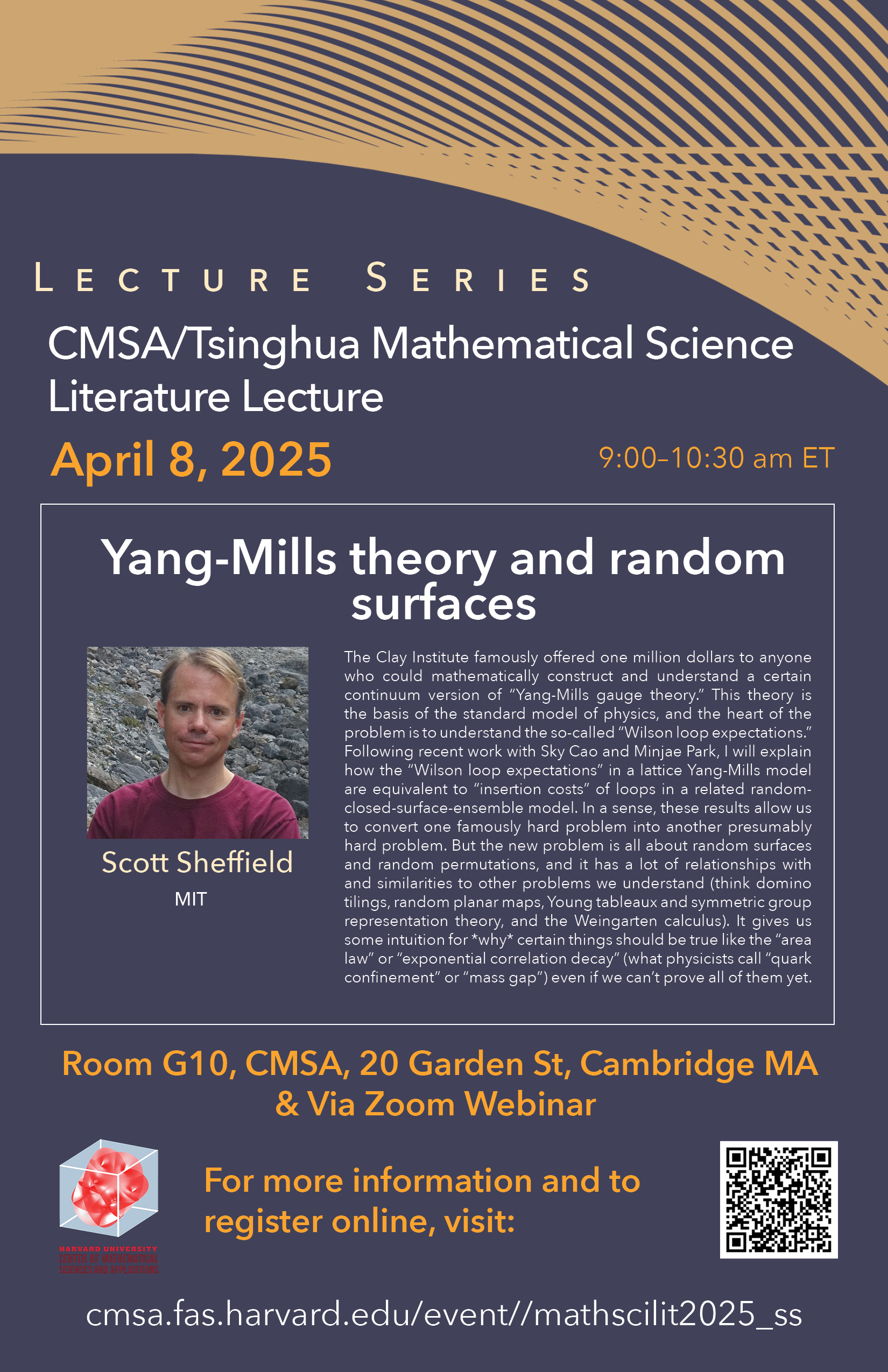
https://youtu.be/JJ88e4H4b8Q CMSA/Tsinghua Math-Science Literature Lecture Date: April 8, 2025 Time: 9:00 - 10:30 am ET Location: CMSA G10, 20 Garden Street, Cambridge MA & via Zoom Speaker: Scott Sheffield (MIT) Title: Yang-Mills theory and random surfaces Abstract: The Clay Institute famously offered one million dollars to anyone who could mathematically construct and understand a certain continuum […]