CMSA Q&A Seminar: Hugh Woodin, Harvard
Common Room, CMSA 20 Garden Street, Cambridge, MA, United StatesCMSA Q&A Seminar Speaker: Hugh Woodin, Harvard Title: Truth, proof, and AI

CMSA Q&A Seminar Speaker: Hugh Woodin, Harvard Title: Truth, proof, and AI
Joint Math/CMSA Geometry and Quantum Theory Seminar Speaker: Tomer Schlank Title: From Markov processes to path integrals Abstract: We will continue with Chapter 2 of the book and cover how we take the Markov process approach and Wick rotation to give a rigorous definition of path integrals.
Joint Math/CMSA Geometry and Quantum Theory Seminar Speaker: Ahsan Khan, HarvardCMSA Title: Markov processes and path integrals continued Abstract: I will continue the discussion of chapter two, in particular focusing on vacuum expectation values and reflection positivity.
CMSA Q&A Seminar Speaker: Shaoyun Bai, MIT Title: What is a virtual fundamental cycle? (ICM Series: On the work of John Pardon) Abstract: One of Pardon’s important contribution to symplectic topology is a new approach to constructing virtual fundamental cycles/chains for moduli spaces of pseudo-holomorphic maps. As a former PhD student of John, my own […]
Joint Math/CMSA Geometry and Quantum Theory Seminar Speaker: Bowen Yang Title: From Random Walks to the Free Quantum Field Abstract: The free quantum field is, heuristically, a Gaussian measure with density exp(−S_E) on a space of fields. We make this precise by building the Gaussian free field from discrete objects: random walks, Brownian motion, and […]
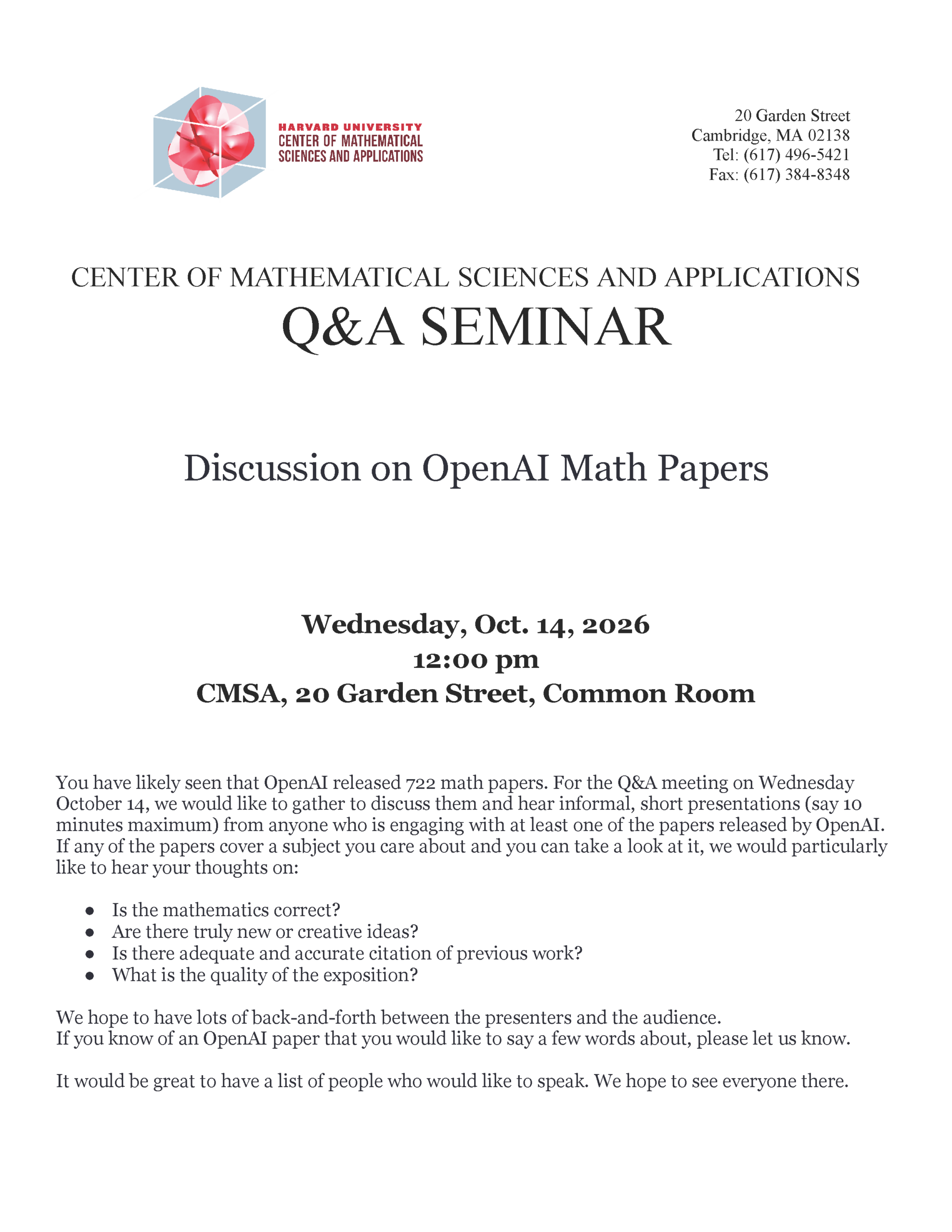
CMSA Q&A Seminar Title: Discussion on OpenAI Math Papers Abstract: You have likely seen that OpenAI released 722 math papers. For the Q&A meeting on Wednesday October 14, we would like to gather to discuss them and hear informal, short presentations (say 10 minutes maximum) from anyone who is engaging with at least one of the […]
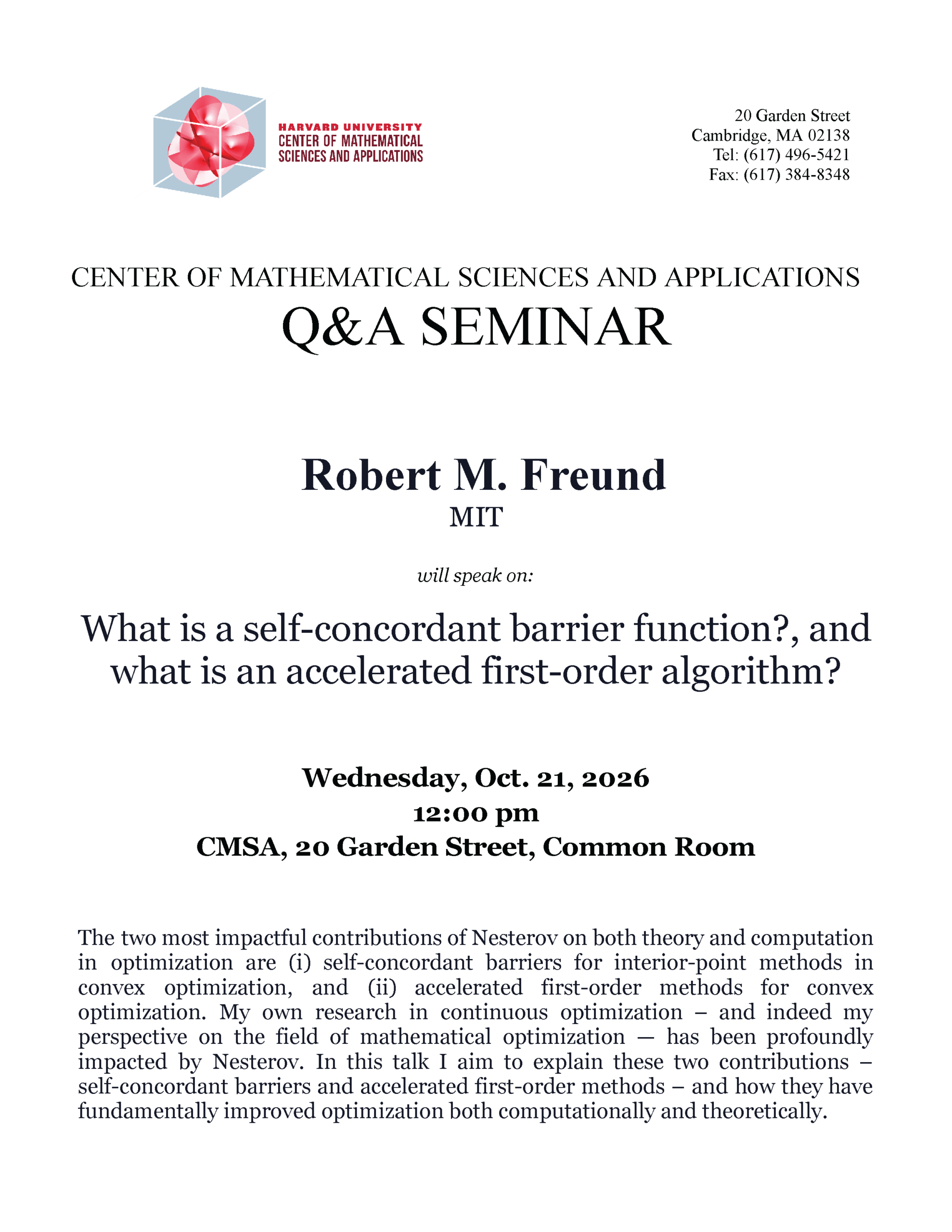
CMSA Q&A Seminar Speaker: Robert M. Freund, MIT Title: What is a self-concordant barrier function?, and what is an accelerated first-order algorithm? (ICM Series: On the work of Yurii Nesterov) Abstract: The two most impactful contributions of Nesterov on both theory and computation in optimization are (i) self-concordant barriers for interior-point methods in convex optimization, and (ii) […]
Joint Math/CMSA Geometry and Quantum Theory Seminar Speaker: Kason Kunkelmann, Harvard Title: A Rigorous Construction of the Free Quantum Field Abstract: In this talk we will build on last week’s discrete intuition and rigorously construct our first continuum quantum field theory: the free field. Following Chapter three of Chatterjee’s notes, we will realize it as a Gaussian […]
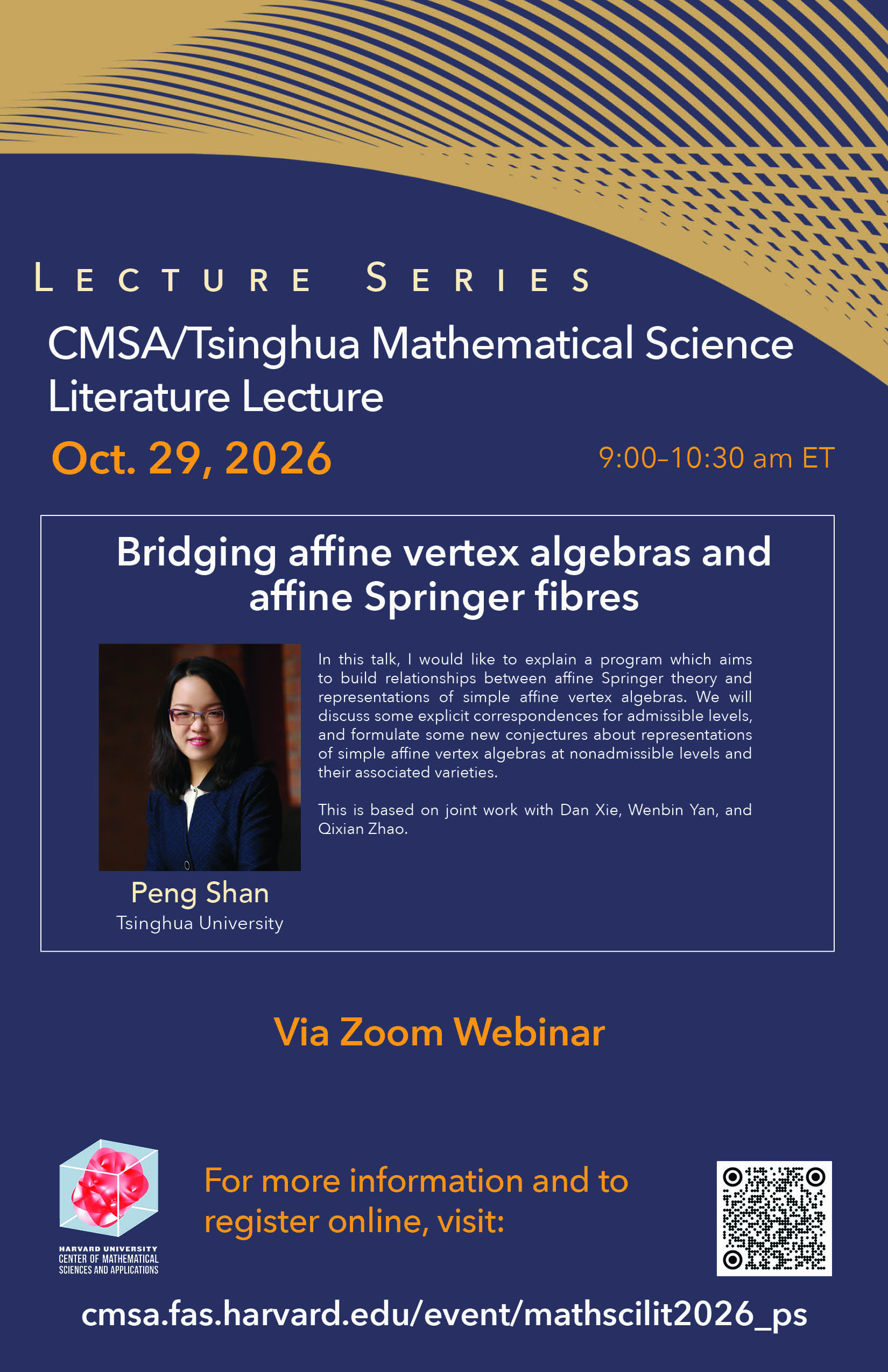
CMSA/Tsinghua Math-Science Literature Lecture Date: Thursday, October 29, 2026 Time: 9:00 - 10:30 am ET Location: online via Zoom Webinar Video (Youtube) Speaker: Peng Shan, Tsinghua University Title: Bridging affine vertex algebras and affine Springer fibres Abstract: In this talk, I would like to explain a program which aims to build relationships between affine Springer […]
Joint Math/CMSA Geometry and Quantum Theory Seminar Speaker: Tobias Schmidt, Harvard CMSA Title: The free field and the Fock space Abstract: Last time we defined a stochastic process on tempered distributions corresponding to the euclidean action of the free field. In this talk, we begin with verifying the Markov property. Next, we will show a […]
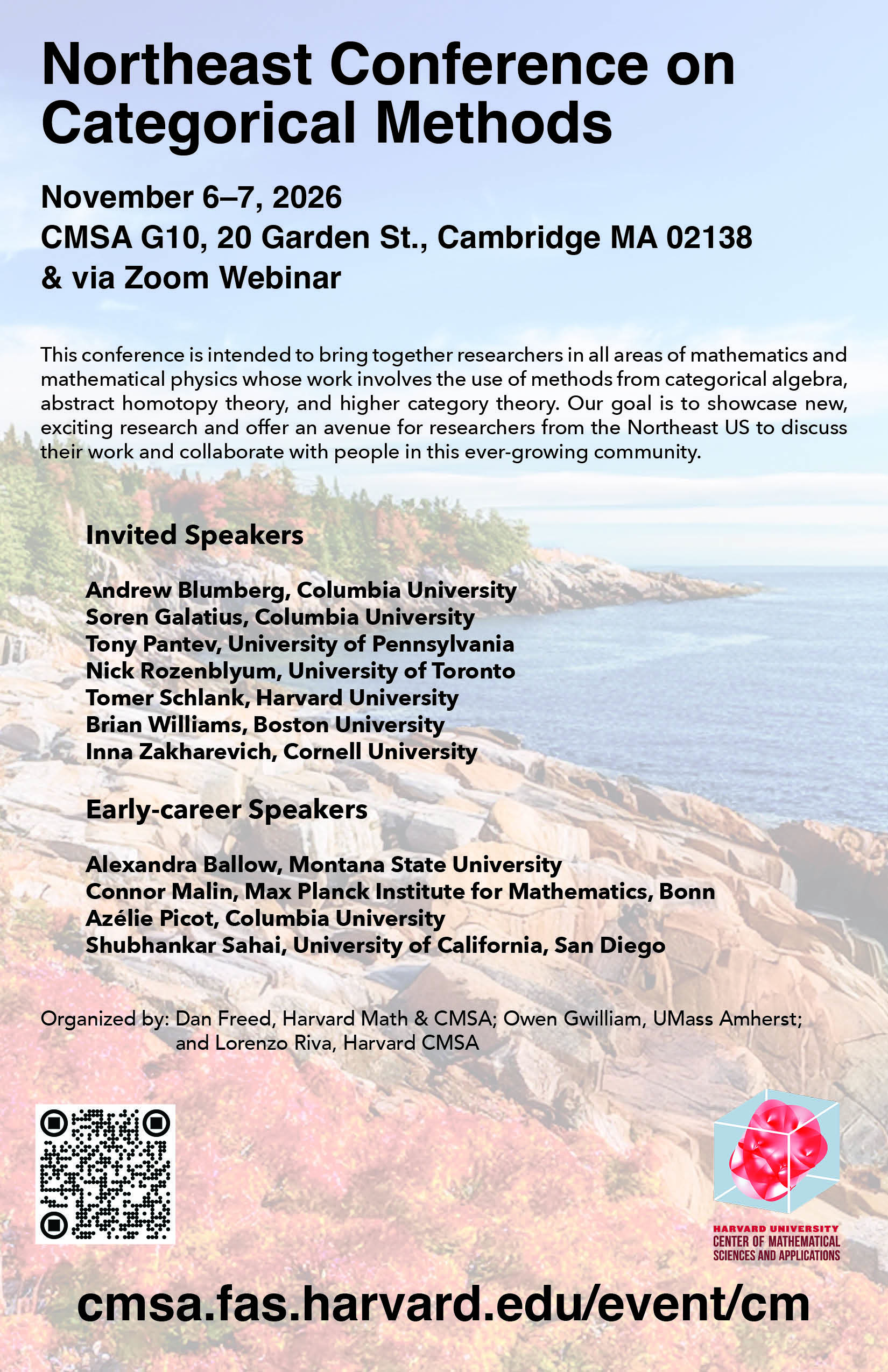
Northeast Conference on Categorical Methods Dates: November 6–7, 2026 Location: CMSA G10, 20 Garden St., Cambridge MA 02138 This conference is intended to bring together researchers in all areas of mathematics and mathematical physics whose work involves the use of methods from categorical algebra, abstract homotopy theory, and higher category theory. Our goal is to […]
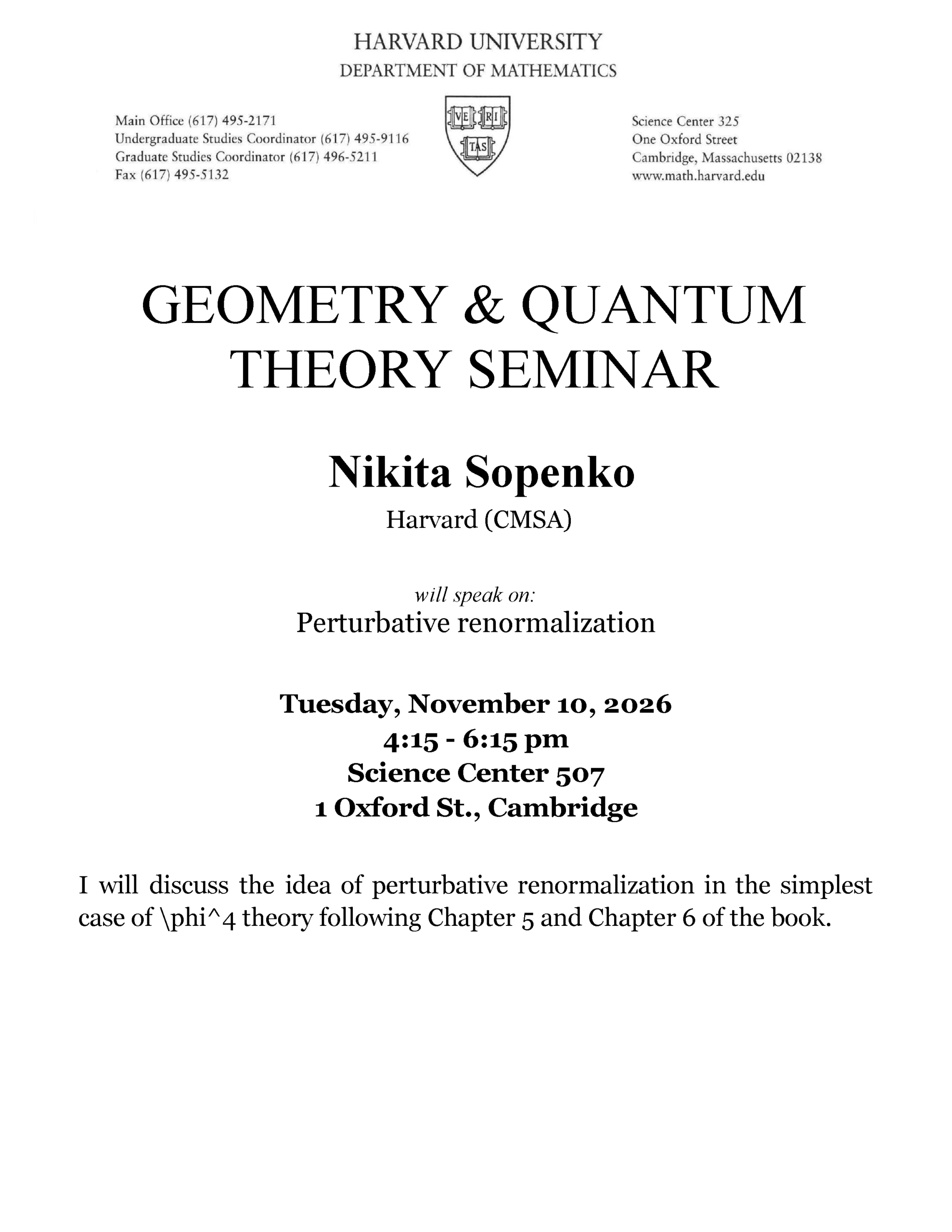
Joint Math/CMSA Geometry and Quantum Theory Seminar Speaker: Nikita Sopenko (CMSA) Title: Perturbative renormalization Abstract: I will discuss the idea of perturbative renormalization in the simplest case of \phi^4 theory following Chapter 5 and Chapter 6 of the book.