• What is a self-concordant barrier function?, and what is an accelerated first-order algorithm?  (ICM Series: On the work of Yurii Nesterov)

    CMSA Q&A Seminar
    Common Room, CMSA 20 Garden Street, Cambridge, MA, United States

    CMSA Q&A Seminar Speaker: Robert M. Freund, MIT Title: What is a self-concordant barrier function?, and what is an accelerated first-order algorithm?  (ICM Series: On the work of Yurii Nesterov) Abstract: The two most impactful contributions of Nesterov on both theory and computation in optimization are (i) self-concordant barriers for interior-point methods in convex optimization, and (ii) […]

  • Local learning needs dendrites

    CMSA Room G10 CMSA, 20 Garden Street, Cambridge, MA, United States

    New Technologies in Mathematics Seminar Speaker: Riccardo Zecchina (Bocconi University) Title: Local learning needs dendrites Abstract: I will present a learning scheme for recurrent networks in which nonlinear dendrites enable learning by generating and stabilizing task-relevant attractors within a representation manifold. The scheme is local in space and time and matches the performance of backpropagation […]

  • The Geography of Symplectic 4-Manifolds

    CMSA Room G10 CMSA, 20 Garden Street, Cambridge, MA, United States

    Colloquium Speaker: Anar Akhmedov, University of Minnesota Title: The Geography of Symplectic 4-Manifolds Abstract: The symplectic geography problem, originally posed by J. McCarthy-J. Wolfson and R. Gompf, asks which ordered pairs of nonnegative integers are realized as (\chi(X),c_1^2(X)) for a symplectic 4-manifold X, where \chi(X)=(e(X)+\sigma(X))/4. In this talk, we will address the geography of simply […]

  • A Rigorous Construction of the Free Quantum Field

    Science Center 507 1 Oxford Street, Cambridge

    Joint Math/CMSA Geometry and Quantum Theory Seminar Speaker: Kason Kunkelmann, Harvard Title: A Rigorous Construction of the Free Quantum Field Abstract: In this talk we will build on last week’s discrete intuition and rigorously construct our first continuum quantum field theory: the free field. Following Chapter three of Chatterjee’s notes, we will realize it as a Gaussian […]

  • The IEANTN Project: Automation and Mathematical Understanding

    Virtual

    New Technologies in Mathematics Seminar Speaker: Xinjie He, UCLA Title: The IEANTN Project: Automation and Mathematical Understanding Abstract: Explicit analytic number theory combines conceptual arguments with extensive bookkeeping and numerical computation, often drawing on long chains of results across many papers. The Integrated Explicit Analytic Number Theory Network (IEANTN) aims to organize this literature into […]

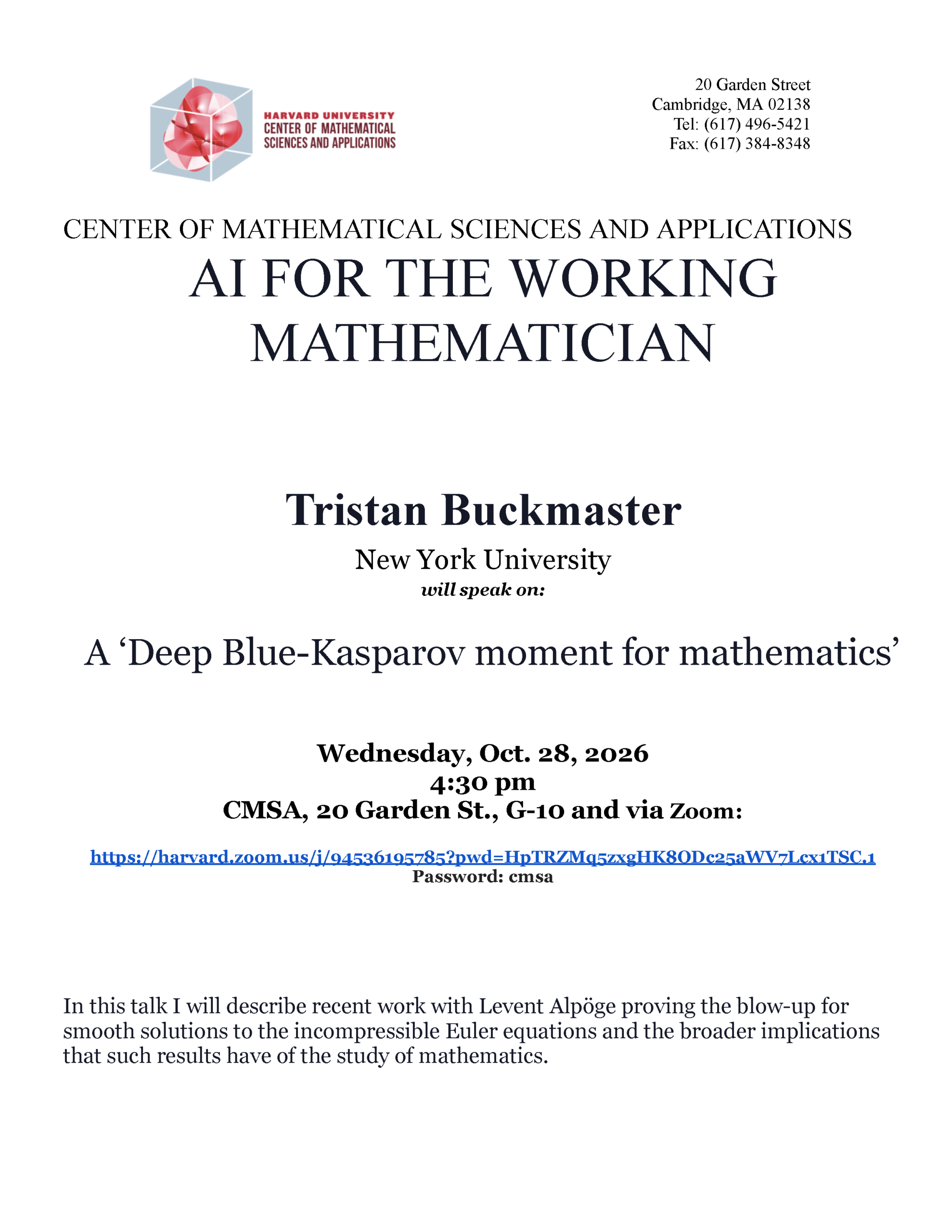
  • A ‘Deep Blue-Kasparov moment for mathematics’

    CMSA Room G10 CMSA, 20 Garden Street, Cambridge, MA, United States

    AI for the Working Mathematician Speaker: Tristan Buckmaster, NYU Title: A 'Deep Blue-Kasparov moment for mathematics' Abstract: In this talk I will describe recent work with Levent Alpöge proving the blow-up for smooth solutions to the incompressible Euler equations and the broader implications that such results have of the study of mathematics.

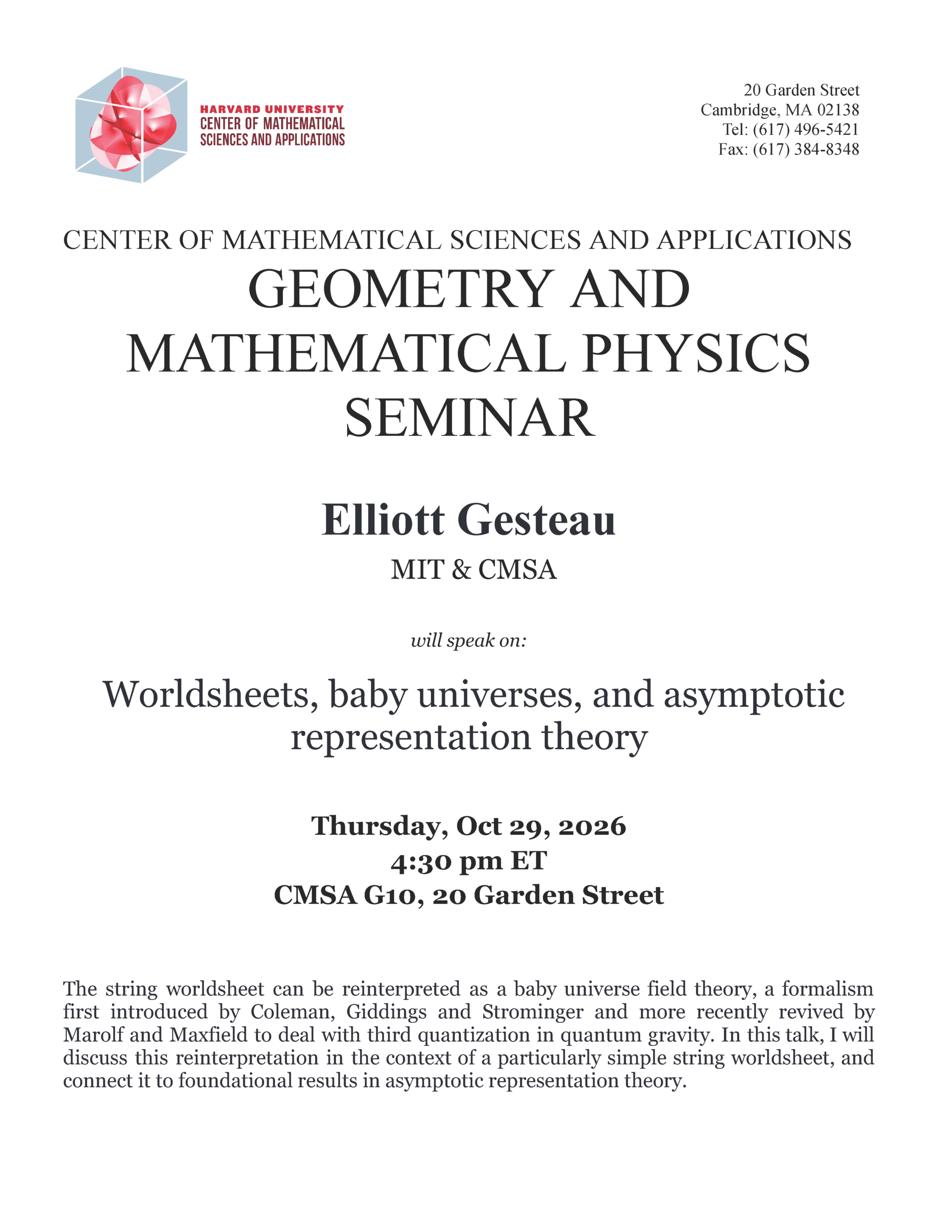
  • Worldsheets, baby universes, and asymptotic representation theory

    CMSA Room G10 CMSA, 20 Garden Street, Cambridge, MA, United States

    Geometry and Mathematical Physics Seminar Speaker: Elliott Gesteau (MIT & CMSA) Title: Worldsheets, baby universes, and asymptotic representation theory Abstract: The string worldsheet can be reinterpreted as a baby universe field theory, a formalism first introduced by Coleman, Giddings and Strominger and more recently revived by Marolf and Maxfield to deal with third quantization in […]

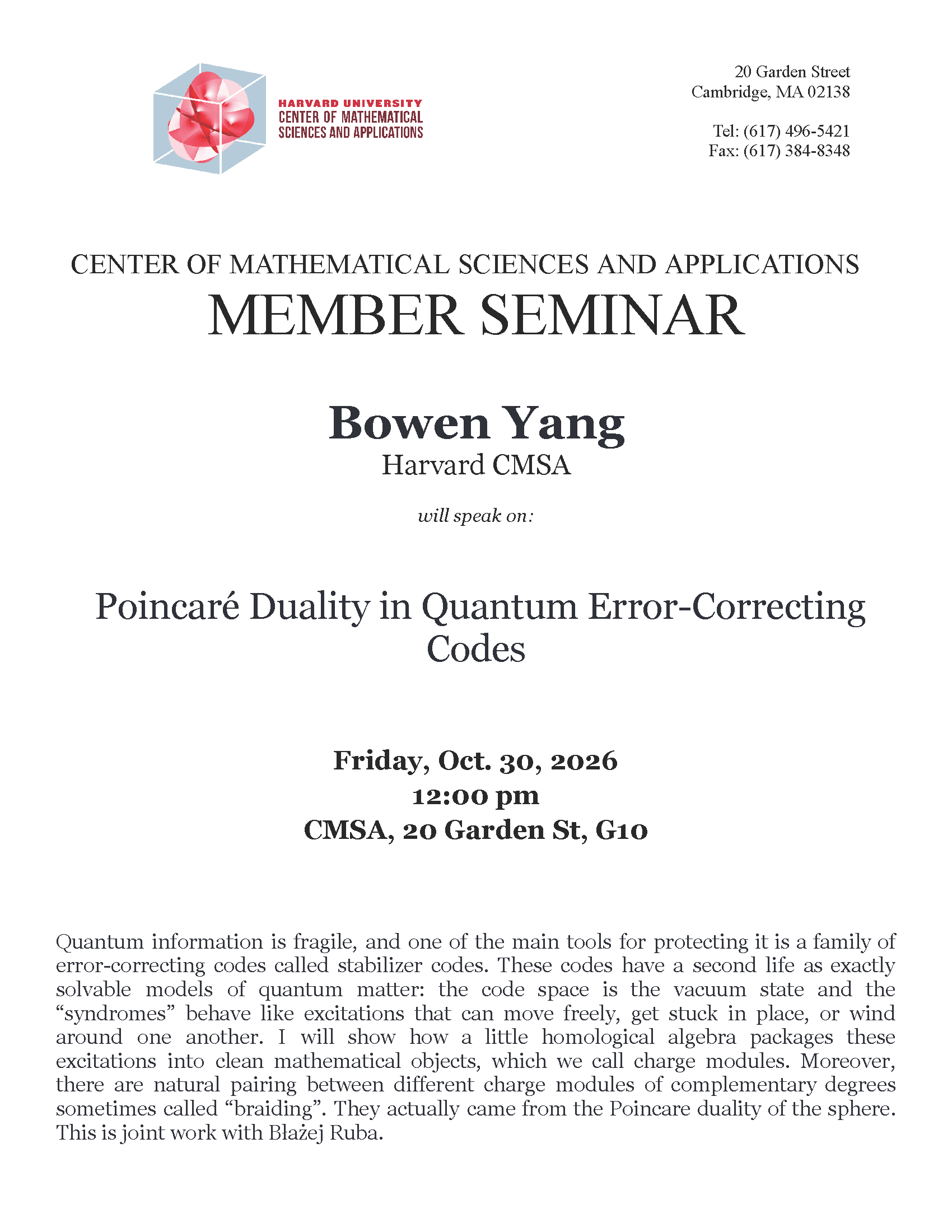
  • Poincaré Duality in Quantum Error-Correcting Codes

    CMSA Room G10 CMSA, 20 Garden Street, Cambridge, MA, United States

    Member Seminar Speaker: Bowen Yang Title: Poincaré Duality in Quantum Error-Correcting Codes Abstract: Quantum information is fragile, and one of the main tools for protecting it is a family of error-correcting codes called stabilizer codes. These codes have a second life as exactly solvable models of quantum matter: the code space is the vacuum state […]

  • 4-manifold topology and collision rank of groups

    Virtual

    Freedman Seminar Speaker: Michael Freedman, Harvard CMSA Title: The geometry of the Bing Involution Abstract: I’ll discuss a new sharper proof, joint with Mike Starbird that precisely quantifies the stretching necessary for Bing’s wild involution on S^3.