• AI and Theorem Proving

    Virtual

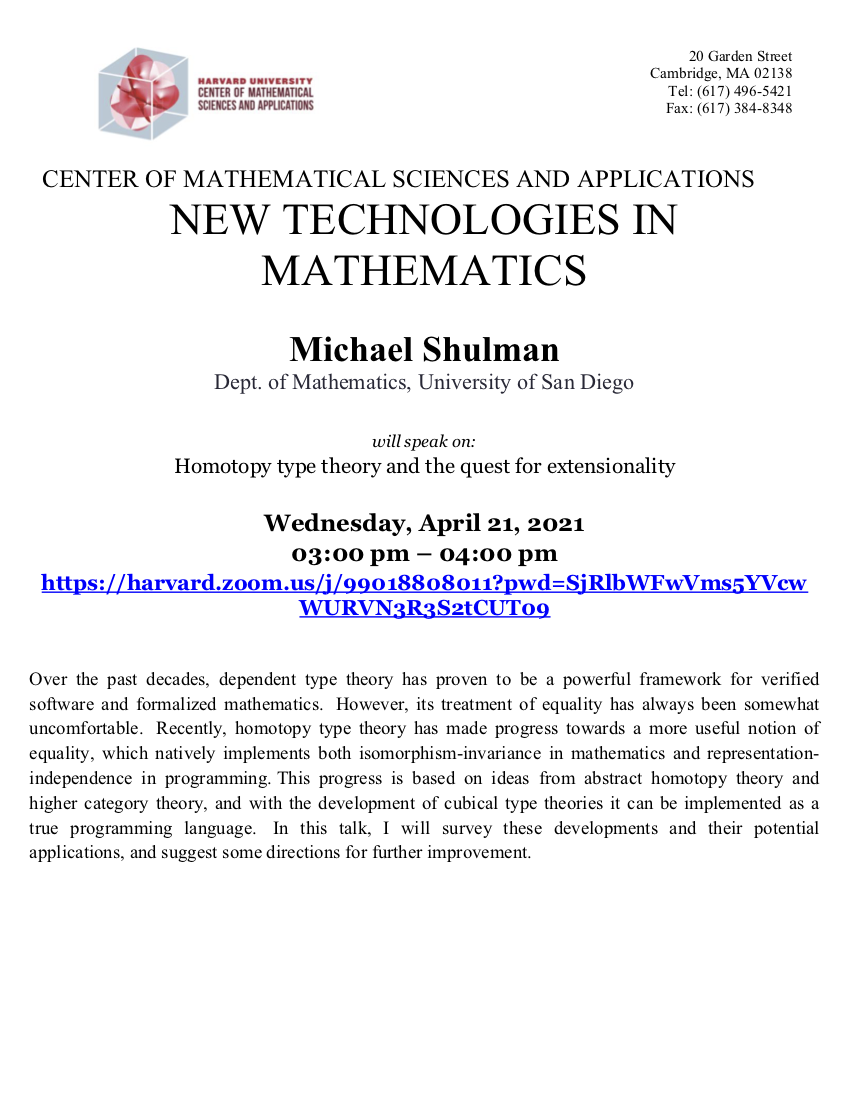
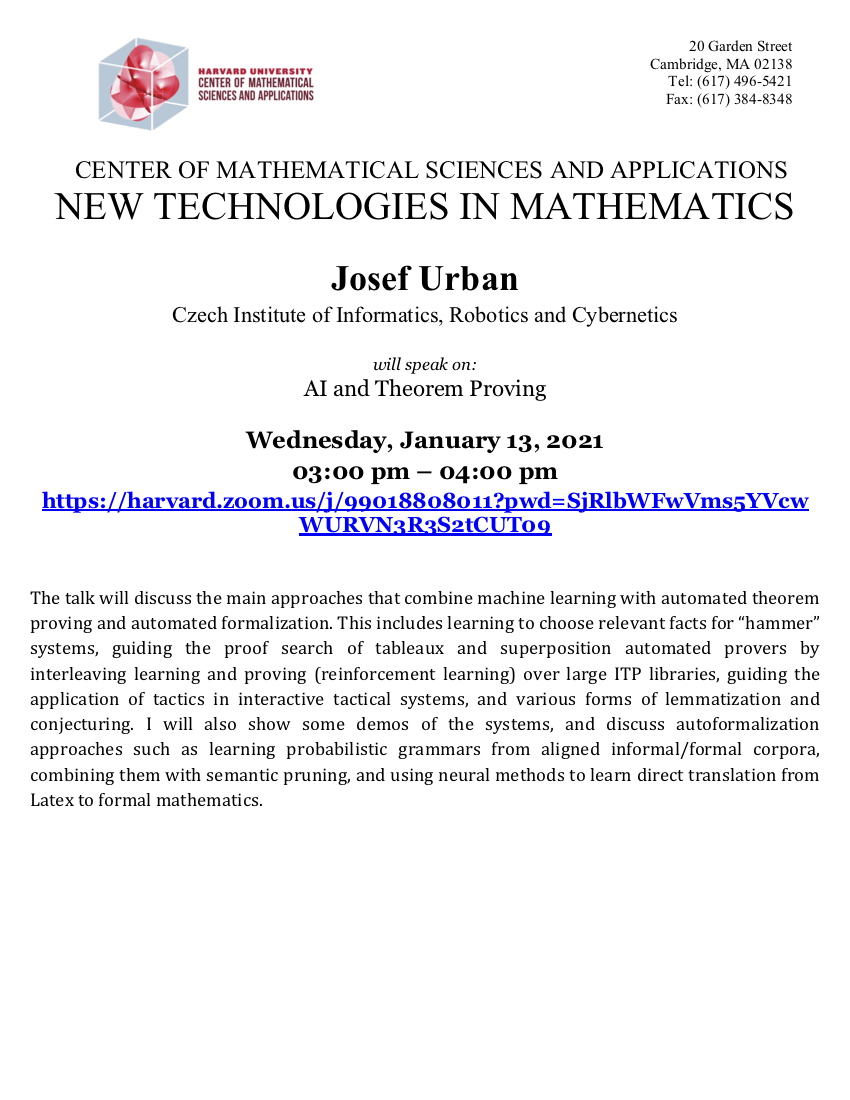
    https://youtu.be/UnYrWuOzOlc Speaker: Josef Urban, Czech Technical University Title: AI and Theorem Proving Abstract: The talk will discuss the main approaches that combine machine learning with automated theorem proving and automated formalization. This includes learning to choose relevant facts for “hammer” systems, guiding the proof search of tableaux and superposition automated provers by interleaving learning and […]
  • Language Modeling for Mathematical Reasoning

    Virtual

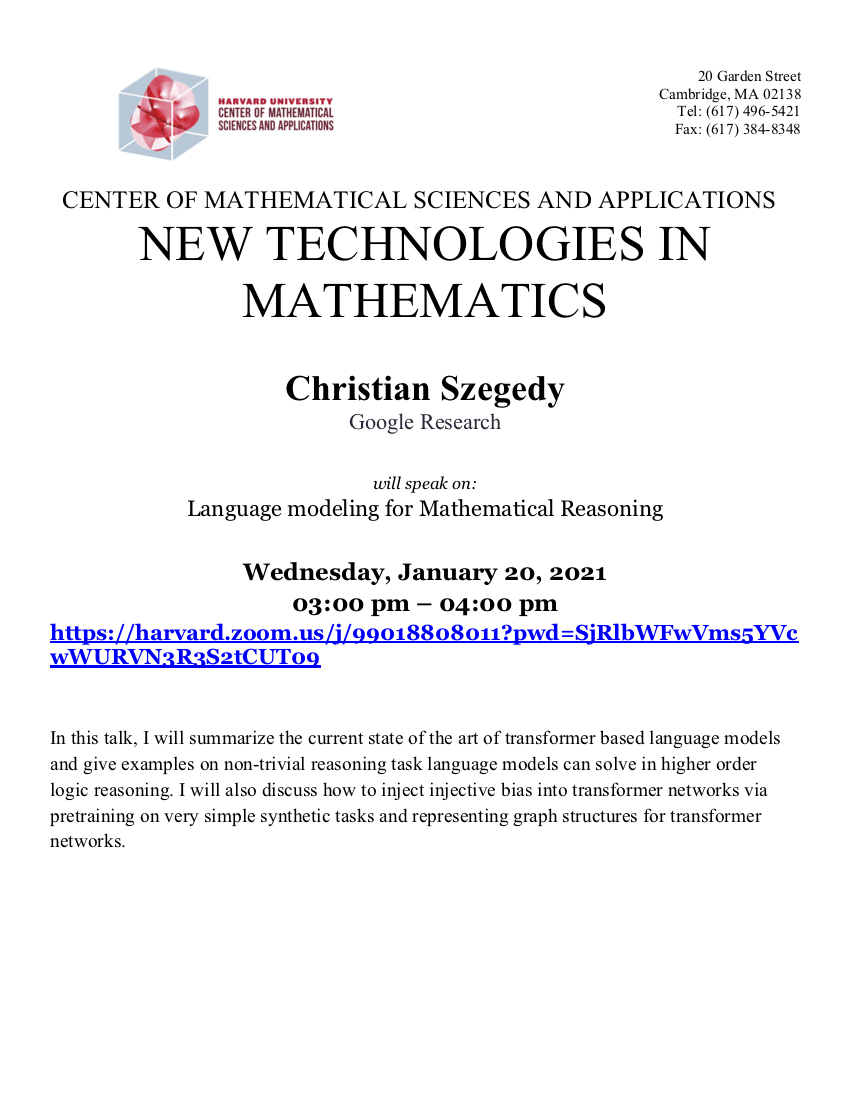
    Speaker: Christian Szegedy Title: Language Modeling for Mathematical Reasoning Abstract: In this talk, I will summarize the current state of the art of transformer based language models and give examples on non-trivial reasoning task language models can solve in higher order logic reasoning. I will also discuss how to inject injective bias into transformer networks via pretraining on […]

  • Knowledge graph representation: From recent models towards a theoretical understanding

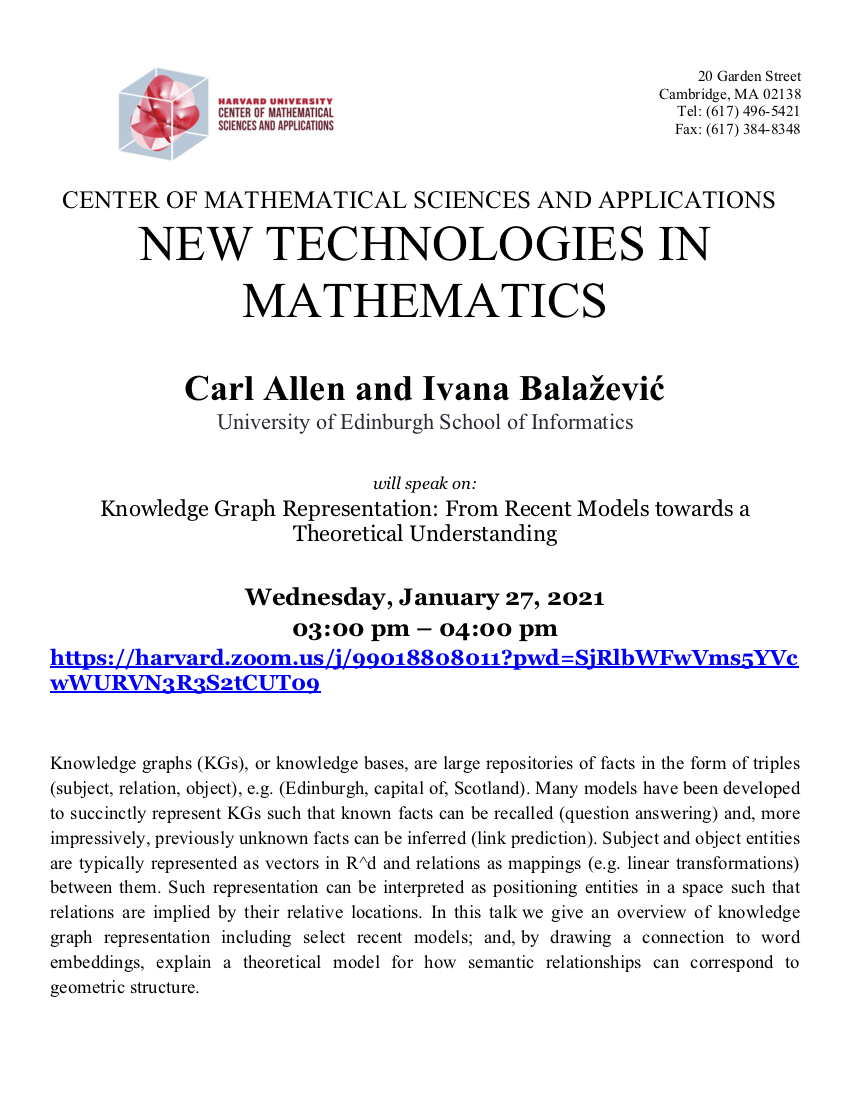
    Speaker: Carl Allen and Ivana Balažević - University of Edinburgh School of Informatics Title: Knowledge graph representation: From recent models towards a theoretical understanding Abstract: Knowledge graphs (KGs), or knowledge bases, are large repositories of facts in the form of triples (subject, relation, object), e.g. (Edinburgh, capital_of, Scotland). Many models have been developed to succinctly represent KGs […]

  • A Mathematical Exploration of Why Language Models Help Solve Downstream Tasks

    https://youtu.be/OoimTbnSe7I Speaker: Nikunj Saunshi, Dept. of Computer Science, Princeton University Title: A Mathematical Exploration of Why Language Models Help Solve Downstream Tasks Abstract: Autoregressive language models pretrained on large corpora have been successful at solving downstream tasks, even with zero-shot usage. However, there is little theoretical justification for their success. This paper considers the following […]

  • A Mathematical Language

      Speaker: Thomas Hales, Univ. of Pittsburgh Dept. of Mathematics Title: A Mathematical Language Abstract: A controlled natural language for mathematics is an artificial language that is designed in an explicit way with precise computer-readable syntax and semantics.  It is based on a single natural language (which for us is English) and can be broadly […]

  • Neural Theorem Proving in Lean using Proof Artifact Co-training and Language Models

    Virtual

    https://youtu.be/EXpmbAfBNnw Speaker: Jason Rute, CIBO Technologies Title: Neural Theorem Proving in Lean using Proof Artifact Co-training and Language Models Abstract: Labeled data for imitation learning of theorem proving in large libraries of formalized mathematics is scarce as such libraries require years of concentrated effort by human specialists to be built. This is particularly challenging when applying […]

  • The Ramanujan Machine: Using Algorithms for the Discovery of Conjectures on Mathematical Constants

    Virtual

    https://youtu.be/h0FW7l7z-C4 Speaker: Ido Kaminer, Technion – Israel Institute of Technology, Faculty of Electrical Engineering Title: The Ramanujan Machine: Using Algorithms for the Discovery of Conjectures on Mathematical Constants Abstract: In the past, new conjectures about fundamental constants were discovered sporadically by famous mathematicians such as Newton, Euler, Gauss, and Ramanujan. The talk will present a […]

  • Word and Graph Embeddings for Machine Learning

    https://youtu.be/-DKctbabRkY Speaker: Steve Skiena, Dept. of Computer Science and AI Insititute, Stony Brook University Title: Word and Graph Embeddings for Machine Learning Abstract: DeepWalk is an approach we have developed to construct vertex embeddings: vector representations of vertices which be applied to a very general class of problems in data mining and information retrieval. DeepWalk […]

  • Doing Mathematics with Simple Types: Infinitary Combinatorics in Isabelle/HOL

    https://youtu.be/LZMtQNdqtvc Speaker: Lawrence Paulson, University of Cambridge Computer Laboratory Title: Doing Mathematics with Simple Types: Infinitary Combinatorics in Isabelle/HOL Abstract: Are proof assistants relevant to mathematics? One approach to this question is to explore the breadth of mathematical topics that can be formalised. The partition calculus was introduced by Erdös and R. Rado in 1956 […]

  • Type theory from the perspective of artificial intelligence

    https://youtu.be/79ymkGQW3b4 Speaker: David McAllester - Toyota Technological Institute at Chicago Title: Type theory from the perspective of artificial intelligence Abstract: This talk will discuss dependent type theory from the perspective of artificial intelligence and cognitive science. From an artificial intelligence perspective it will be argued that type theory is central to defining the "game" of mathematics […]

  • A Bayesian neural network predicts the dissolution of compact planetary systems

    Virtual

    https://youtu.be/VhseP2V3NXg Speaker: Miles Cranmer - Princeton University Title: A Bayesian neural network predicts the dissolution of compact planetary systems Abstract: Despite over three hundred years of effort, no solutions exist for predicting when a general planetary configuration will become unstable. I will discuss our deep learning architecture (arxiv:2101.04117) which pushes forward this problem for compact systems. […]

  • Homotopy type theory and the quest for extensionality

    Virtual

    Speaker: Michael Shulman - Dept. of Mathematics, University of San Diego Title: Homotopy type theory and the quest for extensionality Abstract: Over the past decades, dependent type theory has proven to be a powerful framework for verified software and formalized mathematics.  However, its treatment of equality has always been somewhat uncomfortable.  Recently, homotopy type theory has […]