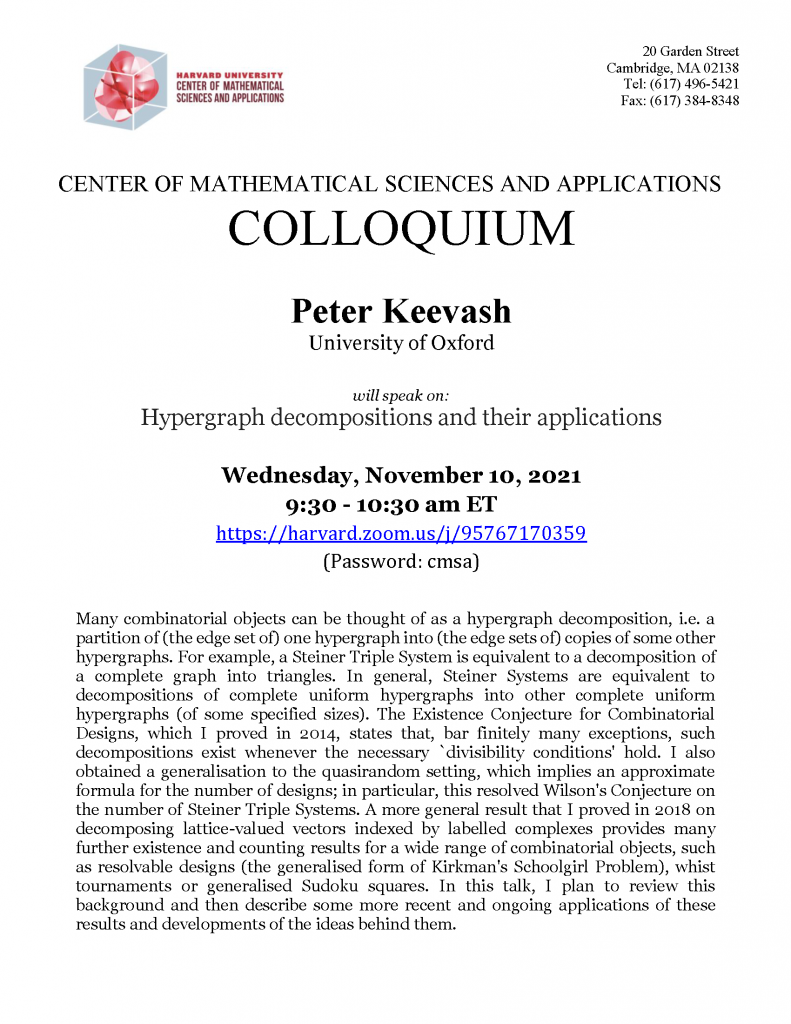
• Hypergraph decompositions and their applications

    Speaker: Peter Keevash, Oxford Title: Hypergraph decompositions and their applications Abstract: Many combinatorial objects can be thought of as a hypergraph decomposition, i.e. a partition of (the edge set of) one hypergraph into (the edge sets of) copies of some other hypergraphs. For example, a Steiner Triple System is equivalent to a decomposition of a complete graph […]
  • Universal relations between entanglement, symmetries, and entropy

    Member Seminar Speaker: Gabriel Wong  Title: Universal relations between entanglement, symmetries, and entropy Abstract: Entanglement is an essential property of quantum systems that distinguishes them from classical ones.   It is responsible for the nonlocal character of quantum information and provides a resource for quantum teleportation and quantum computation. In this talk I will provide an introduction […]

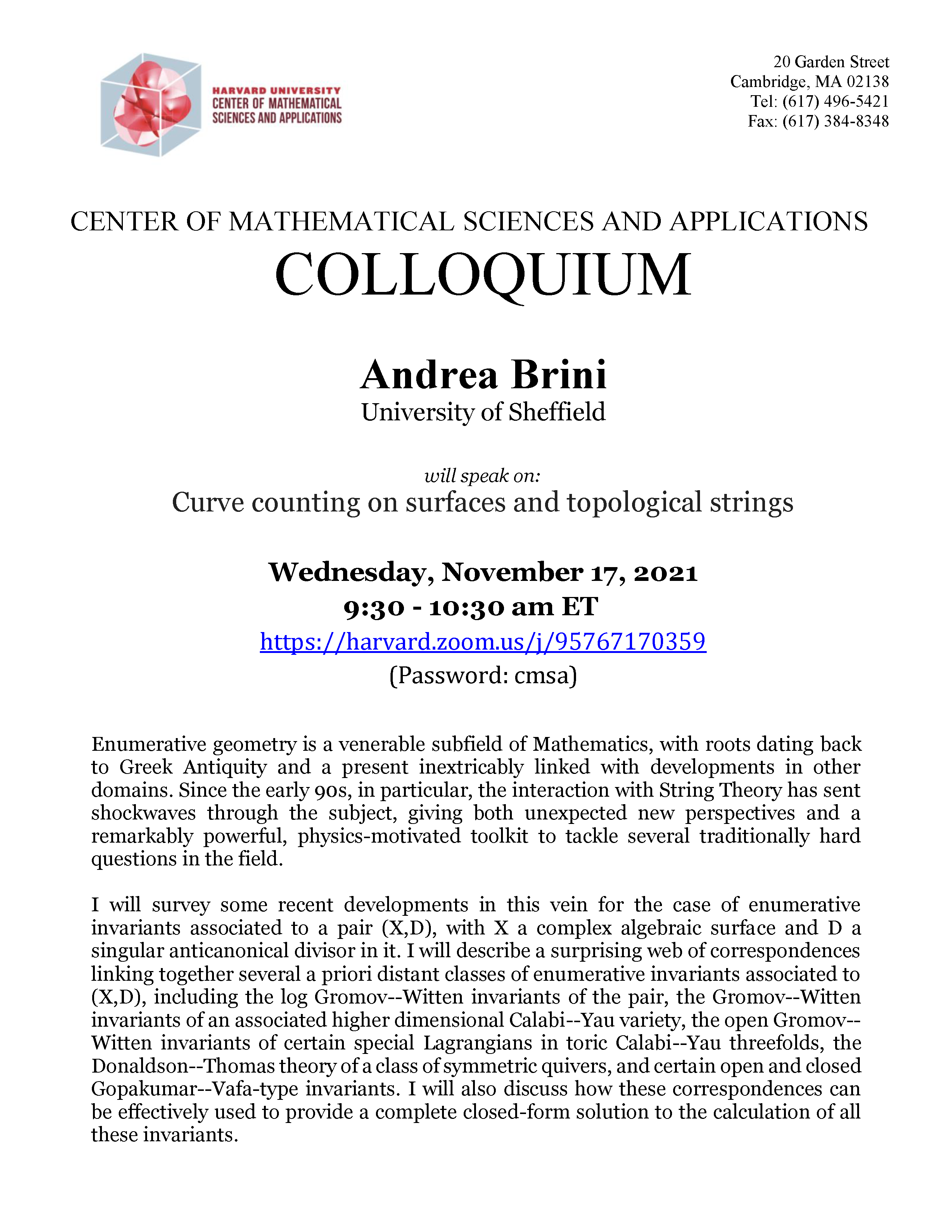
  • Curve counting on surfaces and topological strings

    Speaker: Andrea Brini, U Sheffield Title: Curve counting on surfaces and topological strings Abstract: Enumerative geometry is a venerable subfield of Mathematics, with roots dating back to Greek Antiquity and a present inextricably linked with developments in other domains. Since the early 90s, in particular, the interaction with String Theory has sent shockwaves through the subject, giving […]

  • China’s financial regulatory reform, financial opening-up, and Central Bank Digital Currency (CBDC)

    Member Seminar Speaker: Kan Lin Title: China’s financial regulatory reform, financial opening-up, and Central Bank Digital Currency (CBDC) Abstract: In this talk, I will explain the overall situation of China’s financial industry and review the development of China’s financial regulatory system reform from 1949 to 2021. Then, I will explain the policies of the 3 stages […]

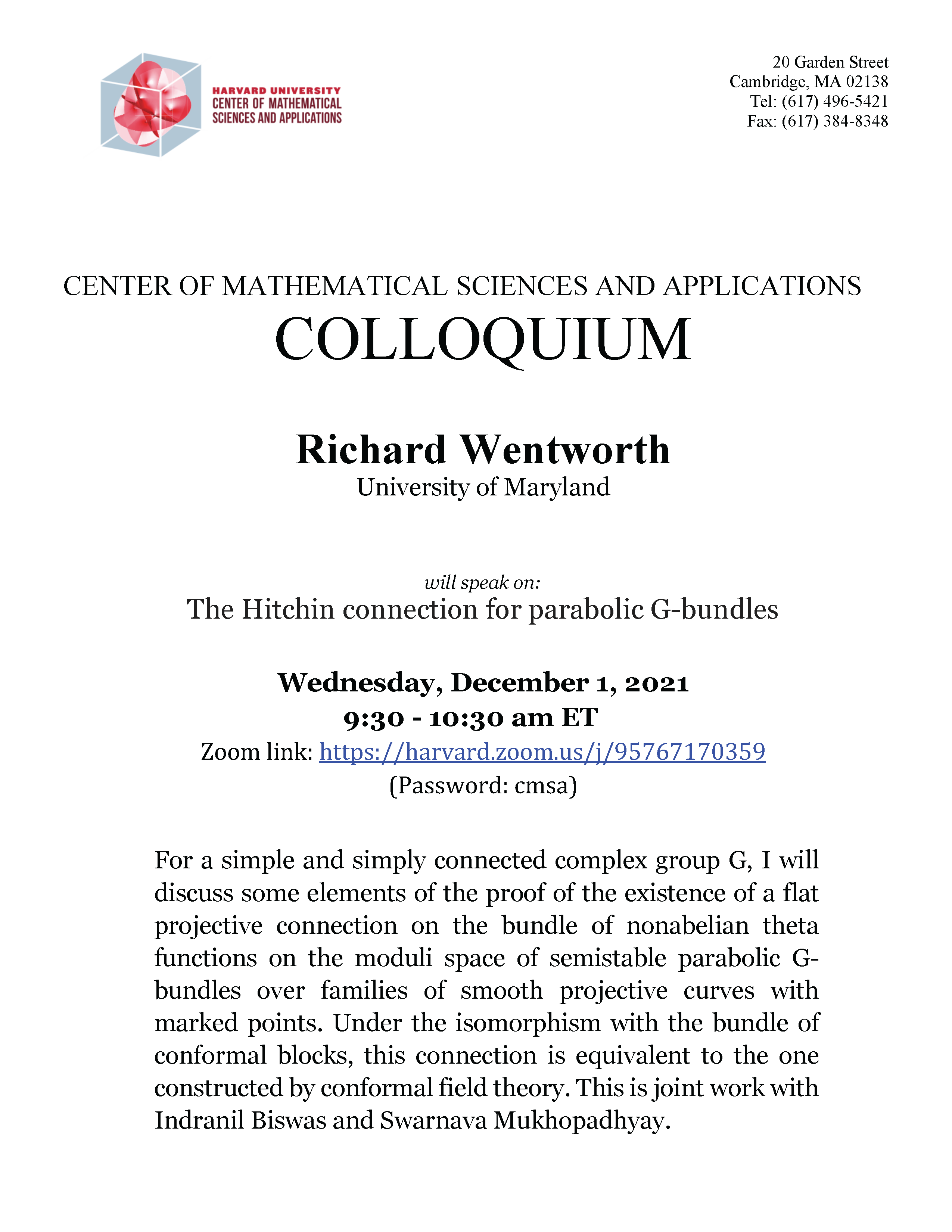
  • The Hitchin connection for parabolic G-bundles

    Speaker: Richard Wentworth, University of Maryland Title: The Hitchin connection for parabolic G-bundles Abstract: For a simple and simply connected complex group G, I will discuss some elements of the proof of the existence of a flat projective connection on the bundle of nonabelian theta functions on the moduli space of semistable parabolic G-bundles over families of […]

  • The Principles of Deep Learning Theory

    Virtual

    https://youtu.be/wXZKoHEzASg Speaker: Dan Roberts, MIT & Salesforce Title: The Principles of Deep Learning Theory Abstract: Deep learning is an exciting approach to modern artificial intelligence based on artificial neural networks. The goal of this talk is to provide a blueprint — using tools from physics — for theoretically analyzing deep neural networks of practical relevance. This […]

  • Black Holes, 2D Gravity, and Random Matrices

    Member Seminar Speaker: Dan Kapec Title: Black Holes, 2D Gravity, and Random Matrices Abstract: I will discuss old and new connections between black hole physics, 2D quantum gravity, and random matrix theory. Black holes are believed to be very complicated, strongly interacting quantum mechanical systems, and certain aspects of their Hamiltonians should be well approximated by random […]

  • Induced subgraphs and tree decompositions

    Speaker: Maria Chudnovsky, Princeton Title: Induced subgraphs and tree decompositions Abstract: Tree decompositions are a powerful tool in both structural graph theory and graph algorithms. Many hard problems become tractable if the input graph is known to have a tree decomposition of bounded “width”. Exhibiting a particular kind of a tree decomposition is also a useful way […]

  • Hierarchical Transformers are More Efficient Language Models

    Virtual

    https://youtu.be/soqWNyrdjkw Speaker: Piotr Nawrot, University of Warsaw Title: Hierarchical Transformers are More Efficient Language Models Abstract: Transformer models yield impressive results on many NLP and sequence modeling tasks. Remarkably, Transformers can handle long sequences which allows them to produce long coherent outputs: full paragraphs produced by GPT-3 or well-structured images produced by DALL-E. These large language […]

  • On the solution space of the Ising perceptron model

    Member Seminar Speaker: Changji Xu Title: On the solution space of the Ising perceptron model Abstract:  Consider the discrete cube $\{-1,1\}^N$ and a random collection of half spaces which includes each half space $H(x) := \{y \in \{-1,1\}^N: x \cdot y \geq \kappa \sqrt{N}\}$ for $x \in \{-1,1\}^N$ independently with probability $p$. The solution space is […]

  • The Kapustin-Rozanski-Saulina “2-category” of a holomorphic integrable system

    Speaker: Constantin Teleman (UC Berkeley) Title: The Kapustin-Rozanski-Saulina “2-category” of a holomorphic integrable system Abstract: I will present a construction of the object in the title which, applied to the classical Toda system, controls the theory of categorical representations of compact Lie groups, along with applications (some conjectural, some rigorous) to gauged Gromov-Witten theory. Time permitting, we […]

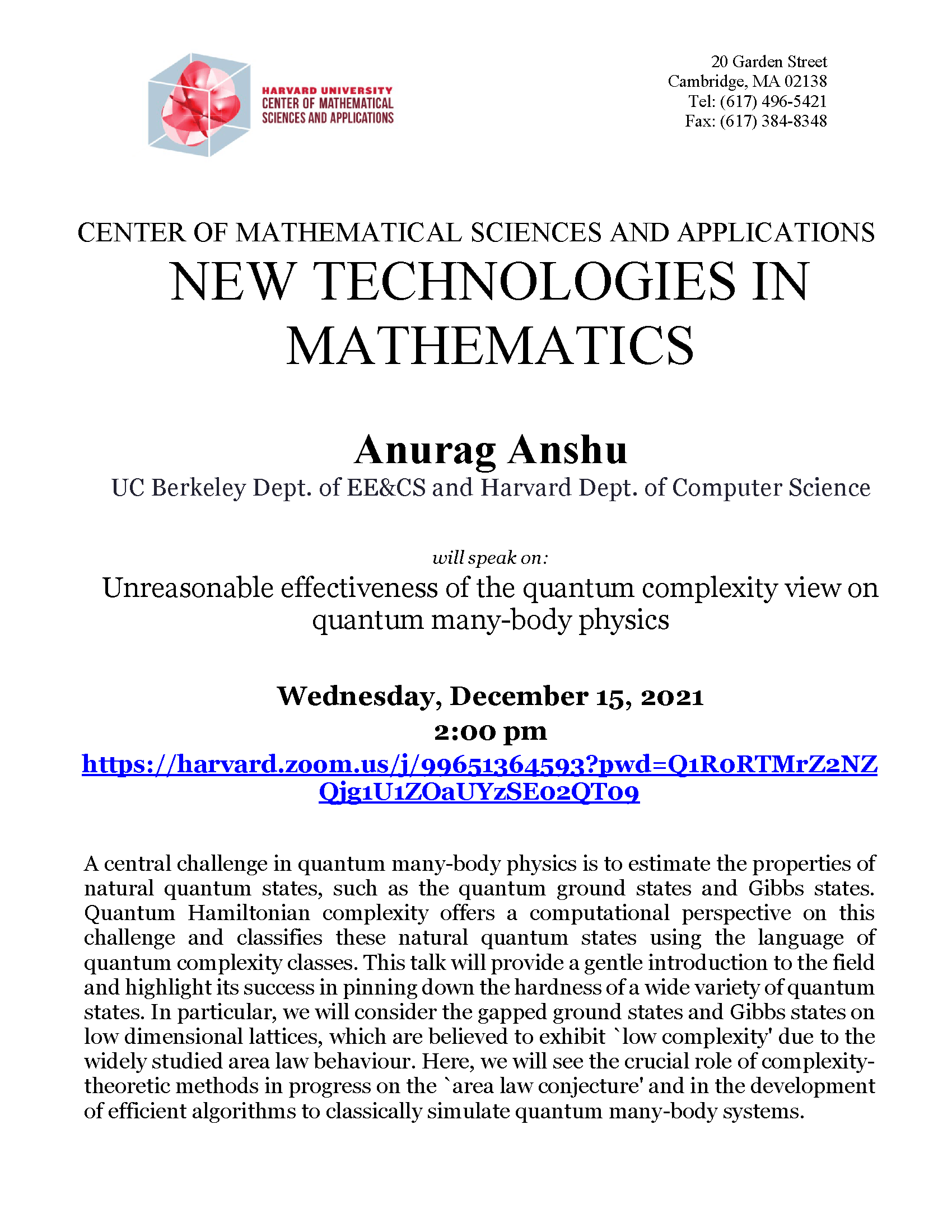
  • Unreasonable effectiveness of the quantum complexity view on quantum many-body physics

    Virtual

    https://youtu.be/wKCgR3aFpnc Speaker: Anurag Anshu, Department of EECS & Challenge Institute for Quantum Computation, UC Berkeley Title: Unreasonable effectiveness of the quantum complexity view on quantum many-body physics Abstract: A central challenge in quantum many-body physics is to estimate the properties of natural quantum states, such as the quantum ground states and Gibbs states. Quantum Hamiltonian complexity […]