During the 2026–27 academic year, the CMSA will be hosting a Colloquium series, organized by Tobias Schmidt, Houcine Ben Dali, and Francesco Mori.

It will take place on Mondays from 4:30 – 5:30 pm (Eastern Time) in Room G10, CMSA, 20 Garden Street. All CMSA postdocs/members are required to attend the weekly CMSA Colloquium series as well as the weekly CMSA Members’ Seminars.

To subscribe to the CMSA Colloquium Mailing list, please visit this link.

The schedule will be updated as talks are confirmed.

  • Asymptotic Theory of Attention: In-Context Learning and Sparse Token Detection

    CMSA Room G10 CMSA, 20 Garden Street, Cambridge, MA, United States

    Colloquium Speaker: Yue M. Lu, Harvard University Title: Asymptotic Theory of Attention: In-Context Learning and Sparse Token Detection Abstract: Attention-based architectures exhibit striking emergent abilities—from learning tasks directly from context to detecting rare, weak features in long sequences—yet a rigorous theory explaining these behaviors remains limited. In this talk, I will present two recent exactly solvable models that […]

  • Recent Advances in Probabilistically Checkable Proofs

    CMSA Room G10 CMSA, 20 Garden Street, Cambridge, MA, United States

    Colloquium Speaker: Dor Minzer (MIT) Title: Recent Advances in Probabilistically Checkable Proofs Abstract: The PCP Theorem is a cornerstone of computer science, with applications to hardness of approximation, verification, interactive protocols and more. It asserts a witness for the satisfiability of a given 3CNF formula can be encoded in a robust way that allows local checking.In this […]

  • The active Young-Dupré equation

    CMSA Room G10 CMSA, 20 Garden Street, Cambridge, MA, United States

    Colloquium Speaker: Julien Tailleur, MIT Title: The active Young-Dupré equation Abstract: The Young-Dupré equation is a cornerstone of the equilibrium theory of capillary and wetting phenomena. In the biological world, interfacial phenomena are ubiquitous, from the spreading of bacterial colonies to tissue growth and flocking of birds, but the description of such active systems escapes […]

  • Bijections for hyperplane arrangements of Coxeter type

    CMSA Room G10 CMSA, 20 Garden Street, Cambridge, MA, United States

    Colloquium Speaker: Olivier Bernardi, Brandeis University Title: Bijections for hyperplane arrangements of Coxeter type Abstract: This talk is about real hyperplane arrangements whose hyperplanes are of the form {xi −xj = s} or {xi +xj = s}. We describe a bijective framework for a large family of such arrangements which we call transitive. For each transitive arrangement A, […]

  • Phase Transition to Chaos in Complex Ecosystems with Non-reciprocal Interactions

    CMSA Room G10 CMSA, 20 Garden Street, Cambridge, MA, United States

    Colloquium Speaker: Pankaj Metha, Boston University Title: Phase Transition to Chaos in Complex Ecosystems with Non-reciprocal Interactions Abstract: Nonreciprocal interactions between microscopic constituents can profoundly shape the large-scale properties of complex systems. In this pedagogical chalk talk, I will discuss recent work from our group on phase transitions and chaos in high-dimensional ecosystems with non-reciprocal […]

  • Facets of link homology

    CMSA Room G10 CMSA, 20 Garden Street, Cambridge, MA, United States

    Colloquium Speaker: Mikhail Khovanov, Johns Hopkins University Title: Facets of link homology Abstract: We will review some link homology theories of algebraic origin and their connections to representation theory and geometry.

  • Enacted collective cognition: Brainless problem-solving in weaver ants

    CMSA Room G10 CMSA, 20 Garden Street, Cambridge, MA, United States

    Colloquium Speaker: Ofer Feinerman, Weizmann Institute of Science Title: Enacted collective cognition: Brainless problem-solving in weaver ants Abstract: Unlike most ants, weaver ants construct their nests by pulling together leaves. Because individual ants are small relative to the leaves, they assemble their bodies into temporary tools that bend the leaves into a hollow structure, later […]

  • Dynamics as intersection problem

    CMSA Room G10 CMSA, 20 Garden Street, Cambridge, MA, United States

    Colloquium Speaker: Nikita Nekrasov, Simons Center Title: Dynamics as intersection problem Abstract: Most classical and quantum field theories are based on an action principle. However, there are important exceptions to this --- hydrodynamics and the theory of self-dual fields. In this talk we formulate the covariant relativistic fluid dynamics, with or without magnetic fields, as […]

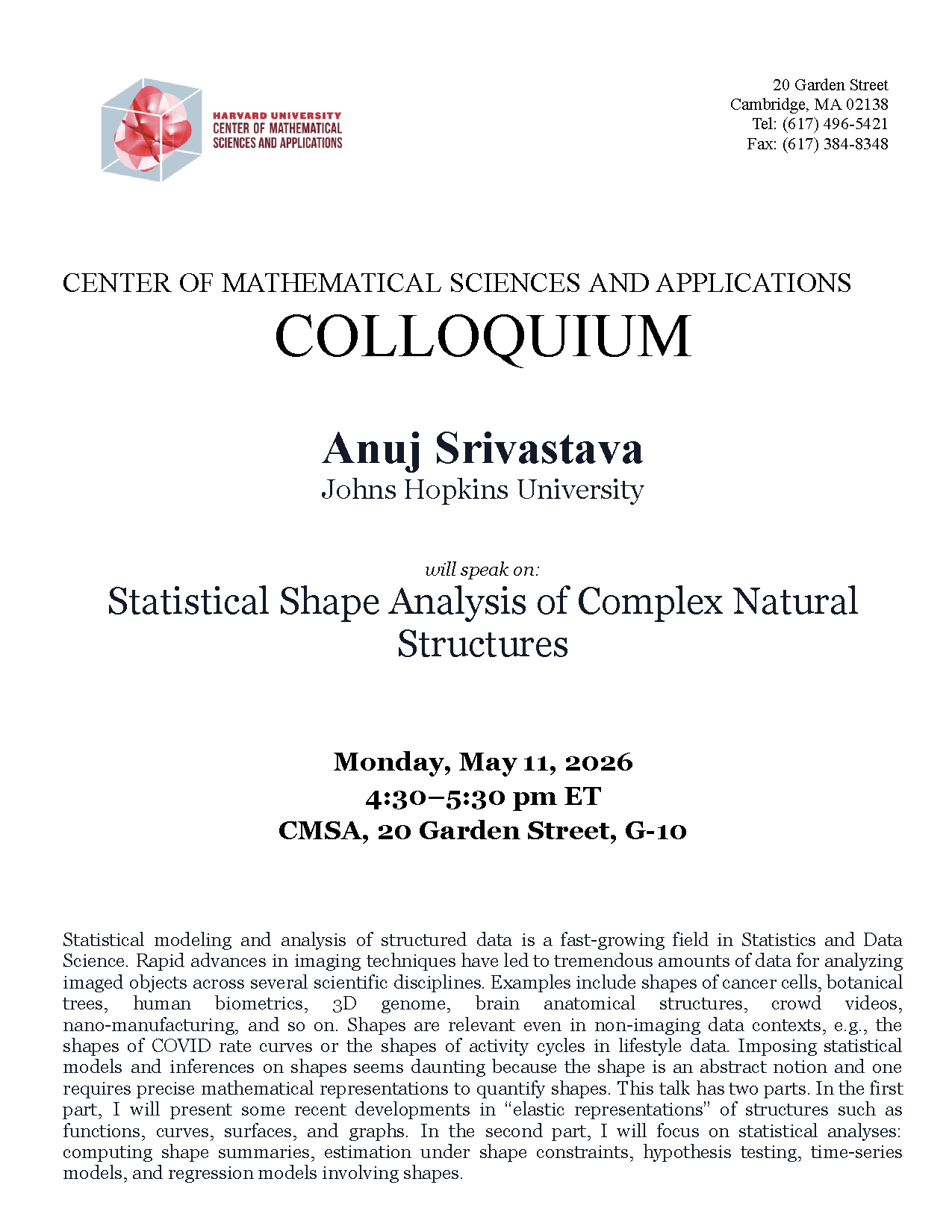
  • Statistical Shape Analysis of Complex Natural Structures

    CMSA Room G10 CMSA, 20 Garden Street, Cambridge, MA, United States

    Colloquium Speaker: Anuj Srivastava, Johns Hopkins University Title: Statistical Shape Analysis of Complex Natural Structures Abstract: Statistical modeling and analysis of structured data is a fast-growing field in Statistics and Data Science. Rapid advances in imaging techniques have led to tremendous amounts of data for analyzing imaged objects across several scientific disciplines. Examples include shapes […]

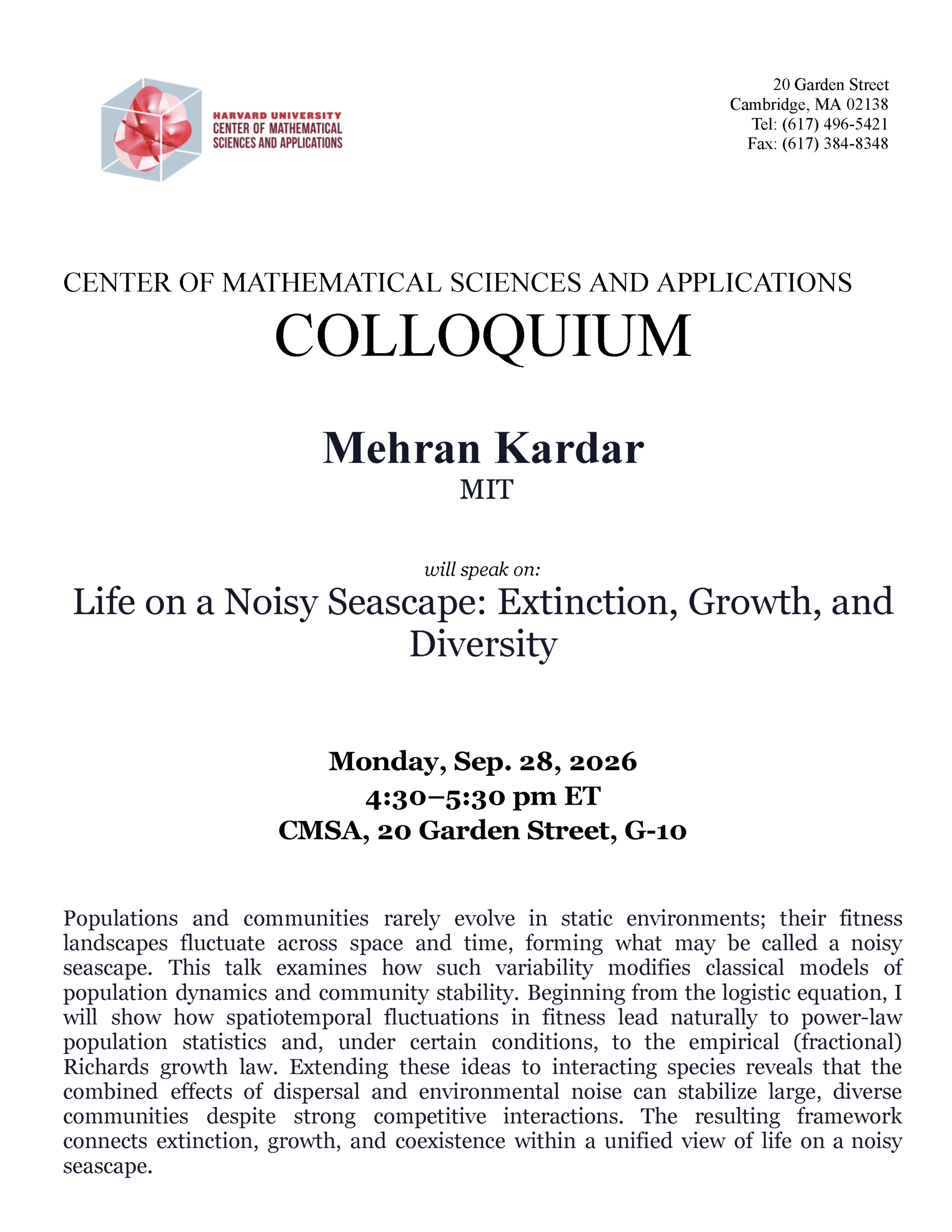
  • Life on a Noisy Seascape: Extinction, Growth, and Diversity

    CMSA Room G10 CMSA, 20 Garden Street, Cambridge, MA, United States

    Colloquium Speaker: Mehran Kardar, MIT Title: Life on a Noisy Seascape: Extinction, Growth, and Diversity Abstract: Populations and communities rarely evolve in static environments; their fitness landscapes fluctuate across space and time, forming what may be called a noisy seascape. This talk examines how such variability modifies classical models of population dynamics and community stability. Beginning from the […]

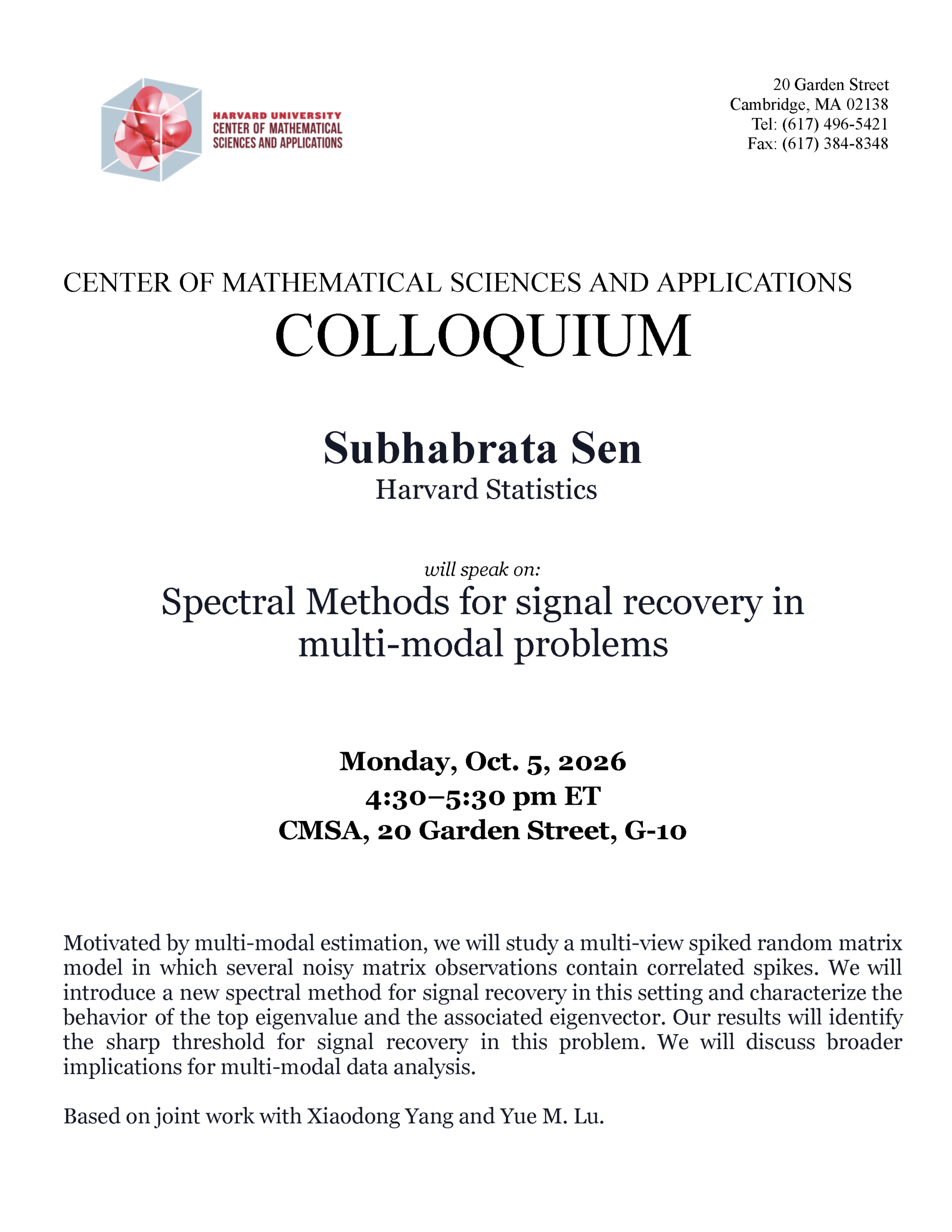
  • Spectral Methods for signal recovery in multi-modal problems

    CMSA Room G10 CMSA, 20 Garden Street, Cambridge, MA, United States

    Colloquium Speaker: Subhabrata Sen, Harvard Statistics Title: Spectral Methods for signal recovery in multi-modal problems Abstract: Motivated by multi-modal estimation, we will study a multi-view spiked random matrix model in which several noisy matrix observations contain correlated spikes. We will introduce a new spectral method for signal recovery in this setting and characterize the behavior […]